Facts
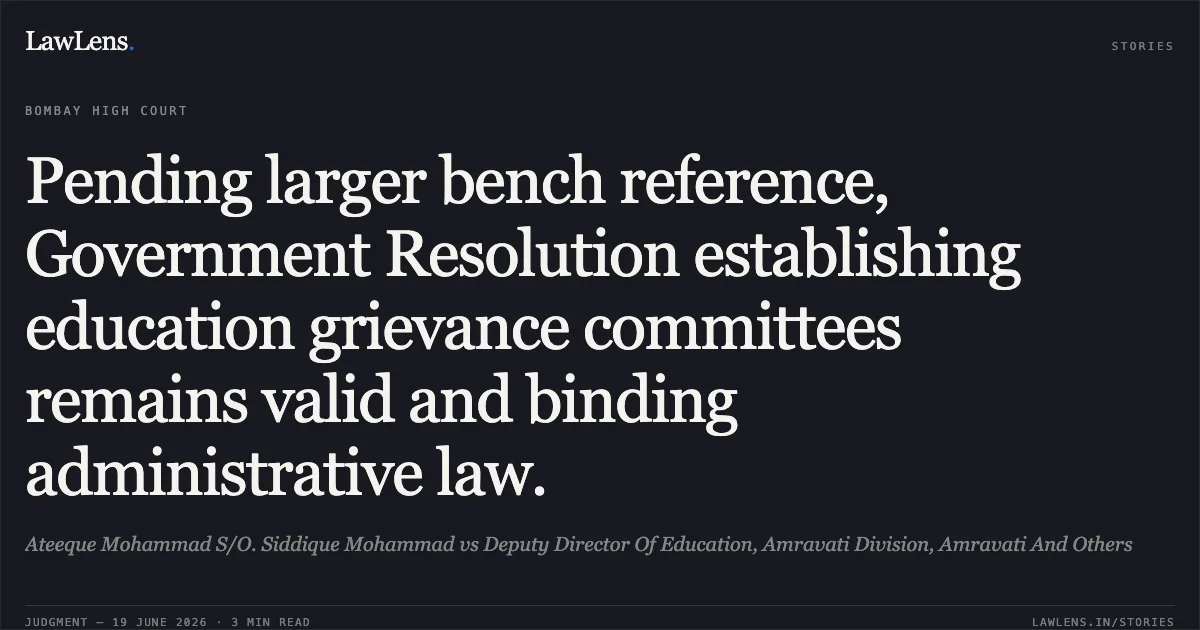
The petitioners, comprising various educational institutions and teaching/non-teaching staff, filed a bunch of writ petitions challenging orders passed by Education Department authorities regarding approvals, transfers, and service benefits
Source reference: p. 1-10The State of Maharashtra had issued a Government Resolution (GR) dated 27-03-2024 constituting Grievance Redressal Committees/Appellate Authorities to handle such recurring complaints following directions in Nitin Bhika Tadge v. State of Maharashtra
Source reference: p. 11However, a subsequent Division Bench in Shri Agrasen Shikshan Sanstha v. State of Maharashtra doubted the State’s executive power to create such a forum and referred the matter to a Larger Bench
Source reference: p. 12Consequently, many litigants bypassed the Committee, citing the pending reference
Source reference: p. 13Issues
1. Whether the High Court must follow the existing law and the 27-03-2024 GR despite a pending reference to a Larger Bench regarding its validity
Source reference: p. 13 / para. 32. Whether the State Government has the competence under Article 162 of the Constitution to constitute such Grievance Redressal Committees to streamline administration
Source reference: p. 23 / para. 20Law Applied
Union Territory of Ladakh v. Jammu and Kashmir National Conference, which mandates that High Courts must decide matters based on the law as it stands even if a reference to a Larger Bench is pending
Source reference: p. 13 / para. 4Article 162 of the Constitution of India regarding the executive power of the State, as interpreted in Bishambhar Dayal Chandra Mohan v. State of Uttar Pradesh and Naraindas Indurkhya v. State of M.P., which establishes that the State can issue administrative instructions on matters within its legislative competence where no specific enactment exists
Source reference: p. 23-24 / para. 22-23Maharashtra Private School Employees (Conditions of Service) Regulation Act (M.E.P.S. Act), 1977 and Rules, 1981
Source reference: p. 16Reasoning
The Court reasoned that under the doctrine of stare decisis, the validity of the GR dated 27-03-2024 remains upheld by the Division Bench in Komal v. State of Maharashtra until the Larger Bench decides otherwise
Source reference: p. 16 / para. 9The Court observed that the Education Department frequently ignores settled legal positions, leading to "avoidable" and "unwarranted" litigation involving thousands of approval and pension disputes
Source reference: p. 19-21It clarified that the Grievance Committees are not exercising quasi-judicial powers or excluding the jurisdiction of Civil Courts, but are administrative forums designed to ensure fair play and effective implementation of the M.E.P.S. Act
Source reference: p. 20-21 / para. 17The Court critiqued the conduct of a counsel who previously supported the GR but later challenged it, emphasizing the need for consistency in judicial proceedings
Source reference: p. 18 / para. 12-15To enhance the GR’s efficacy, the Court determined that while the reference is pending, the mechanism should be treated as Court-issued guidelines
Source reference: p. 25 / para. 26Holding
The Court held that the Grievance Redressal mechanism under the GR dated 27-03-2024 must be followed pending the Larger Bench's decision
The Court directed the State to: (i) treat the GR mechanism as directions/guidelines issued by the Court [p. 26 / para. 28(i)]; (ii) constitute an additional State-level Committee headed by the Secretary of Education to hear grievances against decisions by the Commissioner of Education [p. 27 / para. 28(ii)]; and (iii) consider providing statutory backing to these committees by amending the M.E.P.S. Act [p. 25 / para. 26]. The petitioners were granted six weeks to approach the Grievance Redressal Committee/Appellate forum, and the writ petitions were disposed of
Source reference: p. 27 / para. 28(iv)-(ix)Acts & Sections Cited
2 provisions across 2 statutes referred to in this judgment. Each provision opens on LawLens.
Maharashtra Employees of Private Schools (Conditions of Service) Regulation Act, 1977.1
Maharashtra Government Servants Regulation of Transfers and Prevention of Delay in Discharge of Official Duties Act, 2005.1
Original Court PDF
Ateeque Mohammad S/O. Siddique MohammadvsDeputy Director Of Education, Amravati Division, Amravati And Others
Click to open original judgment
Original judgment, available to read, download and summarize on LawLens.in


