Facts
The petitioner, claiming to be the owner and developer of the redevelopment property, relied on a registered Development Agreement dated 26 December 2023 executed with Respondent No. 1, Rachana Co-operative Housing Society Ltd.
Source reference: para. 2–3The agreement contained an arbitration clause and contemplated redevelopment of the Society’s property, including utilisation of development potential, FSI, TDR, amalgamation of adjoining plots and applicable Government schemes.
Source reference: para. 46–50After obtaining Intimations of Approval from the Slum Rehabilitation Authority on 4 February 2026 and 16 February 2026, the petitioner called upon the Society and its members to vacate their flats and cooperate with the redevelopment.
Source reference: para. 3–5Forty-two of the Society’s stated sixty-three members subsequently submitted declarations consenting to the redevelopment, while Respondent Nos. 2 to 26 allegedly refused to vacate and obstructed the project.
Source reference: para. 32–34The petitioner therefore filed the present petition under Section 9 of the Arbitration and Conciliation Act, 1996, seeking directions for delivery of possession, appointment of a Court Receiver, authority to execute Permanent Alternate Accommodation Agreements (“PAAAs”) for defaulting members, and consequential protective orders.
Source reference: para. 1, 5The contesting respondents challenged, inter alia, the authority of the Managing Committee, the validity of the Society’s resolutions, the change to redevelopment under Regulations 33(10) and 33(11) of the DCPR, the absence of registered PAAAs, the alleged existence of additional members and flats, the pendency of cooperative and commercial proceedings, and the non-joinder of persons claiming rights in the building.
Source reference: para. 16–29, 35–40M/s. Saboo and Varun separately sought intervention, claiming rights in Flat Nos. A/804 and A/904.
Source reference: para. 30, 81–84Issues
Whether the petition under Section 9 of the Arbitration and Conciliation Act, 1996 was maintainable and whether the Court could grant interim protection despite pending disputes concerning the Society’s resolutions, Managing Committee, membership, title and redevelopment scheme?
Source reference: para. 35–39, 87–88Whether redevelopment under Regulations 33(10) and 33(11), amalgamation of adjoining plots and utilisation of statutory development benefits constituted a material variation of the Development Agreement requiring a fresh General Body resolution and a registered addendum?
Source reference: para. 44–54Whether execution and registration of PAAAs was a condition precedent to the issuance of vacation notices and the grant of relief under Section 9?
Source reference: para. 55–58Whether disputes concerning additional flats, waitlisted members, alleged membership rights and persons not impleaded in the petition barred the grant of interim relief or rendered such persons necessary parties?
Source reference: para. 64–77, 81–84Whether the petitioner was entitled to directions requiring the concerned respondents to vacate their flats and to consequential appointment of the Court Receiver?
Source reference: para. 87–89Law Applied
The Court applied Section 9 of the Arbitration and Conciliation Act, 1996, under which the Court may grant interim measures in aid of contemplated or pending arbitration, but cannot finally adjudicate disputes reserved for the arbitral tribunal or another competent forum.
Source reference: para. 35–36Relying on Pranav Constructions Limited v. Priyadarshini Co-operative Housing Society Limited, Arbitration Appeal (L) No. 20093 of 2025, decided on 14 July 2025, the Court held that disputes concerning the validity of General Body resolutions, appointment of a developer, membership and similar cooperative-society issues are ordinarily for the competent statutory or civil forum, while refusal by members bound by the Development Agreement to perform contractual obligations may justify interim protection under Section 9.
Source reference: para. 36The Court also applied the contractual principle that the Development Agreement must be read as a whole; its broad provisions concerning development potential, FSI, TDR, adjoining-plot amalgamation, Government schemes and modification of plans permitted the developer to adopt legally available redevelopment mechanisms, subject to preservation of members’ contractual entitlements.
Source reference: para. 46–50As a protective condition, the Court held that possession could not be taken from any member until the petitioner executed and registered the member’s PAAA and complied with obligations concerning transit rent, hardship compensation and other monetary benefits.
Source reference: para. 56–58Reasoning
The Court held that the objections raised by the respondents did not, at the Section 9 stage, extinguish the Court’s jurisdiction.
Source reference: para. 41–43Questions concerning the Managing Committee’s tenure, validity of General Body resolutions, membership, additional flats and pending cooperative proceedings required determination by the competent forums and could not be conclusively decided on affidavits in a Section 9 proceeding.
Source reference: para. 59–63, 75–77On the redevelopment scheme, the Court found that the Development Agreement used broad language permitting the developer to utilise available development potential, adopt Government schemes, amend plans and amalgamate adjoining plots; therefore, redevelopment through the SRA under Regulations 33(10) and 33(11) was not prima facie outside the agreement or necessarily dependent on a registered addendum.
Source reference: para. 46–54The absence of executed PAAAs did not defeat the petition because the petitioner expressed readiness to execute them and the Society was undertaking the allotment process; however, the members’ rights had to be protected by making execution and registration of the relevant PAAA, together with payment or security for contractual monetary benefits, a condition precedent to obtaining possession.
Source reference: para. 55–58Claims by Respondent Nos. 19 and 21 concerning additional or waitlisted units, and the intervenor’s independent claims concerning Flat Nos. A/804 and A/904, were treated as separate disputes that remained open before the competent forum and did not prevent enforcement of the Development Agreement against the respondents whose flats were specifically involved.
Source reference: para. 64–74, 81–84Since the majority-supported redevelopment was being obstructed by respondents allegedly bound by the contractual arrangement, interim possession-related relief was warranted, while all findings were expressly confined to the Section 9 proceedings.
Source reference: para. 87–88Holding
The petition was partly allowed.
Respondent Nos. 2 to 26 were directed to hand over vacant and peaceful possession of the specified flats within four weeks after the petitioner complied with the Court’s conditions.
Source reference: para. 89(ii)Before seeking possession from any individual member, the petitioner was required to execute and register the applicable PAAA and pay or secure transit rent, hardship compensation and other contractual monetary benefits.
Source reference: para. 89(iii)In default, the Court Receiver, High Court, Bombay, was appointed with authority to issue notice and, if necessary, take physical possession with police assistance, including by breaking open locks, and hand over possession to the petitioner for redevelopment.
Source reference: para. 89(iv)–(vi)The Receiver was also authorised to execute and register PAAAs on behalf of defaulting respondents who refused to execute them after the petitioner complied with its obligations, and the petitioner could deposit disputed or refused monetary benefits with the Receiver.
Source reference: para. 89(vii)–(viii)The respondents were restrained from creating third-party rights or otherwise dealing with the specified existing flats or corresponding permanent alternate accommodation in a manner prejudicial to the Development Agreement.
Source reference: para. 89(x)All disputes concerning Society resolutions, the Managing Committee, membership, additional flats, pending proceedings and independent third-party rights were expressly kept open, and the petitioner was directed to invoke arbitration within ninety days.
Source reference: para. 89(xi)–(xiv)Original Court PDF
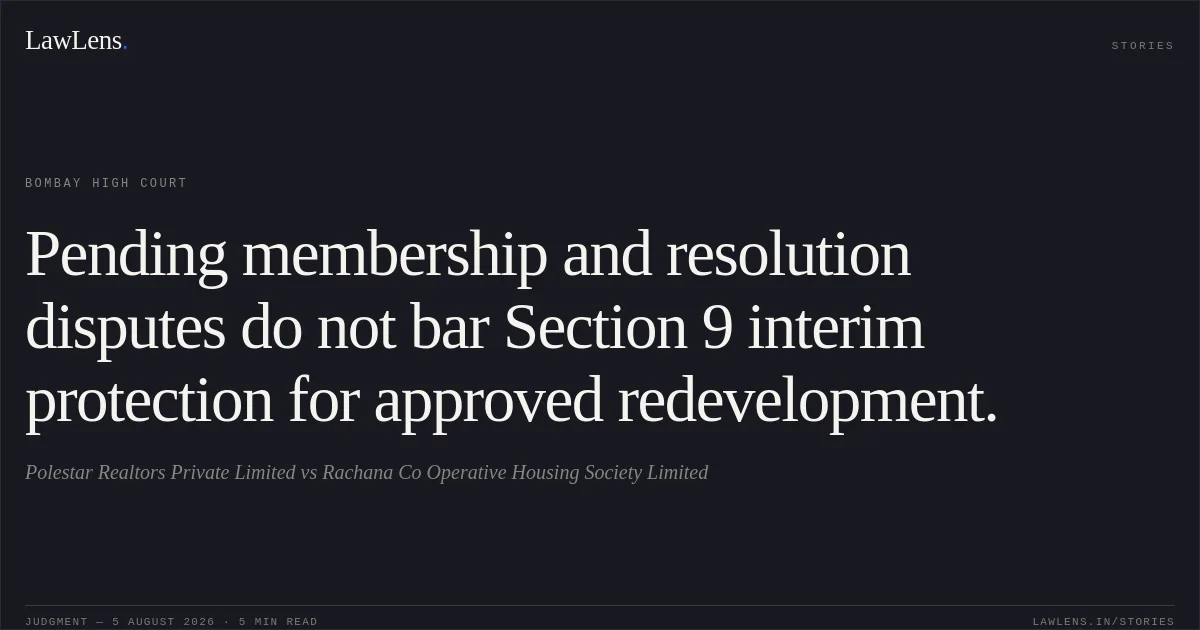
Polestar Realtors Private LimitedvsRachana Co Operative Housing Society Limited
Click to open original judgment
Original judgment, available to read, download and summarize on LawLens.in