Facts
The respondent, Krishan Kant Sharma, was compulsorily retired from the Delhi Development Authority (DDA) on December 24, 1991, following disciplinary proceedings.
Source reference: para. 3Despite his retirement, the DDA failed to release his retiral benefits (pension, GPF, and gratuity) for over three decades, citing untraceable files.
Source reference: para. 8The Central Administrative Tribunal (CAT), via order dated October 6, 2022, directed the DDA to process and grant all pensionary benefits within three months.
Source reference: para. 4The DDA did not challenge this order but unilaterally restricted the payment of arrears to only three years prior to the order, purportedly relying on the Supreme Court judgment in Union of India v. Tarsem Singh.
Source reference: paras. 5-6The respondent filed a contempt petition (CP 106/2023), leading the Tribunal to reiterate on April 21, 2025, that no such restriction existed in the original order.
Source reference: para. 12The DDA subsequently challenged both the 2022 and 2025 orders in this writ petition.
Source reference: para. 13Issues
1. Whether a departmental officer can unilaterally "read down" or restrict a clear judicial direction to pay all pensionary benefits by applying a three-year limitation on arrears.
Source reference: para. 8-92. Whether the rule in Union of India v. Tarsem Singh regarding the restriction of arrears to three years applies to the total withholding of primary pensionary benefits.
Source reference: para. 15, 21-22Law Applied
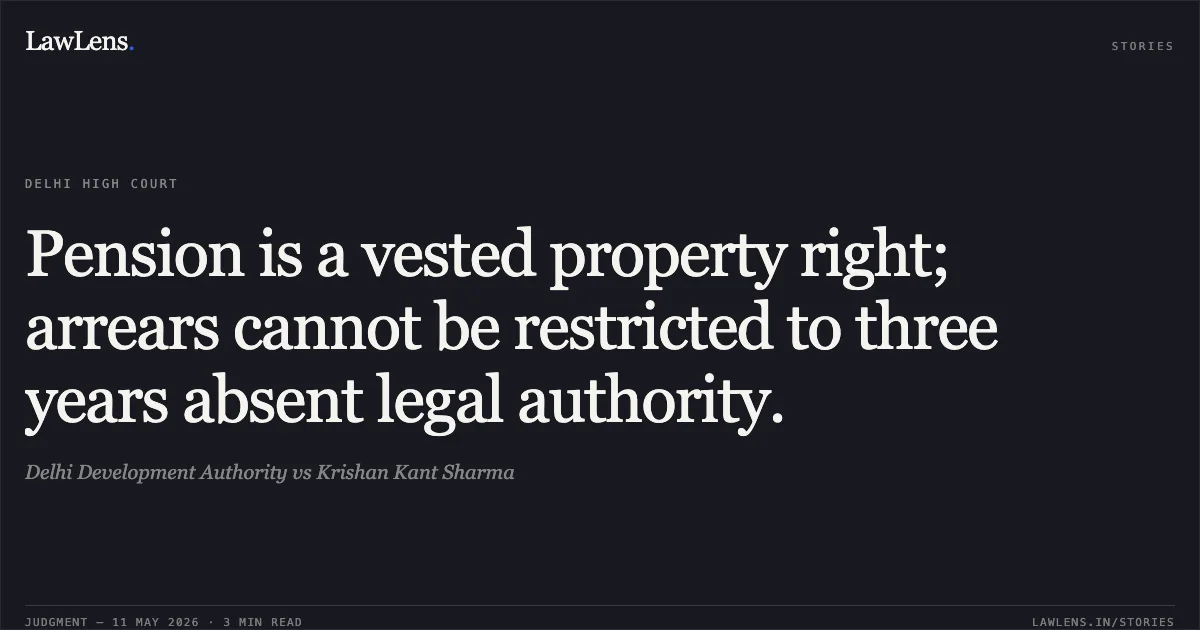
The Court primarily applied the principle that pension is a "vested and enforceable right" and partakes the character of "property" under the law, rather than being a bounty or grace of the State.
Source reference: para. 18It relied on the Supreme Court's decision in Union of India v. Sgt Girish Kumar (2026), which clarified that Union of India v. Tarsem Singh (2008) cannot be used to curtail benefits that have been found due from the date they originally accrued, especially where the delay is not attributable to the claimant.
Source reference: para. 17Under Article 226, the Court emphasized that administrative officers cannot sit in appeal over judicial orders or rewrite them based on their own interpretation of precedents.
Source reference: para. 9, 14Reasoning
The Court expressed "disquietude" and "unhappiness" that the DDA chose to rewrite the Tribunal’s order rather than challenging it through legal channels.
Source reference: paras. 5, 9It held that the Tribunal's 2022 order was unconditional and unambiguously directed the processing of all benefits.
Source reference: para. 8The Court distinguished Tarsem Singh, noting that it dealt with disability pension (a supplement to regular pension) where a 16-year delay in filing occurred.
Source reference: para. 16, 21Conversely, in the present case, the respondent was deprived of even a "farthing" of his basic sustenance since 1991.
Source reference: para. 21Following Sgt Girish Kumar, the Court found that pensionary entitlements cannot be withheld or reduced except by authority of law, and the DDA's attempt to use the "three-year rule" as a shield against its own administrative failures (missing files) was legally unsustainable.
Source reference: paras. 18-20Holding
The Court dismissed the writ petition, upholding the Tribunal's orders in the OA and CP.
It held that the DDA's restriction of arrears was invalid and that the respondent is entitled to the full arrears from his date of retirement.
Source reference: para. 22The Court directed the DDA to positively disburse all remaining retiral benefits within four weeks, failing which the amount will carry interest at 8% p.a. until actual payment.
Source reference: para. 24Acts & Sections Cited
2 provisions across 1 statute referred to in this judgment. Each provision opens on LawLens.
Administrative Tribunals Act, 19852
Original Court PDF
Delhi Development AuthorityvsKrishan Kant Sharma
Click to open original judgment
Original judgment, available to read, download and summarize on LawLens.in