Facts
The applicant, a 1976 batch IPS officer of the Karnataka Cadre, was promoted to the grade of Director General of Police (DGP) in 2010.
Source reference: para 2(b)On 31.01.2011, he was placed in "concurrent charge" as the Head of Police Force (DGIGP) in addition to his regular duties.
Source reference: para 2(c)He held this concurrent charge until 06.07.2011.
Source reference: para 2(f)He superannuated on 31.07.2011 while posted as DGP, CID, not holding the Head of Police Force charge at the time of retirement.
Source reference: para 2(f)The State issued orders in 2015 and 2016 sanctioning servant allowance, telephone charges, and medical reimbursement for retired Heads of Police Force.
Source reference: paras 3-4The applicant’s claim for these benefits was rejected by the Government on 10.01.2022 and 04.07.2022 on the grounds that he held the post only as a "concurrent charge" and did not retire from that specific position.
Source reference: paras 7-9Issues
1. Whether a retired officer who held the post of Head of Police Force as a "concurrent charge" or "additional charge" is entitled to the special allowances sanctioned for retired Heads of Police Force
Source reference: para 172. Whether the applicant can claim the benefit based on the principle of parity with another officer (Shri S.N. Borkar) under Article 14 of the Constitution
Source reference: paras 8, 21Law Applied
Government Orders (DPAR 82 SPP 2015) which limited benefits to "retired Directors Generals of Police (Head of Police Force)"
Source reference: para 4Supreme Court precedent in K. Sreedhar Rao v. Union of India (2019), which established that an "Acting" or "concurrent" charge holder is entitled to salary/perks only during the tenure of service and cannot claim post-retiral benefits (like specific pensions or allowances) attached to the higher post.
Source reference: para 25Article 14 is a positive concept; illegality cannot be used to claim parity, and a "wrong order" in favor of one person does not entitle another to the same illegal benefit (Union Bank of India v. M.T. Latheesh (2006) and Union of India v. M.K. Sarkar (2010)).
Source reference: paras 23-24Reasoning
The Tribunal observed that the governing circulars (Annexure-A6) specifically intended the allowances for those who held the substantive post of Head of Police Force and retired from it.
Source reference: para 18Following K. Sreedhar Rao, the Tribunal reasoned that while an officer in a concurrent charge might receive the salary of that post during their tenure, they do not acquire a substantive right to post-retirement perks associated with that specific office.
Source reference: paras 25-27Regarding the applicant’s plea of parity with Shri S.N. Borkar, the Tribunal noted that the applicant failed to produce the supporting order for the cited officer.
Source reference: para 21Furthermore, even if such a benefit were wrongly granted to another, it would constitute a legal error that cannot be perpetuated under the guise of equality.
Source reference: paras 22-23Holding
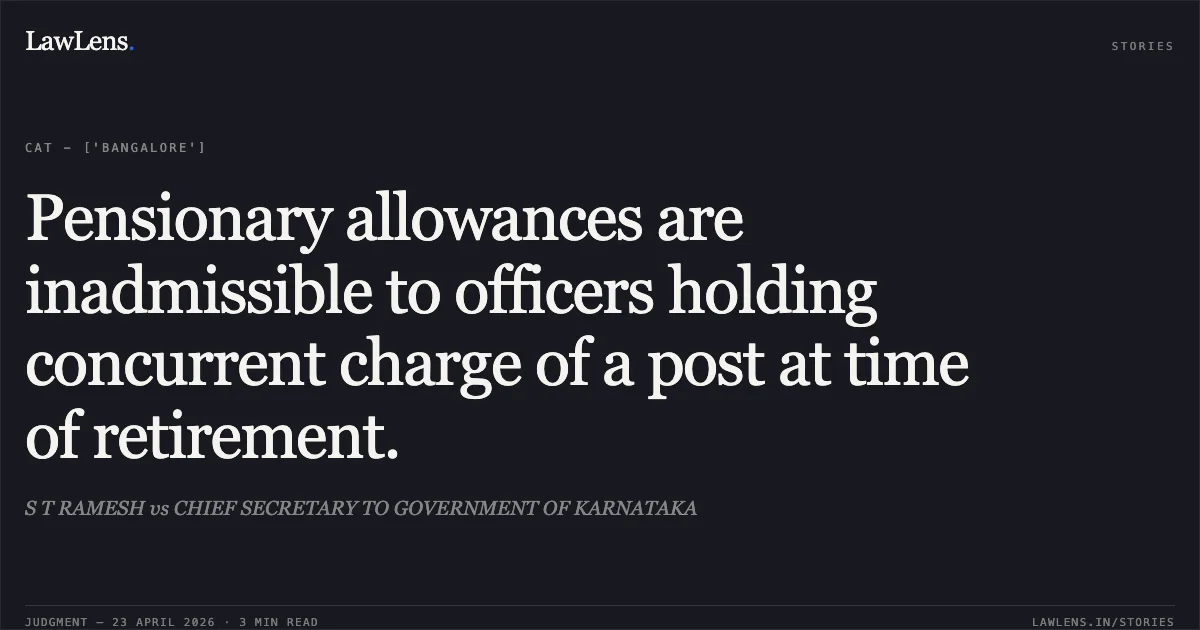
The Tribunal held that the applicant is not entitled to the servant allowance, telephone charges, and medical reimbursement for the period claimed because his stint as Head of Police Force was limited to a "concurrent charge" and not a substantive appointment.
(1) No, concurrent charge holders are not entitled to retiral allowances reserved for substantive retirees of that post; (2) No, parity cannot be claimed based on alleged previous illegal or irregular orders.
Source reference: no citationThe Original Application was dismissed, and parties were ordered to bear their own costs.
Source reference: paras 28-29Acts & Sections Cited
1 provisions across 1 statute referred to in this judgment. Linked provisions open on LawLens.
High Court Judges (Salaries And Conditions Of Service) Act, 19541
Original Court PDF
S T RAMESHvsCHIEF SECRETARY TO GOVERNMENT OF KARNATAKA
Click to open original judgment
Original judgment, available to read, download and summarize on LawLens.in