Facts
The petitioner was appointed as a Junior Noter and Drafter in the Circle Cadre in 1967, promoted as Senior Noter and Drafter in 1971, and permanently absorbed into the Chief Engineer Cadre of the U.P. State Electricity Board by order dated 24 April 1978.
Source reference: paras. 3–6He was confirmed in that cadre in 1983, promoted as Office Superintendent, and retired from the Chief Engineer Cadre on 31 July 2001.
Source reference: paras. 3–6He received retiral benefits, including pension, treating him as an employee of that cadre.
Source reference: para. 27The U.P. Electricity Board Ministerial Establishment Regulations, 1970 governed the relevant service structure.
Source reference: para. 7The Second Amendment Regulations, 1998 retrospectively altered promotional avenues and eligibility conditions with effect from 1 April 1984.
Source reference: paras. 7–10In proceedings instituted by similarly situated employees, a Division Bench of the High Court, by judgment dated 23 August 2007, invalidated the retrospective amendments and restored the benefits available under the unamended Regulations.
Source reference: para. 11The judgment attained finality after dismissal of the Special Leave Petition on 27 July 2009, and the Corporation issued implementation directions on 4 November 2009.
Source reference: paras. 11–12Although employees similarly situated to the petitioner were granted revised second and third time-bound pay scales, the petitioner’s claim was rejected on 12 January 2012 solely because his initial appointment had been in the Circle Cadre.
Source reference: paras. 13–17He therefore sought quashing of the rejection order and a mandamus directing grant of the revised pay scales with consequential service and retiral benefits.
Source reference: no citationIssues
Whether, after the petitioner’s permanent absorption, confirmation, promotion and retirement in the Chief Engineer Cadre, the respondents could deny him the revised second and third time-bound pay scales solely because his initial appointment was in the Circle Cadre?
Source reference: para. 26Whether denial of the benefits granted to similarly situated employees amounted to arbitrary and discriminatory treatment in violation of Article 14 of the Constitution?
Source reference: paras. 31, 34Whether the rejection order dated 12 January 2012 was sustainable despite the binding judgment dated 23 August 2007 and the Corporation’s implementation directions?
Source reference: paras. 29–32Law Applied
The Court applied Section 79 of the Electricity (Supply) Act, 1948, under which the U.P. State Electricity Board framed the 1970 Ministerial Establishment Regulations.
Source reference: para. 7The governing service conditions and promotional benefits were determined by the Regulations applicable to the cadre in which an employee was absorbed.
Source reference: para. 7The Court applied the principle that permanent absorption results in complete integration into the new cadre, after which the employee’s service conditions, promotional avenues and financial benefits are governed by that cadre rather than by the employee’s original cadre.
Source reference: para. 28It further relied on the binding Division Bench judgment dated 23 August 2007, which invalidated the retrospective 1998 amendments and restored the benefits under the unamended Regulations.
Source reference: para. 29That judgment became final upon dismissal of the SLP on 27 July 2009.
Source reference: paras. 11–12The Court also applied the constitutional guarantee of equality under Article 14, holding that similarly situated employees cannot be treated differently through an arbitrary “pick and choose” approach.
Source reference: paras. 31, 34An administrative order based on an irrelevant consideration while ignoring material facts is liable to be quashed under Article 226.
Source reference: para. 35Reasoning
The Court found that the petitioner’s permanent absorption in 1978, subsequent confirmation and promotion, continuous service in the Chief Engineer Cadre, and retirement from that cadre were undisputed.
Source reference: para. 27Applying the legal effect of absorption, the Court held that the petitioner’s original Circle Cadre appointment could not be selectively relied upon to deny benefits attached to the cadre in which he had permanently served.
Source reference: paras. 27–28The respondents were also bound to implement the 2007 judgment and could not create distinctions not recognised by that judgment or by their own implementation directions.
Source reference: paras. 29–30Since similarly situated employees had received the revised second and third time-bound scales and the respondents failed effectively to rebut that assertion, the differential treatment was arbitrary and violated Article 14.
Source reference: para. 31The rejection order ignored the petitioner’s absorption, cadre status, the binding judgment and the Corporation’s directions, while relying only on his initial appointment; it therefore suffered from non-application of mind and consideration of an irrelevant factor.
Source reference: paras. 32, 35Holding
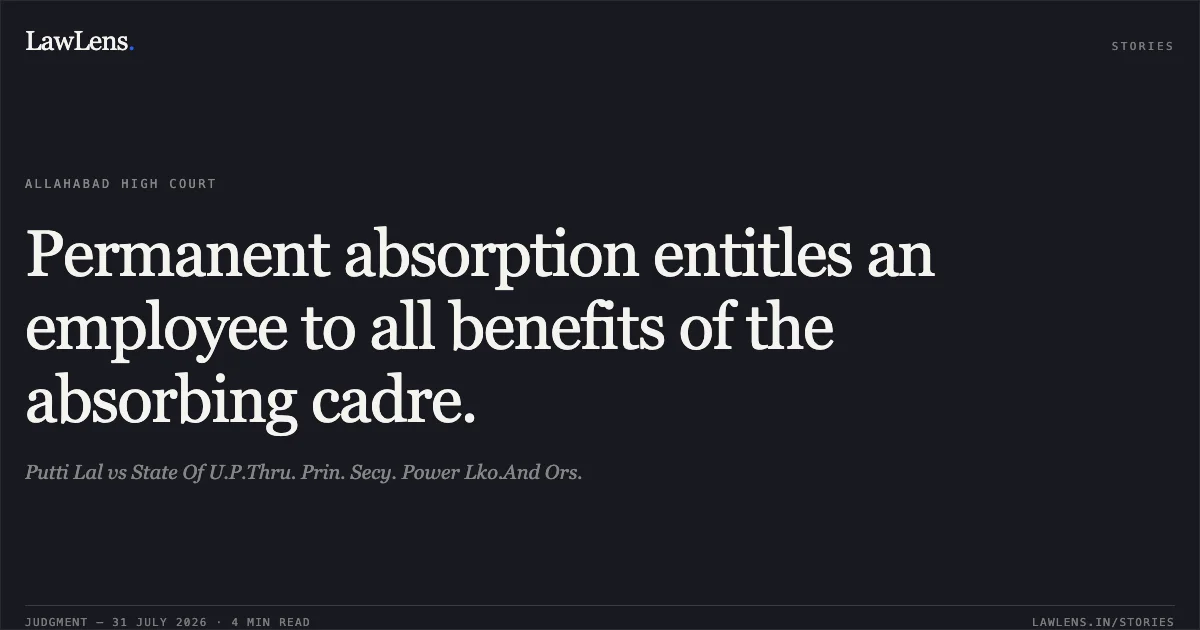
The Court held that the petitioner became entitled, upon permanent absorption into the Chief Engineer Cadre, to the service and financial benefits applicable to that cadre, including the revised second and third time-bound pay scales.
The order dated 12 January 2012 was quashed, and the writ petition was allowed.
Source reference: paras. 37–38The respondents were directed to grant the revised pay scales in accordance with the judgment dated 23 August 2007 and to extend all consequential benefits, including revised pay fixation, pension, gratuity, commutation and arrears.
Source reference: para. 39The entire exercise of refixation and payment was to be completed within four months of production of a certified copy of the judgment; interest would be payable in accordance with law in case of delay.
Source reference: para. 40There was no order as to costs.
Source reference: para. 41Acts & Sections Cited
1 provisions across 1 statute referred to in this judgment. Linked provisions open on LawLens.
Electricity (Supply) Act, 19481
Original Court PDF
Putti LalvsState Of U.P.Thru. Prin. Secy. Power Lko.And Ors.
Click to open original judgment
Original judgment, available to read, download and summarize on LawLens.in