Facts
On 21 August 2005, the claimant was travelling in auto-rickshaw No. GJ-6-W-2938 when Jeep No. GJ-17-A-8169, allegedly driven rashly and negligently, collided with the auto-rickshaw.
Source reference: p.2, para. 2.1The claimant sustained grievous injuries and an FIR was registered at Bodeli Police Station as C.R. No. 58/2005.
Source reference: p.2, para. 2.1The Motor Accident Claims Tribunal partly allowed the claim petition and awarded compensation with interest at 7% per annum from the date of filing until realization.
Source reference: pp.2–3, paras. 2.2–2.4The claimant appealed, challenging the quantum of compensation, particularly the assessment of functional disability at 30%.
Source reference: p.3, para. 2.5; p.6, para. 6The claimant, aged 53 years at the time of the accident, had suffered amputation of the right lower limb above the knee and permanent disability in the left lower limb.
Source reference: pp.4, 6–7, paras. 4 and 7He had been employed as a daily wager and, owing to his physical incapacity, resigned from service on 31 October 2007.
Source reference: pp.4, 6–7, paras. 4 and 7Issues
Whether the Tribunal erred in assessing the claimant’s functional disability at 30%, and whether it should instead be assessed at 90% for calculating future loss of earning capacity?
Source reference: pp.6–7, paras. 6–8Whether the compensation awarded under pain, shock and suffering; special diet, attendant and transportation expenses; loss of amenities; and prosthetic-limb expenses was inadequate?
Source reference: pp.7–8, paras. 9–10What enhanced compensation and consequential interest and directions should be granted?
Source reference: pp.8–10, paras. 11–14Law Applied
The Court applied the principle under the Motor Vehicles Act, 1988 that an injured claimant is entitled to just, fair and reasonable compensation for actual loss, future loss of earning capacity, pain and suffering, medical expenses, loss of amenities, attendant and transportation expenses, and other consequential needs.
Source reference: no citationIt distinguished physical disability from functional disability, holding that the latter must be assessed with reference to the claimant’s occupation and the actual impact of the injuries on earning capacity.
Source reference: pp.6–7, paras. 7–8The Court relied on the principles in National Insurance Co. Ltd. v. Pranay Sethi, (2017) 16 SCC 680, concerning assessment of future prospects and conventional compensation, and Magma General Insurance Co. Ltd. v. Nanu Ram @ Chuhru Ram, (2018) 18 SCC 130, in support of appropriate compensation under conventional heads.
Source reference: p.4, para. 4For future loss of income, the Court applied a multiplier of 11, corresponding to the claimant’s age, and calculated compensation by multiplying annual income by the multiplier and the percentage of functional disability.
Source reference: p.7, para. 8Reasoning
The Court found that the Tribunal’s 30% assessment did not reflect the claimant’s actual loss of earning capacity.
Source reference: pp.6–7, para. 7The claimant had lost his right leg above the knee, suffered permanent disability in the left leg, worked as a daily wager, and was unable to perform physical labour, ultimately resigning from service.
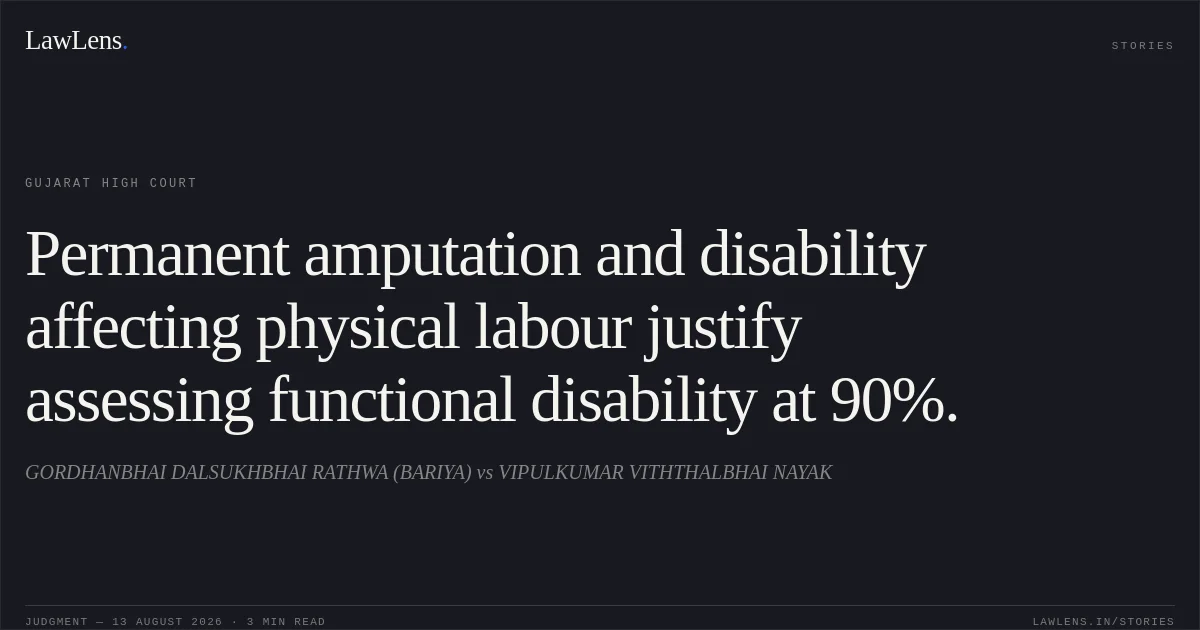
Source reference: pp.6–7, para. 7Although the Medical Board’s certification concerned disability in the limbs, the evidence demonstrated a substantially greater impact on the claimant’s ability to earn; therefore, functional disability was fixed at 90%.
Source reference: p.7, para. 8Applying the undisputed monthly income of Rs.10,000, multiplier of 11, and 90% disability, the Court awarded Rs.11,88,000 for future loss of income: Rs.10,000 × 12 × 11 × 90%.
Source reference: p.7, para. 8The Court maintained the awards of Rs.2,00,000 for actual loss of income and Rs.1,00,000 for pain, shock and suffering.
Source reference: p.7, para. 9It enhanced the amount for special diet, attendant charges and transportation from Rs.50,000 to Rs.1,00,000, considering the serious injuries, prolonged treatment, permanent disabilities and amputation.
Source reference: pp.7–8, para. 9It further awarded Rs.1,00,000 towards a prosthetic limb and its maintenance, and Rs.1,00,000 for loss of amenities of life, which the Tribunal had omitted despite the claimant’s continuing dependence and impaired ability to enjoy ordinary life.
Source reference: p.8, paras. 9–10Holding
The appeal was partly allowed.
The Court reassessed the claimant’s functional disability at 90% and fixed total compensation at Rs.18,58,000, including Rs.11,88,000 for future loss of income, Rs.2,00,000 for actual loss of income, Rs.1,00,000 for pain, shock and suffering, Rs.1,00,000 for loss of amenities, Rs.1,00,000 for special diet, attendant and transportation expenses, Rs.70,000 for medical expenses, and Rs.1,00,000 for a prosthetic limb and maintenance.
Source reference: p.8, para. 11It directed payment of additional compensation of Rs.12,58,000 with interest at 7% per annum from the date of filing of the claim petition until realization.
Source reference: p.9, para. 12The insurer was directed to deposit the additional amount with the Tribunal within four weeks, after which the Tribunal was to disburse the awarded amount, subject to verification and deduction of any deficit court fee.
Source reference: p.9, para. 13No order as to costs was made.
Source reference: p.10, para. 14Original Court PDF
GORDHANBHAI DALSUKHBHAI RATHWA (BARIYA)vsVIPULKUMAR VITHTHALBHAI NAYAK
Click to open original judgment
Original judgment, available to read, download and summarize on LawLens.in