Facts
The appellant-claimant sustained multiple injuries, including fractures to both legs and injuries to the jaw, elbow and forearm, in a motor-vehicle accident dated 29 July 2001 caused by the rash and negligent driving of respondent No.1, who was driving a TATA 407 owned by respondent No.2 and insured with respondent No.3.
Source reference: paras. 4, 9, pp. 2–4The Motor Accident Claims Tribunal, Gurgaon, awarded the claimant ₹1,85,000 with interest at 7.5% per annum, holding respondents jointly and severally liable.
Source reference: paras. 4, 7, pp. 2–3The claimant appealed seeking enhancement. During the appeal, additional evidence regarding the claimant’s increased disability was permitted to be led before the Tribunal.
Source reference: paras. 1–3, pp. 1–2The Tribunal had assessed the claimant’s permanent disability at 40%; subsequent medical evidence assessed it at 60% in relation to the right lower limb, with the Court ultimately taking the average disability at 50%.
Source reference: para. 22, pp. 10–11Issues
Whether the compensation of ₹1,85,000 awarded by the Tribunal was inadequate and required enhancement in view of the claimant’s injuries, treatment, permanent disability and consequential loss of earning capacity?
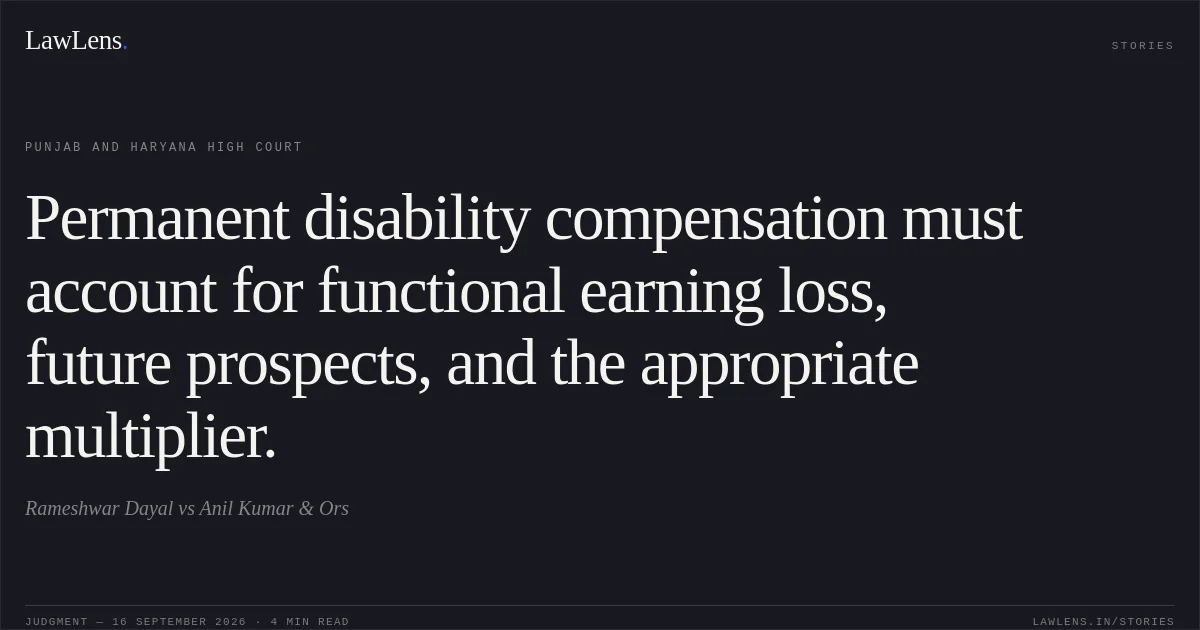
Source reference: paras. 9–12, pp. 3–6Whether compensation for loss of future income was required to be calculated on the basis of the claimant’s functional disability, future prospects and the applicable multiplier?
Source reference: paras. 21–23, pp. 9–12What amount of just compensation, and at what rate of interest, was payable to the claimant?
Source reference: paras. 24–30, pp. 12–14Law Applied
The Court applied Section 166 of the Motor Vehicles Act, 1988, under which an injured claimant is entitled to just compensation arising from a motor accident.
Source reference: para. 4, p. 2It relied on G. Ravindranath @ R. Chowdary v. E. Srinivas, 2013 (3) RCR (Civil) 934, for assessing personal-injury compensation under pecuniary heads—medical and treatment expenses, loss of earnings, future medical expenses—and non-pecuniary heads such as pain and suffering, loss of amenities and loss of expectation of life.
Source reference: para. 13, pp. 5–7The Court applied Chandra alias Chander alias Chanda Ram v. Mukesh Kumar Yadav, (2022) 1 SCC 198, for the principle that absence of documentary proof does not justify rejecting oral evidence of income and that income may be assessed on a reasonable and probabilistic basis.
Source reference: para. 21, pp. 9–10It relied on Sanjay Verma v. Haryana Roadways, 2014 (1) RCR (Civil) 914, and National Insurance Co. Ltd. v. Pranay Sethi, (2017) 16 SCC 680, for adding future prospects; Sarla Verma v. Delhi Transport Corporation, (2009) 6 SCC 121, for the multiplier method; and Yadava Kumar v. The Divisional Manager, National Insurance Co. Ltd., 2010 (4) PLR 242, for assessing loss of earning capacity by reference to the functional impact of disability rather than merely the medical percentage.
Source reference: paras. 21–23, pp. 9–12The governing principle was that compensation must be fair, reasonable and equitable—neither a windfall nor a pittance.
Source reference: para. 12, pp. 5–6Reasoning
The Court affirmed the finding that the accident resulted from respondent No.1’s rash and negligent driving because that finding had not been challenged by the respondents.
Source reference: para. 9, pp. 3–4It found the original award inadequate considering the claimant’s multiple fractures, prolonged treatment, surgical intervention, permanent disability and associated expenses.
Source reference: paras. 14–20, pp. 7–9The claimant’s income was reassessed from ₹3,000 to ₹4,000 per month because he was a transporter driving his own vehicle, and 40% was added towards future prospects, resulting in a notional monthly income of ₹5,600.
Source reference: paras. 21, 23, pp. 9–12Since the claimant was 38 years old, the multiplier of 15 was applied.
Source reference: paras. 22–23, pp. 10–12The Court treated the claimant’s permanent disability as 50% and concluded that, because the disability affected his right lower limb and impaired his ability to drive a truck, it materially reduced his earning capacity.
Source reference: paras. 22–23, pp. 10–12Accordingly, the monthly loss of income was calculated at ₹2,800, producing a future loss-of-income award of ₹5,04,000.
Source reference: paras. 22–23, pp. 10–12The Court further enhanced the amounts for treatment and future treatment, pain and suffering, loss of income during treatment, attendant charges, transportation and loss of amenities on the basis of the medical evidence, duration of treatment and the claimant’s continuing physical limitations.
Source reference: paras. 19–28, pp. 8–13Holding
The appeal was partly allowed with costs.
The total compensation was enhanced from ₹1,85,000 to ₹7,54,000, comprising ₹50,000 for pain and suffering, ₹70,000 for treatment and future treatment, ₹40,000 for loss of income during treatment, ₹20,000 for attendant charges, ₹20,000 for special diet, ₹20,000 for transportation, ₹5,04,000 for loss of future income due to permanent disability, and ₹30,000 for loss of amenities.
Source reference: para. 29, p. 13The enhanced amount of ₹5,69,000 was directed to carry interest at 9% per annum from 4 September 2001, the date of filing of the claim petition, until realization, payable by respondents No.1 to 3 jointly and severally.
Source reference: para. 30, p. 14The Registry was also directed to email the authenticated award to the insurer, and pending miscellaneous applications, if any, were disposed of.
Source reference: paras. 31–32, p. 14Acts & Sections Cited
2 provisions across 2 statutes referred to in this judgment. Each provision opens on LawLens.
Code of Civil Procedure, 19081
Motor Vehicles Act, 19881
Original Court PDF
Rameshwar DayalvsAnil Kumar & Ors
Click to open original judgment
Original judgment, available to read, download and summarize on LawLens.in