Facts
The appellant was injured when a bus struck him while he was crossing the road on 30 January 2019.
Source reference: pp. 3–5He sustained serious injuries resulting in below-knee amputation and claimed that he had worked as a driver earning ₹25,000 per month.
Source reference: pp. 3–5The Motor Accident Claims Tribunal assessed notional monthly income at ₹13,250 and awarded ₹15,08,710.
Source reference: pp. 3–5The appellant appealed under Section 173(1) of the Motor Vehicles Act, 1988, seeking enhancement, principally on the grounds of income, disability, and the amounts awarded under various heads.
Source reference: pp. 3–5, 8Issues
Whether the compensation awarded by the Tribunal was inadequate and required modification, including in respect of income, functional disability, future prospects, and compensation under individual heads
Source reference: p. 8What order should follow from the Court’s determination of the compensation issue
Source reference: pp. 8, 20–22Law Applied
Under Section 173(1) of the Motor Vehicles Act, 1988, an aggrieved claimant may appeal an award of the Claims Tribunal.
Source reference: p. 3Where income is not proved, the Court may assess notional income by reference to the Karnataka State Legal Services Authority chart.
Source reference: p. 11Sarla Verma v. Delhi Transport Corporation, 2009 ACJ 1298, guides selection of the multiplier by age; for a claimant aged 39, the multiplier is 15.
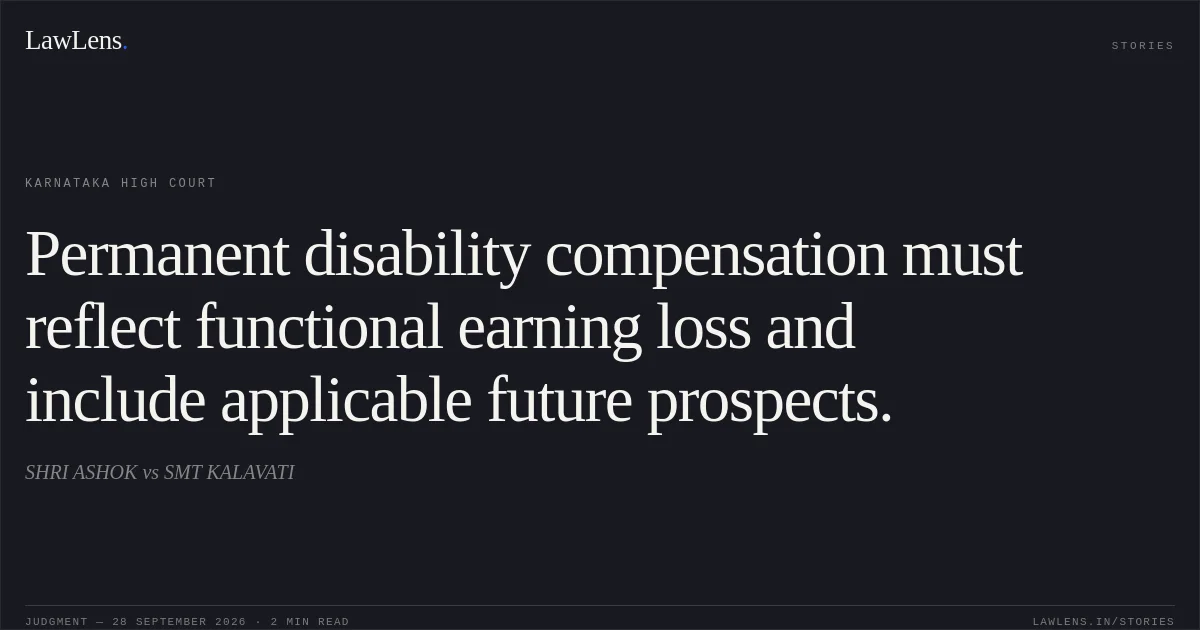
Source reference: p. 11Under Raj Kumar v. Ajay Kumar, (2011) 1 SCC 343, the effect of permanent disability on earning capacity is assessed by considering the claimant’s work, abilities after injury, and whether the disability prevents or restricts prior or alternative work; physical disability and functional loss of earning capacity are not necessarily identical.
Source reference: pp. 13–16National Insurance Co. Ltd. v. Pranay Sethi, (2017) 16 SCC 680, supplies the principle of adding future prospects to income, which the Court applied to this permanent-disability claim.
Source reference: p. 17The Court also relied on M. Paramesh v. VRL Logistics Ltd., (2022) 5 SCC 651, concerning the need to assess functional disability rather than simply equating it with physical disability.
Source reference: p. 16Reasoning
The Court rejected the claimed salary of ₹25,000 because the employer produced no employment, wage, or tax records, and the claimant’s driving licence did not establish qualification to drive the employer’s heavy vehicles.
Source reference: pp. 9–11It therefore retained the Tribunal’s notional income of ₹13,250 per month.
Source reference: pp. 9–11Applying Raj Kumar and M. Paramesh, the Court considered the below-knee amputation and its effect on the claimant’s ability to earn, and assessed functional disability at 70%, notwithstanding the doctor’s physical-disability assessment of 79%.
Source reference: pp. 13–17Applying a 40% addition for future prospects and multiplier 15, it calculated future-income loss at ₹23,37,300.
Source reference: pp. 17–18It further enhanced compensation for pain and suffering, laid-up-period income, amenities, future medical expenses, and attendant, food, and conveyance charges, while leaving medical expenses unchanged.
Source reference: pp. 18–20Holding
The appeal was allowed in part.
The Court enhanced the total compensation from ₹15,08,710 to ₹30,93,510 and directed that the enhanced amount carry interest at 6% per annum from the date of the claim petition until payment.
Source reference: pp. 20–22The insurer was directed to deposit the enhanced compensation with accrued interest before the Tribunal within 60 days of receiving the certified copy of the judgment.
Source reference: pp. 20–22Acts & Sections Cited
1 provisions across 1 statute referred to in this judgment. Each provision opens on LawLens.
Motor Vehicles Act, 19881
Original Court PDF
SHRI ASHOKvsSMT KALAVATI
Click to open original judgment
Original judgment, available to read, download and summarize on LawLens.in