Facts
The appellant was riding a motorcycle from Pune towards Manchar on 25 May 2002 when it was hit by a truck owned by Respondent No. 1 and insured by United India Insurance Company Ltd.
Source reference: para. 3The Tribunal found the truck driver negligent, and that finding was not challenged in the appeal; consequently, the High Court confined its consideration to the quantum of compensation.
Source reference: para. 3The appellant sustained a compound fracture of the right femur, injuries to the right tibia, dislocation of the great toe, and amputation of the right arm below the elbow.
Source reference: para. 10At the time of the accident, he was a 45-year-old clerk in the Post and Telegraph Department earning Rs. 8,122 per month.
Source reference: para. 11The Tribunal awarded approximately Rs. 2,11,000 under various heads, including disability, pain and suffering, conveyance, nourishing diet, future surgery, future inconvenience, and medical expenses.
Source reference: para. 5Issues
Whether the Tribunal correctly applied the principles for assessing compensation in an injury claim, particularly in determining physical disability, functional disability, income, and the appropriate quantum of compensation?
Source reference: para. 1Whether the appellant’s 65% physical disability justified an equivalent or otherwise substantial percentage of functional disability and compensation for loss of future earning capacity?
Source reference: paras. 16–18, 26–30Whether the appellant was entitled to enhanced amounts under the heads of medical expenses, attendant charges, conveyance, loss of amenities, future medical expenses, and loss of income during the period of leave?
Source reference: paras. 31–36Law Applied
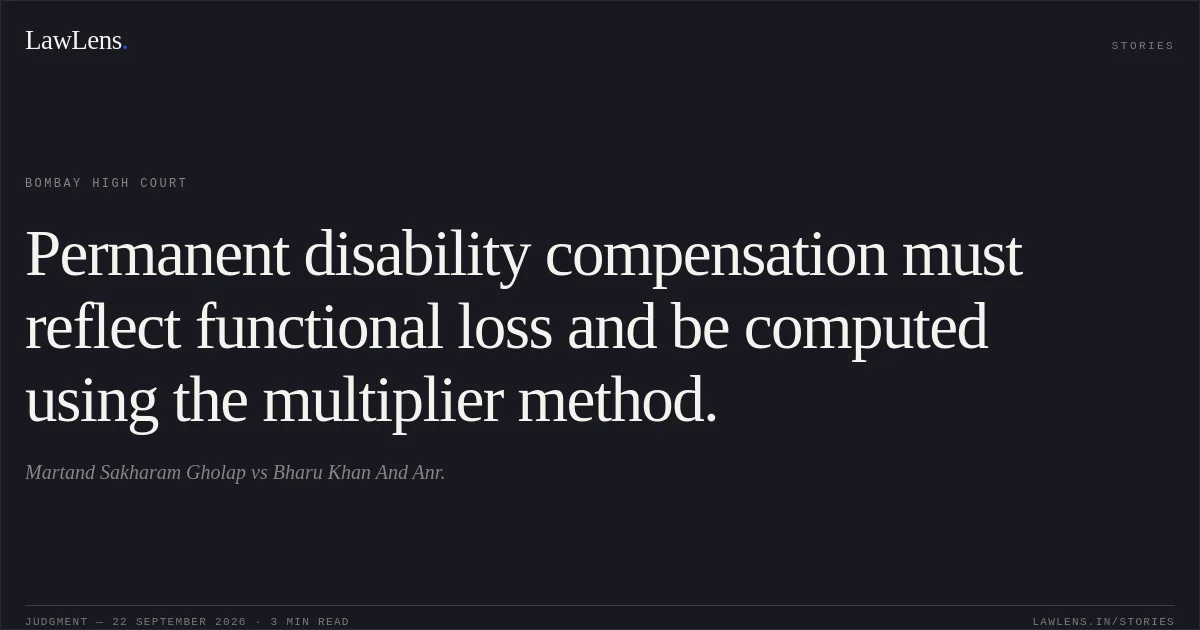
The Court applied the principles governing compensation for bodily injury under the Motor Vehicles Act, distinguishing physical disability from functional disability and loss of earning capacity.
Source reference: no citationRelying principally on Raj Kumar v. Ajay Kumar, the Court held that the percentage of physical disability cannot automatically be treated as the percentage of loss of earning capacity; the assessment must consider the injured person’s occupation, the affected body part, and the impact of the disability on his ability to earn.
Source reference: paras. 16–17, 20–21The Court also applied the multiplier method to quantify loss of future earning capacity.
Source reference: para. 18It relied on Municipal Corporation of Delhi v. Gurnam Kaur for the principle that only the ratio decidendi of a judgment constitutes binding precedent, while factual determinations and non-essential observations do not.
Source reference: paras. 13–14Reasoning
The Court accepted the 65% permanent physical disability certified by the medical witness, despite the fact that he was not the appellant’s treating doctor, because the appellant’s evidence regarding disability was not materially challenged and the later certificate was considered more reliable for assessing permanent disability.
Source reference: paras. 24–26However, since the appellant was employed as a clerk rather than in manual work requiring both arms, the amputation did not render him wholly incapable of employment.
Source reference: paras. 27–30The Court therefore assessed the adverse effect on his earning capacity at 55%, rather than treating the physical disability as 65% functional disability or 100% loss of earning capacity.
Source reference: paras. 27–30Applying the annual income of Rs. 8,122, a multiplier of 14, and 55% functional disability, it calculated loss of future earnings at Rs. 7,50,472.80 and added 30% towards future prospects, amounting to Rs. 2,25,141.84.
Source reference: para. 30The claim for loss of income during the period of leave was rejected because the appellant had subsequently resigned, making the rationale concerning depletion of future sick leave inapplicable.
Source reference: paras. 31–32The Court enhanced medical expenses to Rs. 1,23,236, holding that reimbursement received from the employer under service conditions did not extinguish the insurer’s liability under the separate insurance relationship.
Source reference: paras. 33–34It awarded Rs. 50,000 for attendant charges, Rs. 50,000 for conveyance, and Rs. 15,000 for future medical expenses, while retaining Rs. 50,000 for pain and suffering and Rs. 25,000 for nourishing diet.
Source reference: paras. 35–36For the appellant’s continuing restrictions and reduced comfort in daily life, the Court enhanced compensation for loss of expectation, comfort, and amenities to Rs. 1,00,000, while considering the risk of duplication with loss of future earnings.
Source reference: para. 28Holding
The appeal was partly allowed.
The Court determined the total compensation at Rs. 14,03,851 and, after deducting the Tribunal’s award of Rs. 2,11,000, granted an enhancement of Rs. 11,92,851.
Source reference: para. 36The respondents were directed to pay the enhanced amount jointly and severally within eight weeks, with interest at 6% per annum from the date of filing of the claim petition until payment.
Source reference: para. 37The enhanced compensation was made subject to payment of the deficit court fee.
Source reference: para. 37Original Court PDF
Martand Sakharam GholapvsBharu Khan And Anr.
Click to open original judgment
Original judgment, available to read, download and summarize on LawLens.in