Facts
The appellant-claimant was injured in a motor-vehicle accident in March 1997 caused by the rash and negligent driving of a Tata Sumo bearing registration No. DLC-3F-7135.
Source reference: no citationThe vehicle was owned by respondent No. 2 and insured with respondent No. 3, New India Assurance Company.
Source reference: no citationThe claimant, aged 25 years and matriculate, suffered a fracture of the right shoulder and neck, along with a brachial plexus injury rendering his right upper limb non-functional.
Source reference: no citationA medical board assessed permanent disability of 85%–90% in relation to the right upper limb.
Source reference: pp. 5–6, para. 13The Motor Accident Claims Tribunal, Kaithal, awarded Rs.50,000, with interest at 9% per annum from the date of filing of the claim petition, jointly and severally against the respondents.
Source reference: pp. 2–3, paras. 2, 5The claimant appealed seeking enhancement, contending that the compensation awarded under the pecuniary and non-pecuniary heads was inadequate.
Source reference: p. 3, para. 8The finding on negligence was not challenged by the respondents and was therefore affirmed by the High Court.
Source reference: p. 3, para. 7Issues
Whether the compensation of Rs.50,000 awarded by the Tribunal was inadequate and required enhancement in view of the claimant’s permanent disability and injuries?
Source reference: p. 3, para. 7; p. 3, para. 8Whether the claimant was entitled to compensation under separate heads including pain and suffering, medical treatment, attendant charges, special diet, transportation, loss of income during treatment, loss of future income due to permanent disability, and loss of amenities?
Source reference: pp. 4–5, para. 11; pp. 9–10, paras. 19–22What income, future-prospect addition, disability percentage, and multiplier should be applied for assessing loss of future earning capacity?
Source reference: pp. 7–9, paras. 16–18Law Applied
Under Section 166 of the Motor Vehicles Act, 1988, an injured claimant is entitled to “just compensation” for losses arising from a motor accident.
Source reference: no citationIn personal-injury cases, compensation may include pecuniary damages for medical and incidental expenses, loss of earnings during treatment, loss of future earning capacity, and future medical expenses, as well as non-pecuniary damages for pain and suffering, loss of amenities, and loss of expectation of life, as explained in G. Ravindranath @ R. Chowdary v. E. Srinivas, 2013 (3) RCR (Civil) 934.
Source reference: pp. 4–5, para. 11The assessment must be fair, reasonable and equitable, and should provide realistic restitution rather than a nominal amount or windfall.
Source reference: p. 4, para. 10Documentary proof of income is not indispensable where the claimant belongs to the unorganised sector; income may be assessed on the basis of oral evidence, social status and surrounding circumstances, with minimum wages serving as a yardstick but not the sole basis, as recognised in Chandra alias Chander alias Chanda Ram v. Mukesh Kumar Yadav, (2022) 1 SCC 198.
Source reference: pp. 7–8, para. 16The Court relied on Sanjay Verma v. Haryana Roadways, 2014 (1) RCR (Civil) 914, and National Insurance Co. Ltd. v. Pranay Sethi, (2017) 16 SCC 680, for addition of future prospects, and Sarla Verma v. Delhi Transport Corporation, (2009) 6 SCC 121, for application of the multiplier.
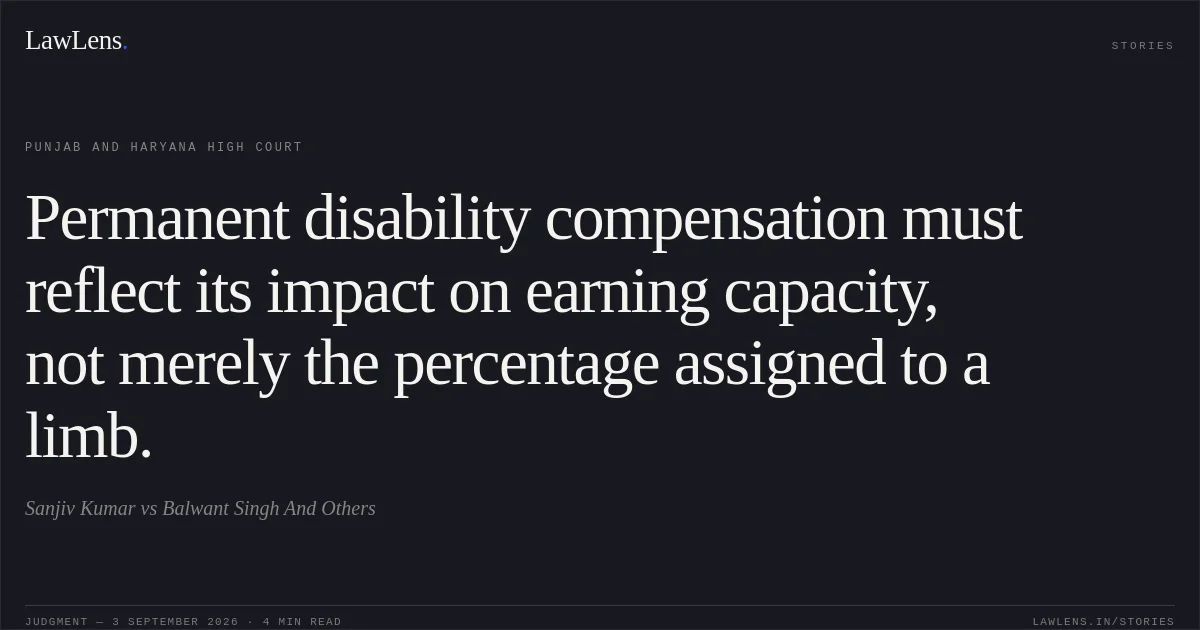
Source reference: pp. 3–4, paras. 8, 16–18The relationship between permanent physical disability and loss of earning capacity must be assessed with reference to its effect on the claimant’s avocation and earning ability, as indicated in Yadava Kumar v. Divisional Manager, National Insurance Co. Ltd., 2010 (4) PLR 242.
Source reference: p. 8, para. 18Reasoning
The High Court found the Tribunal’s award grossly inadequate considering that the claimant’s right upper limb had become paralysed and non-functional due to a brachial plexus injury, with the disability assessed at 85%–90% in that limb.
Source reference: pp. 5–7, paras. 13–15Given the severity and duration of treatment, the Court awarded Rs.40,000 for pain and suffering.
Source reference: no citationAlthough bills established treatment expenses of Rs.5,200, the Court allowed Rs.20,000, recognising that all expenses, including physiotherapy and allied treatment, may not be supported by preserved bills.
Source reference: p. 9, para. 21It further awarded Rs.7,500 each for attendant charges, special diet and transportation, and Rs.12,000 for six months’ loss of income during treatment.
Source reference: pp. 9–10, paras. 19–20For future loss of income, the Court assessed the claimant’s monthly income at Rs.2,000, considering his age, matriculation and circumstances, and added 40% towards future prospects, resulting in a monthly income of Rs.2,800.
Source reference: p. 8, paras. 16–17Applying the assessed 85% disability to earning capacity, the monthly loss was calculated at Rs.2,380, or Rs.28,560 annually.
Source reference: pp. 8–9, para. 18Applying the multiplier of 18 applicable to a 25-year-old claimant, the Court awarded Rs.5,14,080 for loss of future income due to permanent disability.
Source reference: pp. 8–9, para. 18A further Rs.20,000 was granted for lifelong loss of amenities, discomfort and hardship.
Source reference: p. 10, para. 22Holding
The appeal was allowed and the total compensation was enhanced to Rs.6,28,580, comprising Rs.40,000 for pain and suffering; Rs.20,000 for treatment expenses; Rs.7,500 each for attendant charges, special diet and transportation; Rs.5,14,080 for loss of future income due to permanent disability; Rs.12,000 for loss of income during treatment; and Rs.20,000 for loss of amenities.
The enhanced compensation was stated as Rs.5,78,580 over and above the Tribunal’s award of Rs.50,000, rounded off in the operative direction to Rs.5,78,500, with interest at 9% per annum from 2 January 1998 until realization, payable jointly and severally by respondents Nos. 1 to 3.
Source reference: p. 10, para. 24The Registry was directed to email the authenticated judgment to the insurer, which was required to comply with the Supreme Court’s directions in Bajaj Allianz General Insurance Co. v. Union of India, W.P. (Civil) No. 534 of 2020, decided on 16 March 2021.
Source reference: p. 10, para. 25Acts & Sections Cited
1 provisions across 1 statute referred to in this judgment. Each provision opens on LawLens.
Motor Vehicles Act, 19881
Original Court PDF
Sanjiv KumarvsBalwant Singh And Others
Click to open original judgment
Original judgment, available to read, download and summarize on LawLens.in