Facts
The appellant-claimant sustained multiple injuries, including a fracture of the right femur shaft, a compound fracture of the upper one-third of the ulna with radio-humeral dislocation, and dental injuries, in a motor-vehicle accident on 28 July 2002 caused by the rash and negligent driving of respondent No. 1.
Source reference: p.1; paras 1, 4The offending truck was owned by respondent No. 2 and insured with respondent No. 3.
Source reference: p.1; paras 1, 4The Motor Accident Claims Tribunal held the respondents jointly and severally liable and awarded compensation of ₹3,38,000 with interest at 9% per annum.
Source reference: p.1; paras 1, 4The claimant, who was a fourth-year B.E. (Mechanical) student at the time of the accident, appealed seeking enhancement of compensation.
Source reference: p.3; para 7; p.8; para 15The Tribunal had accepted 27% permanent orthopaedic disability and 5% dental disability, but awarded compensation under various heads, including ₹2,12,242 for actual expenses, ₹50,000 for pain and suffering, ₹50,000 for loss of amenities, and ₹25,000 for inconvenience and mental stress.
Source reference: pp.5–6; para 11Issues
Whether the compensation awarded by the Tribunal was just and adequate in light of the claimant’s injuries, permanent disability, medical expenses, loss of income, and non-pecuniary losses?
Source reference: p.3; paras 6–7Whether the claimant was entitled to enhanced compensation under the heads of medical and future treatment expenses, pain and suffering, disability/loss of amenities, attendant, transportation and special-diet expenses, and loss of income during treatment?
Source reference: pp.7–9; paras 14–18Law Applied
The Court applied Section 166 of the Motor Vehicles Act, 1988, under which an injured claimant is entitled to “just compensation” for injuries caused by a motor accident.
Source reference: p.1; para 1It reiterated that compensation must be fair, reasonable, equitable, evidence-based, and neither a windfall nor a pittance.
Source reference: p.3; para 9Relying on G. Ravindranath @ R. Chowdary v. E. Srinivas, 2013 (3) RCR (Civil) 934, the Court recognised pecuniary heads such as medical and treatment expenses, loss of earnings during treatment, loss of future earning capacity, and future medical expenses, as well as non-pecuniary heads such as pain and suffering, loss of amenities, and loss of expectation of life.
Source reference: pp.3–5; para 10The Court also referred to Sanjay Verma v. Haryana Roadways, 2014 (1) RCR (Civil) 914, Sarla Verma v. Delhi Transport Corporation, (2009) 6 SCC 121, and National Insurance Co. Ltd. v. Pranay Sethi, (2017) 16 SCC 680, in support of assessment of compensation according to settled principles.
Source reference: p.3; para 7The disability certified by the PGIMER Medical Disability Board was accepted as 27% orthopaedic disability and 5% dental disability.
Source reference: pp.6–7; para 12Reasoning
The Court confined its examination to the quantum of compensation because the Tribunal’s finding that the accident resulted from respondent No. 1’s rash and negligent driving had not been challenged by appeal or cross-objections and was therefore affirmed.
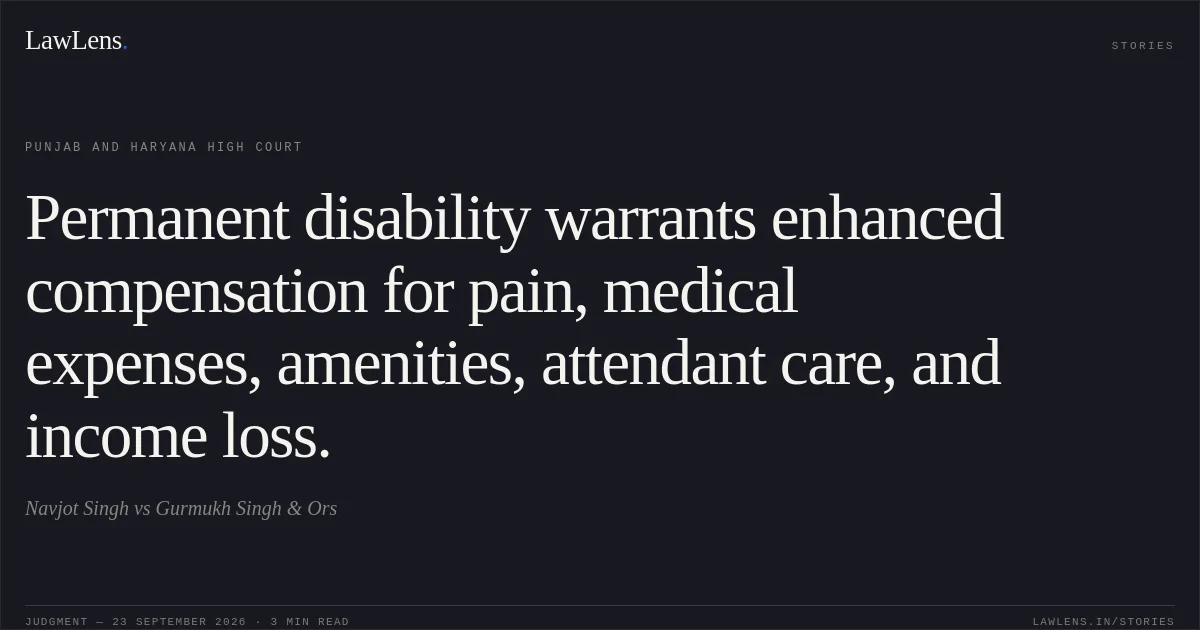
Source reference: p.2; para 6Considering the claimant’s serious fractures, two surgical interventions, prolonged medical care, and permanent disability, the Court enhanced medical and future-treatment expenses from ₹2,12,242 to ₹2,50,000 and pain-and-suffering compensation from ₹50,000 to ₹75,000.
Source reference: p.7; paras 13–14Although the Court found that the claimant’s disability would not materially impair his future earning capacity as an engineering graduate, it awarded ₹1,00,000 for the established orthopaedic and dental disabilities.
Source reference: pp.6–7; para 12Treating the claimant’s reasonable monthly income in 2002 as ₹7,500 and the treatment period as four months, it awarded ₹30,000 for loss of income during treatment.
Source reference: p.8; para 15–16It further awarded ₹25,000 for attendant charges, transportation, and special diet, and ₹40,000 for loss of amenities, inconvenience, hardship, discomfort, and related non-pecuniary consequences.
Source reference: p.8; paras 17–18The total compensation was consequently reassessed at ₹5,20,000.
Source reference: p.9; para 19Holding
The appeal was partly allowed with costs.
The claimant was held entitled to total compensation of ₹5,20,000, representing an enhancement of ₹1,82,000 over the Tribunal’s award of ₹3,38,000.
Source reference: p.10; para 20The enhanced amount was directed to carry interest at 9% per annum from 23 October 2002, the date of filing of the claim petition, until realization, payable by respondents No. 1 to 3 jointly and severally.
Source reference: p.10; para 20The Registry was directed to email an authenticated copy of the judgment to the insurer in accordance with the directions in Bajaj Allianz General Insurance Co. v. Union of India, W.P. (C) No. 534 of 2020, decided on 16 March 2021.
Source reference: p.10; para 21Pending miscellaneous applications, if any, were disposed of.
Source reference: p.10; para 22Acts & Sections Cited
1 provisions across 1 statute referred to in this judgment. Each provision opens on LawLens.
Motor Vehicles Act, 19881
Original Court PDF
Navjot SinghvsGurmukh Singh & Ors
Click to open original judgment
Original judgment, available to read, download and summarize on LawLens.in