01Facts
Pravinchandra Joshi died on 30 July 2009 when the two-wheeler he was riding collided with a truck.
¶ 2–3 · pp. 1–2His wife and son instituted a motor accident compensation claim.
¶ 2–3 · pp. 1–2The Motor Accident Claims Tribunal, Kheda at Nadiad, assessed the deceased’s monthly income at ₹27,000, including ₹779 towards agricultural income, applied a multiplier of 13, and awarded total compensation of ₹30,33,000 under various heads.
¶ 2–3 · pp. 1–2The claimants challenged the award, principally contending that future prospects and the deceased’s full agricultural income had not been properly considered.
¶ 4–5 · p. 202Issues
i.1. Whether the Tribunal erred in assessing the deceased’s monthly income and in excluding the claimed agricultural income from the computation of compensation.
¶ 5, 7–8 · pp. 2–3ii.2. Whether the claimants were entitled to an addition towards future prospects, considering that the deceased was a permanent school teacher and was aged 49 years.
¶ 9 · p. 3iii.3. Whether the compensation under the heads of loss of dependency, consortium, loss of estate, and funeral expenses required modification, and what rate of interest should apply.
¶ 9–12 · pp. 3–403Law Applied
The Court applied the principles governing motor accident compensation under the Motor Vehicles Act, including assessment of actual income, deduction for personal expenses, application of the appropriate multiplier, and award of conventional heads of damages.
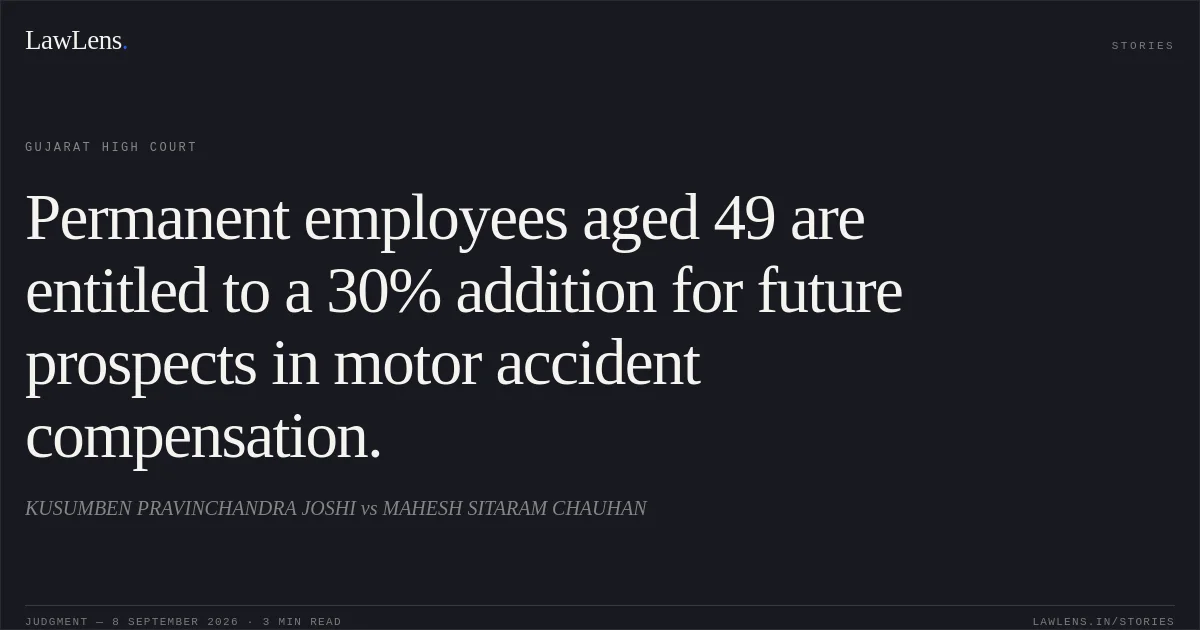
Relying on National Insurance Co. Ltd. v. Pranay Sethi, AIR 2017 SC 5157, the Court held that a deceased holding permanent employment is entitled to an addition for future prospects, and that a person aged 49 years is entitled to a 30% addition.
¶ 9 · p. 3The Court also relied on Reena v. Managing Director, Karnataka State Road Transport Corporation, 2026 (0) AIJEL-SC 77486, for quantification of consortium and other non-pecuniary compensation.
¶ 11 · p. 3Where the deceased left a wife and two sons as dependants, one-fourth of the income was deductible towards personal expenses.
¶ 9 · p. 304Reasoning
The Court upheld the Tribunal’s assessment of the deceased’s salary at ₹26,221 per month because it was based on documentary evidence.
¶ 7 · p. 2It also upheld the inclusion of only ₹779 per month as agricultural income, finding no credible evidence supporting a higher amount.
¶ 8 · p. 3However, the Tribunal had failed to add future prospects.
¶ 9–10 · p. 3Since the deceased was a permanent employee aged 49 years, the Court added 30% to the monthly income, bringing it to ₹35,100.
¶ 9–10 · p. 3After deducting one-fourth for personal expenses, the monthly multiplicand was fixed at ₹26,325.
¶ 9–10 · p. 3Applying the multiplier of 13 resulted in ₹41,06,700 towards loss of future income.
¶ 9–10 · p. 3The Court then recalculated the conventional damages in accordance with Pranay Sethi and Reena, awarding ₹1,56,000 for consortium, ₹19,500 for loss of estate, and ₹19,500 for funeral expenses.
¶ 11 · p. 3It further considered the Tribunal’s interest award of 7.5% per annum inadequate and enhanced the rate to 9% per annum.
¶ 12 · p. 405Holding
The appeal was partly allowed.
¶ 11 · p. 4The total compensation was enhanced from ₹30,33,000 to ₹43,01,700, resulting in an enhancement of ₹12,68,700.
¶ 11 · p. 4The enhanced compensation comprised ₹41,06,700 for loss of future income, ₹1,56,000 for consortium, ₹19,500 for loss of estate, and ₹19,500 for funeral expenses.
¶ 11 · p. 4Interest was directed to be paid at 9% per annum instead of 7.5% per annum, while the terms of disbursement were left unchanged in accordance with the Tribunal’s award.
¶ 12–14 · p. 4Original Court PDF
KUSUMBEN PRAVINCHANDRA JOSHIvsMAHESH SITARAM CHAUHAN
Click to open original judgment
Original judgment, available to read, download and summarize on LawLens.in