Facts
The original plaintiff instituted Special Civil Suit No. 35 of 2008 seeking a declaration that he had acquired ownership of the suit land by adverse possession.
Source reference: paras. 3–4; pp. 2–3He relied on a document allegedly executed by the predecessor of respondent Nos. 1–3, claiming that he had been placed in possession in 1981 and had remained in uninterrupted possession thereafter.
Source reference: paras. 3–4; pp. 2–3The defendants contended that the land was restricted-tenure land and could not be transferred without prior governmental permission under Section 73AA of the Bombay Tenancy and Agricultural Lands Act, 1948. Defendant No. 4 claimed ownership under a registered sale deed executed after obtaining permission from the competent authority.
Source reference: paras. 5–6; pp. 3–4The Trial Court dismissed the suit, finding that the plaintiff had neither acquired title by adverse possession nor by inheritance, while holding that the defendants had proved the restricted nature of the land and the validity of defendant No. 4’s purchase.
Source reference: para. 5; pp. 3–4The Principal District Judge, Valsad dismissed the plaintiff’s Regular Civil Appeal No. 31 of 2013 on 15 April 2026. The plaintiff’s legal heirs consequently preferred the present second appeal under Section 100 CPC.
Source reference: paras. 2, 7; pp. 1–2, 4Issues
Whether the plaintiff had established open, continuous, peaceful and hostile possession, accompanied by animus possidendi, for the statutory period so as to acquire title by adverse possession?
Source reference: paras. 9–12; pp. 6–17Whether possession originating from the alleged permission or declaration of the original owner could be treated as adverse possession merely because it continued for a long period?
Source reference: paras. 9–12; pp. 6–17Whether the registered sale deed in favour of defendant No. 4 was valid, having been executed after obtaining the requisite permission for transfer of restricted-tenure land?
Source reference: paras. 5–6, 13; pp. 3–4, 18Whether the concurrent findings of the Courts below disclosed perversity, a gross error of law, or any substantial question of law warranting interference under Section 100 CPC?
Source reference: paras. 14–16; pp. 18–21Law Applied
The Court applied Section 100 of the Code of Civil Procedure, 1908, under which a second appeal lies only on a substantial question of law and concurrent findings of fact are not ordinarily open to interference unless perverse, unsupported by evidence, or contrary to settled law.
Source reference: paras. 15–15.1; pp. 19–20It applied Section 73AA of the Bombay Tenancy and Agricultural Lands Act, 1948, which restricts transfer of tribal/restricted-tenure land without prior permission of the Collector or competent authority.
Source reference: para. 9; pp. 6–7On adverse possession, relying principally on State of Kerala v. Joseph, AIR 2023 SC 3988 : (2023) 17 SCC 400, and the authorities discussed therein, the Court held that possession must be peaceful, open, continuous, actual, visible and hostile to the true owner—nec vi, nec clam, nec precario—and must be accompanied by animus possidendi.
Source reference: paras. 10–11; pp. 7–16Mere long or permissive possession does not become adverse without clear and cogent proof of hostile title and knowledge of the true owner; the burden rests on the person asserting adverse possession.
Source reference: para. 11; pp. 10–17The Court also relied on Jaichand v. Sahnulal, 2024 SCC OnLine SC 3864, and Russi Fisheries (P) Ltd. v. Bhavna Seth, 2026 SCC OnLine SC 555, for the limited scope of interference with findings of fact in second appeal.
Source reference: paras. 15–15.1; pp. 19–20Reasoning
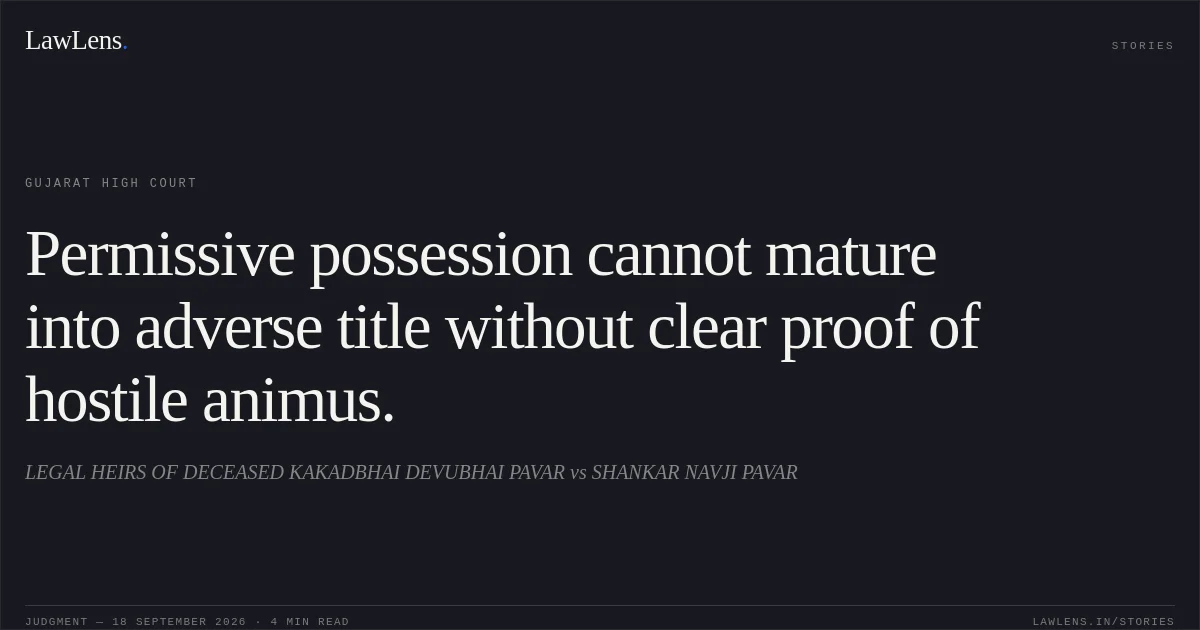
The Court held that the document relied upon by the plaintiff established, at most, that he had been placed in possession by the original owner in 1981. Such possession was permissive in character and did not demonstrate a hostile assertion of title against the true owner.
Source reference: paras. 9–10; pp. 6–8The plaintiff produced no clear and cogent evidence identifying when his possession became adverse, or proving that it was openly and continuously hostile to the title holder with the requisite animus possidendi.
Source reference: paras. 10–12; pp. 7–17Mere uninterrupted possession until the filing of the suit in 2008 was therefore insufficient to perfect title by adverse possession.
Source reference: paras. 10–12; pp. 7–17Since the plaintiff failed to establish adverse title, the original owners retained the authority to transfer the land.
Source reference: paras. 12–13; pp. 17–18The Court further accepted that defendant No. 4 had acquired the property under a registered sale deed after obtaining prior permission from the competent revenue authority.
Source reference: para. 13; p. 18The concurrent findings of the Courts below were neither perverse nor based on inadmissible evidence, and the appellants’ proposed questions did not raise any substantial question of law.
Source reference: paras. 14–16; pp. 18–21Holding
The High Court answered the issues against the appellants. It held that the plaintiff had not acquired title by adverse possession because his possession was permissive and the necessary hostile animus and other legal requirements were not proved.
It also upheld the validity of defendant No. 4’s purchase following governmental permission for transfer of the restricted-tenure land.
Source reference: paras. 12–13; pp. 17–18The second appeal was dismissed in limine, the judgments and decrees of the Courts below were confirmed, and the connected Civil Application for stay was disposed of as infructuous. No order as to costs was made.
Source reference: para. 16; p. 21Acts & Sections Cited
4 provisions across 3 statutes referred to in this judgment. Each provision opens on LawLens.
Code of Civil Procedure, 19081
Bombay Tenancy and Agricultural Lands Act-19481
Limitation Act, 19632
Original Court PDF
LEGAL HEIRS OF DECEASED KAKADBHAI DEVUBHAI PAVARvsSHANKAR NAVJI PAVAR
Click to open original judgment
Original judgment, available to read, download and summarize on LawLens.in