Facts
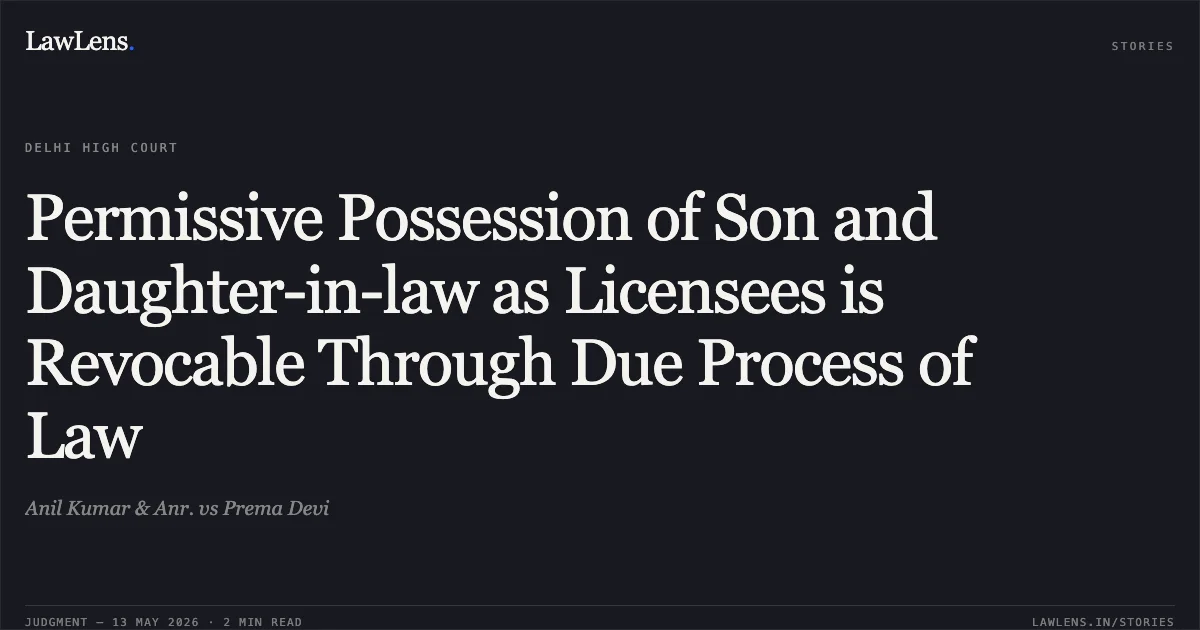
The Respondent (plaintiff), a 62-year-old woman, filed a suit for possession, permanent injunction, and mesne profits against her son (Appellant No. 1) and daughter-in-law (Appellant No. 2) regarding the first floor of property No. A-40, Shahbad Daulatpur, Delhi.
Source reference: p. 1-2The Respondent claimed absolute ownership through three purchase transactions between 1993 and 2004, documented via GPA, Agreement to Sell, and Receipts.
Source reference: p. 2-3She alleged the Appellants were permissive licensees whose license was revoked via a public notice and legal notice in December 2022 due to harassment and attempts to claim title.
Source reference: p. 3-4The Appellants contended the property was purchased using Joint Hindu Family (HUF) funds and that they had a legal right to reside there.
Source reference: p. 4-5The Trial Court decreed the suit in favor of the Respondent on 28.11.2025.
Source reference: p. 1-2Issues
1. Whether the Respondent established absolute ownership of the suit property and whether the Appellants' occupation was that of mere licensees.
Source reference: p. 9-102. Whether the suit property carried the character of Joint Hindu Family (HUF) or ancestral property.
Source reference: p. 123. Whether the daughter-in-law (Appellant No. 2) possessed an indefeasible right of residence under the DV Act, 2005.
Source reference: p. 15Law Applied
Section 96 and Order XLI Rule 1 of the CPC regarding appeals and Order XX Rule 12 regarding mesne profits.
Source reference: p. 1, 9The principle from Muddasani Venkata Narsaiah v. Muddasani Sarojana that unchallenged testimony in cross-examination is deemed accepted.
Source reference: p. 11Commissioner of Wealth Tax v. Chander Sen and Yudhishter v. Ashok Kumar, establishing that self-acquired property does not automatically become HUF property under the Hindu Succession Act, 1956.
Source reference: p. 12Satish Chander Ahuja v. Sneha Ahuja, ruling that a daughter-in-law’s right to a "shared household" under the DV Act does not override the owner's right to seek eviction through due process.
Source reference: p. 15-16Reasoning
The Court found that the Respondent proved her title through a consistent chain of documents (GPAs and Agreements to Sell) dating back to 1993.
Source reference: p. 10The Appellants’ plea of HUF property failed because Appellant No. 1 was a minor/student (aged 14-15) at the time of the initial purchases and provided no evidence of a common hotchpotch or ancestral nucleus.
Source reference: p. 13-14The court noted that the Appellants did not challenge the execution of title documents during cross-examination, reinforcing the Respondent’s ownership.
Source reference: p. 11Regarding the "shared household" defense, the court reasoned that while Appellant No. 2 has a right of residence, it is not absolute against the true owner and can be terminated via "procedure established by law," which the current civil suit satisfied.
Source reference: p. 16Mesne profits at Rs. 5,000/month were deemed reasonable based on the existing rental income of other rooms in the same building.
Source reference: p. 18Holding
The court held that the Respondent is the absolute owner and the Appellants are licensees whose rights stood terminated upon the service of the legal notice.
The High Court dismissed the appeal and upheld the Trial Court’s judgment, ordering the Appellants to deliver vacant possession and pay damages of Rs. 5,000 per month from 07.01.2023 until the date of handing over possession.
Source reference: p. 18-19Acts & Sections Cited
6 provisions across 3 statutes referred to in this judgment. Each provision opens on LawLens.
Code of Civil Procedure, 19084
Hindu Succession Act, 19561
Protection of Women from Domestic Violence Act, 20051
Original Court PDF
Anil Kumar & Anr.vsPrema Devi
Click to open original judgment
Original judgment, available to read, download and summarize on LawLens.in