01Facts
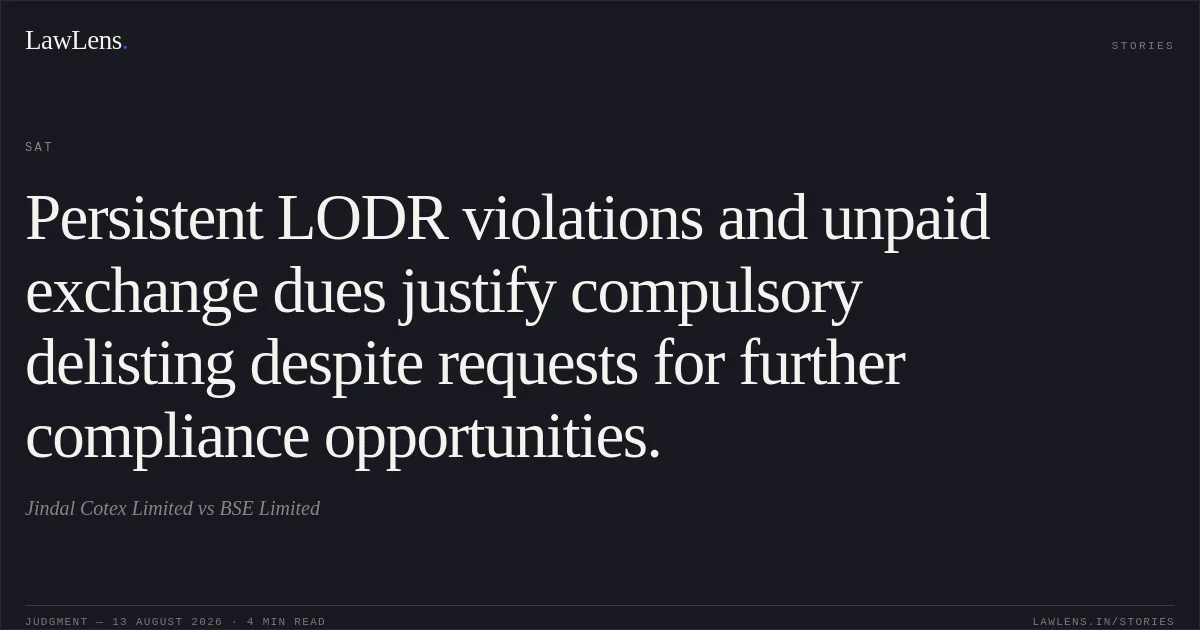
Jindal Cotex Limited (“Company”) was listed on the BSE and NSE from 22 September 2009. Its securities were suspended for non-compliance with Regulation 31 of the SEBI (Listing Obligations and Disclosure Requirements) Regulations, 2015 (“LODR Regulations”).
¶ 13The Company attributed its financial difficulties to adverse changes in export policy, unsold inventory, the COVID-19 pandemic, and recovery proceedings initiated by its creditors.
¶ 3It subsequently failed to comply with several disclosure and governance requirements, including submission of investor-grievance statements, shareholding patterns, secretarial compliance reports, reconciliation of share capital audit reports, and maintenance of a minimum six-member Board under Regulation 17(1)(c) of the LODR Regulations.
¶ 14, 26The NSE repeatedly considered the matter between February 2023 and October 2024 and granted the Company several opportunities to cure the defaults and participate in personal hearings.
¶ 16–25As on 9 September 2024, the Company owed approximately ₹1.08 crore towards SOP fines and ₹56.51 lakh towards annual listing fees to the NSE.
¶ 15The NSE Delisting Committee compulsorily delisted the Company on 9 October 2024, and the BSE passed a corresponding delisting order dated 24 February 2025. The Company challenged the NSE and BSE actions under Section 23L of the Securities Contracts (Regulation) Act, 1956 (“SCRA”).
¶ 1, 27–2802Issues
i.1. Whether the Company had shown sufficient cause for condonation of delay in filing the appeals, particularly on the ground that time was spent pursuing review applications before the Exchanges
¶ 6, 9, 30ii.2. Whether the NSE and BSE were justified in compulsorily delisting the Company for persistent non-compliance with the LODR Regulations and failure to pay outstanding SOP fines and annual listing fees
¶ 26–31iii.3. Whether the Company was entitled to one further opportunity to complete its regulatory filings and pay the outstanding dues
¶ 5, 8, 3103Law Applied
The Tribunal applied Section 23L of the SCRA, under which appeals lie against orders of recognised stock exchanges.
title pageRule 21 of the Securities Contracts (Regulation) Rules, 1957 (“SCRR”) identifies circumstances supporting delisting, including prolonged suspension of trading, failure to comply with statutory and regulatory requirements, and the existence of an unknown or false company address.
¶ 26The Tribunal relied on the LODR Regulations, particularly Regulations 13, 17(1)(c), 24A and 31, concerning investor-grievance statements, minimum Board strength, secretarial compliance reports and shareholding-pattern disclosures, respectively, as well as Regulation 76 of the SEBI (Depositories and Participants) Regulations, 2018 concerning reconciliation of share capital audit reports.
¶ 13–14, 26Regulation 33 of the SEBI (Delisting of Equity Shares) Regulations, 2021 places an obligation on the promoter to acquire delisted shares from public shareholders within three months of delisting, at a value determined by an independent valuer.
¶ 26In the absence of any statutory provision conferring review jurisdiction on the Exchanges, the time spent pursuing an impermissible review application could not be excluded for limitation purposes.
¶ 30Provisions in the judgment · 1
The Securities Contracts (Regulation) Act, 1956 Section 23L
04Reasoning
The Tribunal found that the Company’s defaults were persistent and substantial, rather than isolated or technical. It had failed for several years to maintain the minimum number of directors, submit mandatory regulatory reports, pay SOP fines and annual listing fees, or respond to repeated communications and hearing notices.
¶ 19–26The Exchanges had considered the matter on several occasions and granted multiple opportunities, including a final opportunity before the delisting decision; the Company nevertheless remained non-responsive.
¶ 16–25These circumstances satisfied the regulatory basis for compulsory delisting under Rule 21 of the SCRR and justified the Exchanges’ conclusion that the Company had failed to demonstrate sufficient efforts to remain compliant.
¶ 26The Tribunal also rejected the limitation explanation. Since no statutory power of review was available to the Exchanges, the Company could not claim exclusion of the period spent pursuing review applications before them.
¶ 30On the merits, the Company’s admission that it was not functioning, coupled with its continuing regulatory defaults and unpaid dues, made a further opportunity inappropriate. The Tribunal considered that permitting such a company to regain listing could expose unsuspecting investors to further risk.
¶ 3105Holding
The Tribunal held that the delay applications were not sustainable because the time spent pursuing review applications before the Exchanges could not be excluded in the absence of a statutory review provision.
¶ 30It further held that the NSE and BSE were justified in compulsorily delisting Jindal Cotex Limited after repeated non-compliance with the LODR Regulations, failure to maintain the required Board strength, non-payment of SOP fines and annual listing fees, and failure to respond to repeated opportunities and communications.
¶ 29–31Miscellaneous Application No. 1369 of 2025 and Appeal No. 565 of 2025, as well as Miscellaneous Application No. 1374 of 2025 and Appeal No. 566 of 2025, were dismissed. Pending interlocutory applications were disposed of, with no order as to costs.
¶ 32Original Court PDF
Jindal Cotex LimitedvsBSE Limited
Click to open original judgment
Original judgment, available to read, download and summarize on LawLens.in