01Facts
The petitioner appeared in the UPSC Civil Services Examination, 2022, cleared the Preliminary and Mains examinations, and was called for the Personality Test.
¶ 2A DoPT communication dated 23.01.2023 recorded her Roll Number as "106438" instead of "0106438," omitting the first digit.
¶ 2After the final result, she found her Essay Paper score unexpectedly low and apprehended that similar errors had affected the recording of her marks. She filed an RTI application dated 26.05.2023 seeking certified copies and inspection of her evaluated answer booklets for all papers.
¶ 3By reply dated 22.06.2023, UPSC refused copies, stating that evaluated answer sheets are not provided to candidates. It stated, however, that the Essay answer booklet had been re-scrutinised and found to have no unvalued parts, an intact answer book, no totalling error, and no other clerical error.
¶ 4The first appeal was dismissed on 07.07.2023.
¶ 5The petitioner's earlier writ (W.P.(C) 11533/2023) was withdrawn on 31.08.2023 with liberty to approach the CIC.
¶ 6The CIC dismissed her second appeal on 30.10.2023.
¶ 7UPSC contended that the Roll Number omission occurred only in DoPT's medical examination letters, affecting all 362 finally qualified candidates, and had no bearing on evaluation or mark recording.
¶ 1302Issues
i.1. Whether a candidate is entitled to certified copies and personal inspection of her evaluated answer booklets in the UPSC Civil Services (Mains) Examination absent a demonstrated public interest, where the claim rests on a personal apprehension of mark-recording errors.
¶ 14 · ¶ 16–17 · p. 6 · p. 10ii.2. Whether the Roll Number discrepancy in the DoPT communication constitutes a public-interest element warranting disclosure under the exception recognised in Angesh Kumar.
¶ 16–17 · p. 10iii.3. Whether the judgments in CBSE v. Aditya Bandopadhyay and Mradul Mishra v. Chairman, UPPSC justify disclosure in the present case.
¶ 18–19 · pp. 10–1103Law Applied
The RTI Act, 2005, read with the Supreme Court's construction in UPSC v. Angesh Kumar (2018) 4 SCC 530, holds that the right to information under Sections 3 and 6 is subject to inherent limitations, requiring a balance between transparency and public interest, optimal use of fiscal resources, and confidentiality of sensitive information.
¶ 14 · p. 6Angesh Kumar holds that marks and evaluated answer sheets in Civil Services Examinations cannot be disclosed mechanically, that furnishing raw marks is not in public interest because of the integrity and examiner-anonymity concerns catalogued in Prashant Ramesh Chakkarwar v. UPSC, but that courts may order disclosure where a case of public interest is made out.
¶ 14 · pp. 6–9Nitish Shankar v. UPSC (DB, LPA 449/2023), Vijay Pal Singh v. UoI (2021 SCC OnLine Del 2232) and UPSC v. Siddhartha Bishnoi (W.P.(C) 388/2016) apply the same public-interest requirement.
¶ 15 · pp. 9–10Aditya Bandopadhyay concerns CBSE examinations, which stand on a different footing, and Mradul Mishra does not address UPSC Civil Services examinations, so neither displaces the Angesh Kumar standard.
¶ 18–19 · pp. 10–11Provisions in the judgment · 5 · Linked ones open on LawLens
Right to Information Act, 2005 Section 3Section 6Section 8Section 9Section 11
04Reasoning
The petitioner's only ground, the apprehension that the first-digit omission reflected an error in recording her marks, was a personal concern and did not, by itself, constitute public interest under the Angesh Kumar exception.
¶ 17 · p. 10The respondents explained that the omission was a clerical error confined to DoPT's medical communications, affecting all 362 qualified candidates, with no bearing on evaluation.
¶ 16 · p. 10UPSC's re-scrutiny of the Essay booklet, which found no unvalued answers, no totalling error, and no other clerical error, addressed the specific apprehension raised.
¶ 4 · ¶ 16 · p. 10The petitioner's claim was "premised purely on personal rights" and lacked a public-interest element.
¶ 20 · pp. 10–11The court distinguished Aditya Bandopadhyay because it concerns CBSE examinations, and distinguished Mradul Mishra because its observations were not shown to apply to UPSC Civil Services examinations, where Angesh Kumar disallows raw-mark disclosure in the public interest.
¶ 18–19Because the petitioner had not shown any public-interest justification, the court declined to exercise its extraordinary jurisdiction to override the statutory and judicial limits on disclosure.
¶ 2005Holding
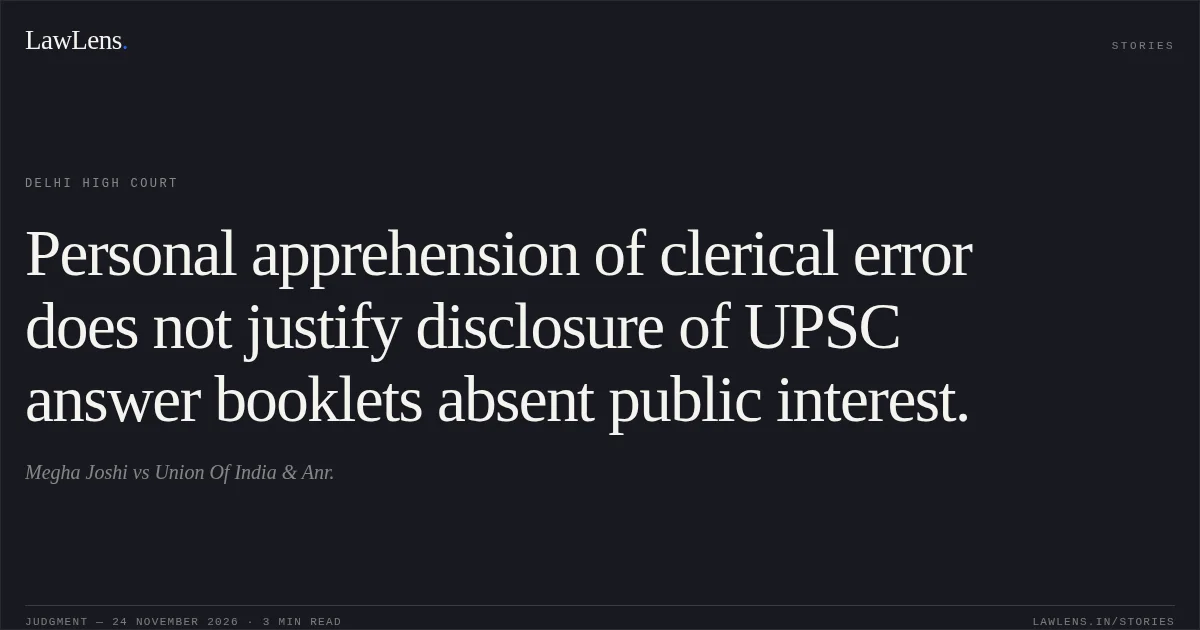
A candidate's personal apprehension of a mark-recording error, unsupported by any demonstrated public interest, does not justify disclosure of evaluated answer booklets in the UPSC Civil Services (Mains) Examination under the Angesh Kumar exception.
¶ 17 · ¶ 20The petition is dismissed, and pending applications are disposed of. No directions were issued for certified copies, inspection, or revision of the petitioner's result. The petitioner's prayers (i)–(v) for supply and inspection of answer booklets and consequential relief are refused.
¶ 1 · ¶ 21–22Original Court PDF
Megha JoshivsUnion Of India & Anr.
Click to open original judgment
Original judgment, available to read, download and summarize on LawLens.in