Facts
The appellants, State Bank of India (SBI) and Bank of India (BOI), challenged judgments from the Calcutta and Delhi High Courts which quashed orders classifying the respondents' (borrowers) loan accounts as "fraud"
Source reference: para 7, 10In the SBI matter, the borrower’s account was declared a Non-Performing Asset (NPA) in 2019, followed by a Show Cause Notice (SCN) in 2023 alleging financial irregularities
Source reference: para 6Despite receiving a reply, the bank classified the account as "fraud" in March 2024 via a speaking order without granting an oral hearing
Source reference: para 6Similarly, BOI classified M/s Liliput Kidswear as "fraud" in 2025 after two SCNs based on Forensic Audit Reports (FAR), but without a personal hearing
Source reference: paras 8-9The High Courts quashed these classifications, interpreting the Supreme Court's decision in State Bank of India v. Rajesh Agarwal (2023) to mean that a personal hearing and the full supply of the FAR were mandatory
Source reference: paras 7, 10The Reserve Bank of India (RBI) was impleaded to clarify the application of its Master Directions (2016 and 2024)
Source reference: paras 4, 13Issues
1. Whether the decision in Rajesh Agarwal recognizes a right in the borrower to a personal/oral hearing before an account is classified as "fraud" under RBI Master Directions?
Source reference: para 112. Whether the issuance of a detailed SCN, consideration of a reply, and a reasoned order satisfy the principles of natural justice?
Source reference: para 113. Whether banks are obligated to furnish the entire Forensic Audit Report (FAR) to borrowers, or if providing conclusions is sufficient?
Source reference: para 11Law Applied
The Court primarily interpreted Section 35A and Section 21 of the Banking Regulation Act, 1949, which empower the RBI to issue directions in the public interest
Source reference: paras 14-15It applied the principle that natural justice is a flexible concept, as established in A.K. Kraipak v. Union of India, where the specific requirements depend on the facts and statutory framework
Source reference: para 76The court relied on Union of India v. Jyoti Prakash Mitter, which held that a personal hearing is not necessarily an incident of natural justice except in courts of law
Source reference: para 80Regarding disclosure, the court applied T. Takano v. SEBI, which mandates the disclosure of all "relevant material" used in adjudication, subject to narrow exceptions like third-party privacy
Source reference: paras 120-121It also analyzed its previous holding in State Bank of India v. Rajesh Agarwal (2023), which read audi alteram partem into the RBI’s 2016 Master Directions
Source reference: paras 66-70Reasoning
The Court clarified that Rajesh Agarwal did not explicitly mandate a "personal hearing"; rather, it required an "opportunity of being heard," which can be satisfied through a written representation (SCN and reply)
Source reference: paras 74, 92The Court reasoned that an absolute right to an oral hearing would hamper administrative promptitude, allow fraudsters to dissipate assets, and overwhelm banking infrastructure
Source reference: paras 93-94It noted that the 2024 Master Directions (Clauses 2.1.1.1 to 2.1.1.4) correctly codified this by requiring a detailed SCN, a minimum of 21 days to reply, and a reasoned order
Source reference: paras 21, 101Regarding the FAR, the Court rejected the banks' argument that providing only "conclusions" was sufficient. It held that the FAR is central investigative material; since findings and conclusions are inextricably linked to the reasoning in the body of the report, the full report must be disclosed to ensure the borrower can effectively represent their case
Source reference: paras 121, 125Redaction is permitted only in exceptional cases where third-party privacy or strategic market information is at stake
Source reference: para 124Holding
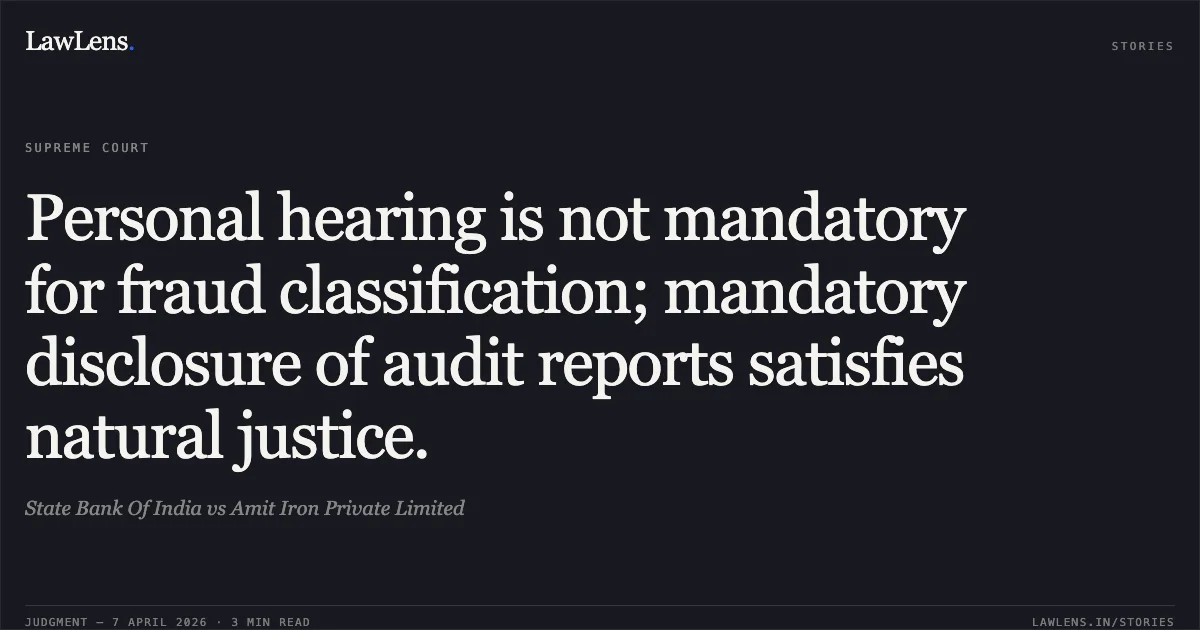
Borrowers do not have an inherent right to a personal hearing before "fraud" classification
SCN, a 21-day reply window, and a reasoned order satisfy natural justice
Source reference: para 126(c)Banks are mandatory required to furnish the full FAR (or relevant audit reports) to the borrower
Source reference: para 126(d)The Court set aside the High Courts' directions for personal hearings but upheld the directions to furnish the FAR
Source reference: para 127The appellant-banks were directed to provide the FARs to the respondents, elicit fresh replies, and pass new reasoned orders in accordance with the 2024 Master Directions
Source reference: para 127Acts & Sections Cited
1 provisions across 1 statute referred to in this judgment. Each provision opens on LawLens.
Banking Regulation Act, 19491
Original Court PDF
State Bank Of IndiavsAmit Iron Private Limited
Click to open original judgment
Original judgment, available to read, download and summarize on LawLens.in