Facts
The Petitioner, along with several co-accused, sought the quashing of an FIR (Crime No. 348 of 2025) involving charges under Sections 85, 115(2), 64, 351(2), 61(2)(a), 70(2) of the Bharatiya Nyaya Sanhita (BNS), 2023; Sections 3/4 of the Muslim Women (Protection of Rights on Marriage) Act, 2019; and Sections 5(l)/6 and 17/18 of the POCSO Act.
Source reference: para 2The prosecutrix alleged she was forced into marriage at age 15 in 2015, followed by a Triple Talaq in 2016.
Source reference: para 3She was then coerced into a nikah halala while still a minor (approx. 16 years old) to remarry her husband.
Source reference: para 14, 22Following a second divorce in 2021, she was subjected to a second halala in February 2025, during which she alleged she was gang-raped by her ex-husband’s relatives (Shahnawaz and Hakim Nishat) under the pretext of religious ritual.
Source reference: para 4, 23Medical reports estimated her age above 25 in late 2025, corroborating her minority during the first halala incident.
Source reference: para 5, 21Issues
1. Whether the practice of nikah halala or personal laws can serve as a valid defense against charges of statutory rape and gang rape under the BNS and POCSO Act.
Source reference: para 202. Whether the FIR and investigation should be quashed on the grounds that the alleged acts were permissible under personal law or because certain accused played "marginal" roles.
Source reference: para 24, 26Law Applied
Independent Thought v. Union of India (2017), which established that all sexual acts with a child below 18 years are rape, overriding personal laws.
Source reference: para 15, 20Exception 2 to Section 63 of the BNS, which excludes only consensual sex with a wife above 18 from the definition of rape.
Source reference: para 20The Neeharika Infrastructure Pvt. Ltd. v. State of Maharashtra guidelines, which mandate that High Courts be extremely slow to quash FIRs involving serious cognizable offences like sexual violence.
Source reference: para 19Section 69 of the BNS regarding sexual intercourse obtained by deceitful means.
Source reference: para 15Reasoning
The Court rejected the argument that nikah halala protected the accused, stating that penal statutes and constitutional values regarding personal dignity and equality (Articles 14 and 21) override personal laws when a crime is committed.
Source reference: para 20, 25Analysis of the prosecutrix's statement under Section 183 BNSS revealed that the first halala occurred when she was approximately 16, constituting statutory rape under POCSO, as consent from a minor is legally irrelevant.
Source reference: para 22, 24Regarding the 2025 incident, the Court found that the allegations of gang rape and a "bogus nikah" used to obtain carnal access through fraud fell squarely within the BNS.
Source reference: para 23The Court noted that even if some petitioners played "marginal" roles as abettors or conspirators, they were part of a criminal enterprise that required thorough investigation rather than threshold dismissal.
Source reference: para 26Holding
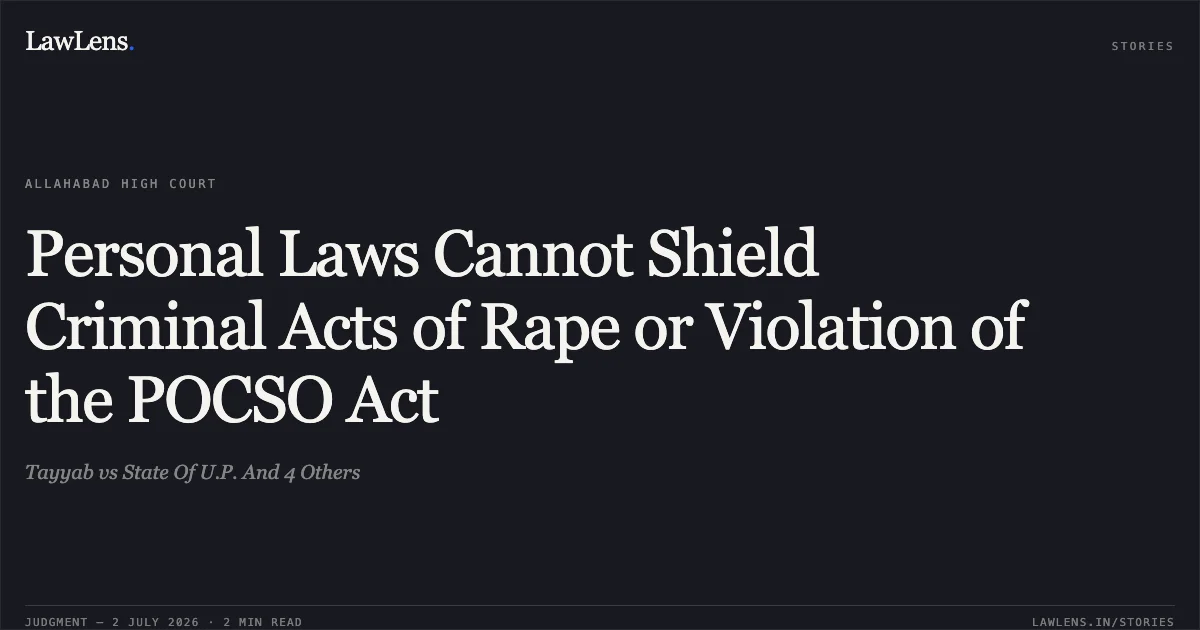
The Court answered that personal laws cannot shield individuals from prosecution for sexual violence and that the gravity of the allegations warranted a full investigation.
The High Court dismissed all writ petitions, vacated interim orders, and held that the case presented a "shocking" violation of constitutional aspirations; the prayer to quash the FIR was denied as a prima facie case for serious offences was established.
Source reference: para 24, 25, 27Acts & Sections Cited
20 provisions across 5 statutes referred to in this judgment. Each provision opens on LawLens.
Bharatiya Nyaya Sanhita, 2023
Protection of Children from Sexual Offences Act, 20124
Bharatiya Nagarik Suraksha Sanhita, 20233
Indian Penal Code, 18601
Original Court PDF
TayyabvsState Of U.P. And 4 Others
Click to open original judgment
Original judgment, available to read, download and summarize on LawLens.in