Facts
The petitioner sought to quash FIR No. 73/2022 registered at PS Mahila Thana, Shahdol, for offences under Sections 376 and 376(2)(n) of the IPC.
Source reference: para. 1The complainant (Respondent No. 2) alleged that while they were engaged to be married, the petitioner forced her into physical relations on May 25, 2022, by convincing her of their upcoming marriage.
Source reference: para. 2The complainant filed the FIR on September 4, 2022, after discovering the petitioner had married another woman.
Source reference: para. 2The petitioner challenged the FIR on grounds of a three-month delay, a prior withdrawn dowry complaint, and the subsequent framing of charges.
Source reference: paras. 3-4During the pendency of this petition, the trial reached the stage of final hearing.
Source reference: para. 11Issues
1. Whether the FIR and consequential criminal proceedings should be quashed under Section 528 of the Bharatiya Nagarik Suraksha Sanhita (BNSS), 2023, despite the trial being at the stage of final hearing.
Source reference: para. 10-12Law Applied
The Court applied Section 528 of the Bharatiya Nagarik Suraksha Sanhita (BNSS), 2023.
Source reference: para. 1, 10Kamaladevi Agrawal v. State of W.B. (2002) 1 SCC 555, which held that inherent powers to quash should be used sparingly and only if the FIR, taken at face value, discloses no cognizable offence.
Source reference: para. 6R. Kalyani v. Janak C. Mehta (2009) 1 SCC 516 and Amit Kapoor v. Ramesh Chander (2012) 9 SCC 460, establishing that Courts should not conduct a meticulous examination of evidence or marshal records at the quashing stage, especially when the offence is broadly satisfied prima facie.
Source reference: paras. 7-9Reasoning
The Court observed that the High Court’s inherent jurisdiction under Section 528 of the BNSS is intended to prevent the abuse of the process of law, but it cannot be used to resolve disputed and controversial facts which are subject to trial.
Source reference: paras. 6, 10In this instance, the petitioner moved the Court after the framing of charges and as the trial neared completion.
Source reference: paras. 4, 11The Court found that since the evidence of the parties had already been recorded and the trial was at the "fag end," it would be improper to interfere.
Source reference: para. 12The allegations in the FIR, if taken as true, did disclose the commission of an offence, and any potential benefits from the evidence are matters for the trial court to determine in its final judgment.
Source reference: para. 12Holding
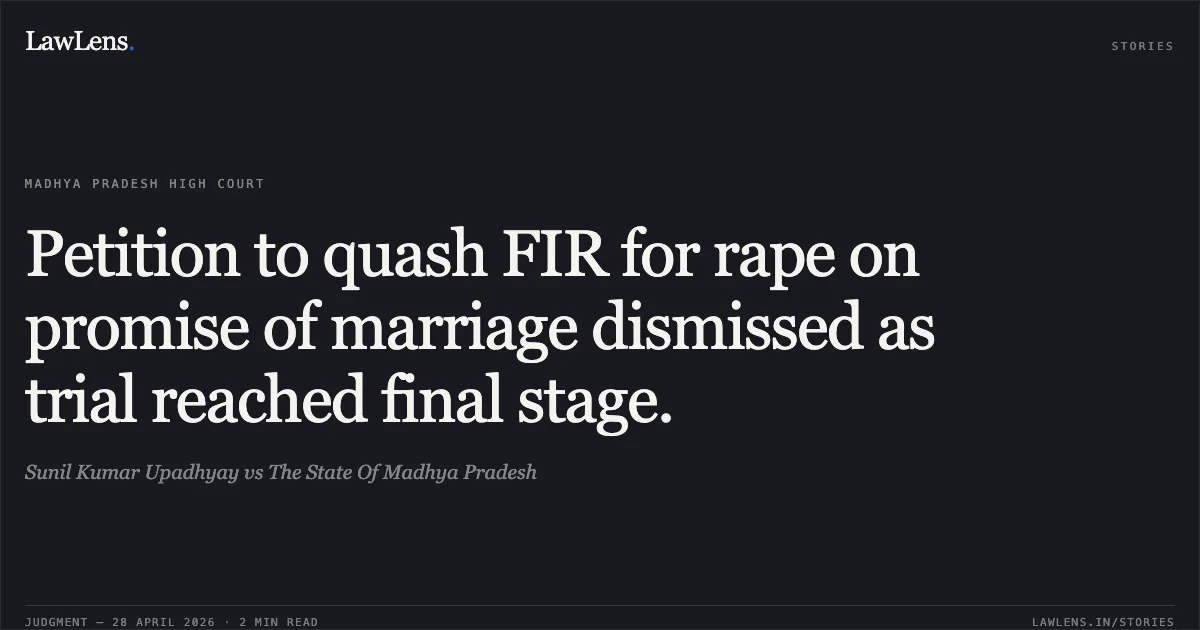
The High Court dismissed the petition, holding that quashing is not warranted when the trial is almost complete.
The Court directed the trial court to conclude the proceedings at an early date, uninfluenced by any observations made in this order.
Source reference: para. 13No orders were made as to costs.
Source reference: p. 6Acts & Sections Cited
2 provisions across 2 statutes referred to in this judgment. Each provision opens on LawLens.
Bharatiya Nagarik Suraksha Sanhita, 20231
Indian Penal Code, 18601
Original Court PDF
Sunil Kumar UpadhyayvsThe State Of Madhya Pradesh
Click to open original judgment
Original judgment, available to read, download and summarize on LawLens.in