Facts
The plaintiff and the three appellants were the children of late T. Govindarajulu.
Source reference: no citationThe suit property had been allotted to him in a partition decree and was treated by the parties and the Court as ancestral and joint family property.
Source reference: no citationThe plaintiff claimed her own 1/5 share and a further 1/5 share under her father’s registered Will dated 7 June 2012, seeking a total 2/5 share.
Source reference: pp. 3–5, 17The defendants disputed the Will, alleging that their father lacked mental capacity and that the document was fabricated; they also sought to produce medical records as additional evidence in the appeal.
Source reference: pp. 7–8, 12–14The Trial Court decreed the suit for the plaintiff’s 2/5 share.
Source reference: pp. 9–13The defendants appealed under Section 96 CPC.
Source reference: pp. 9–13Issues
1. Whether the plaintiff proved that Govindarajulu executed the registered Will dated 7 June 2012, bequeathing his 1/5 share to her
Source reference: pp. 15–162. Whether the additional medical records established that Govindarajulu lacked mental capacity and had not executed the Will
Source reference: p. 163. Whether the Will was proved in accordance with Section 63 of the Indian Succession Act and Section 68 of the Evidence Act
Source reference: p. 164. Whether the plaintiff and the defendants were entitled only to 1/4 share each, rather than the shares claimed and decreed
Source reference: p. 165. Whether the Trial Court’s judgment and decree required interference
Source reference: p. 17Law Applied
Section 63 of the Indian Succession Act requires a Will to be signed or marked by the testator and attested by at least two witnesses in the prescribed manner; under Section 68 of the Evidence Act, at least one attesting witness must be called to prove its execution.
Source reference: pp. 19–22, 26–29The propounder bears the burden of proving due execution, the testator’s sound and disposing state of mind, and the testator’s understanding and voluntary approval of the dispositions; where suspicious circumstances arise, the propounder must remove legitimate doubts.
Source reference: pp. 19–22, 26–29The Court relied on H. Venkatachala Iyengar v. B.N. Thimmajamma, AIR 1959 SC 443; Jagdish Chand Sharma v. Narain Singh Saini, (2015) 8 SCC 612; N. Kamalam v. Ayyasamy, (2001) 7 SCC 503; and J.T. Surappa v. Satchidanandendra Saraswathi Swamiji Public Charitable Trust, ILR 2008 KAR 2115.
Source reference: pp. 19–29The Court also considered the appellants’ application to produce additional evidence under Order XLI Rule 27 CPC.
Source reference: pp. 12–14, 36–38Reasoning
The Court accepted the evidence of P.W.2, an attesting witness, who testified that Govindarajulu read and signed the Will in the witnesses’ presence, that the witnesses then signed it, and that he was of sound and disposing mind.
Source reference: pp. 31–35Her evidence was not materially shaken in cross-examination; the Will also stated why the plaintiff was to receive her father’s share.
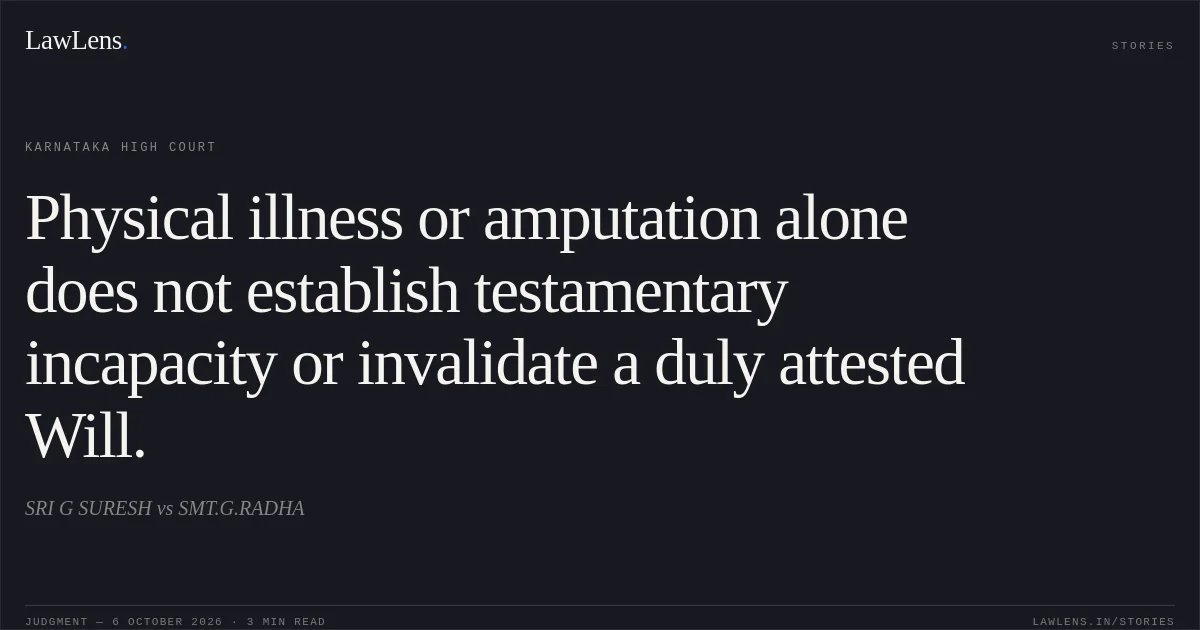
Source reference: pp. 31–35The medical records showed treatment for physical ailments, but no mental illness; the imaging reports described normal brain structures.
Source reference: pp. 36–38The records related principally to 2016, whereas the Will was executed in 2012, and the Court found no basis to infer incapacity at the time of execution.
Source reference: pp. 36–38It therefore held that the Will was duly proved and that the plaintiff was entitled to her 1/5 share plus her father’s bequeathed 1/5 share.
Source reference: p. 39Holding
The Court answered that the Will was proved and that the plaintiff was entitled to a total 2/5 share; it rejected the defendants’ contention that the parties were entitled only to 1/4 share each.
The appeal was dismissed, the Trial Court’s judgment and decree dated 29 July 2020 were confirmed, and no order as to costs was made.
Source reference: p. 40Acts & Sections Cited
5 provisions across 3 statutes referred to in this judgment. Each provision opens on LawLens.
Code of Civil Procedure, 19081
Indian Succession Act, 19253
Transfer of Property Act, 18821
Original Court PDF
SRI G SURESHvsSMT.G.RADHA
Click to open original judgment
Original judgment, available to read, download and summarize on LawLens.in