Facts
The appellant was convicted by the trial court under Sections 376(1) and 506 Part-II of the IPC for allegedly committing sexual intercourse with the prosecutrix on the false pretext of marriage between September and November 2006.
Source reference: para. 1-2The prosecutrix alleged she was threatened into silence and later stayed at the appellant's house before he fled.
Source reference: para. 2An FIR was lodged on 22.12.2006, nearly three months after the initial incident.
Source reference: para. 2The medical examination found the victim habitual to intercourse but noted no injuries or positive pregnancy results.
Source reference: para. 2, 14The appellant challenged the conviction, arguing the relationship was consensual and that the allegations were a retaliatory response to a complaint and legal notice he had filed against the victim prior to her FIR.
Source reference: para. 5, 16Issues
1. Whether the sexual relationship between the appellant and the prosecutrix was consensual or obtained through a misconception of fact regarding a promise to marry.
Source reference: para. 4, 102. Whether the prosecution proved the charges of rape and criminal intimidation beyond reasonable doubt in light of the delayed FIR and contradictory evidence.
Source reference: para. 13-17Law Applied
The Court applied Section 376 (Punishment for rape) and Section 506 (Punishment for criminal intimidation) of the Indian Penal Code.
Source reference: para. 1-2The court analyzed the legal distinction between a breach of promise to marry and a false promise made with the intent to deceive (misconception of fact) to obtain consent.
Source reference: para. 4, 17It also considered the evidentiary value of a prosecutrix’s testimony under Section 161 Cr.P.C. and the requirement for corroboration in cases involving significant delays in reporting.
Source reference: para. 2, 11, 14Reasoning
The Court found the prosecutrix’s testimony lacked credibility as she admitted the acts were voluntary, she did not resist, and she failed to raise an alarm despite being in a public area.
Source reference: para. 10Her claim of pregnancy was refuted by medical evidence, and her parents did not support her version of the events.
Source reference: para. 13-14Furthermore, the State failed to produce the chemical examination report for seized articles, creating an evidentiary gap.
Source reference: para. 15Crucially, the Court noted that the appellant had filed a formal complaint and issued a legal notice against the victim before she lodged the FIR, suggesting the criminal charges were made with an ulterior motive.
Source reference: para. 16The High Court determined that the trial court failed to scan the evidence properly and ignored materials favoring the defense.
Source reference: para. 16-17Holding
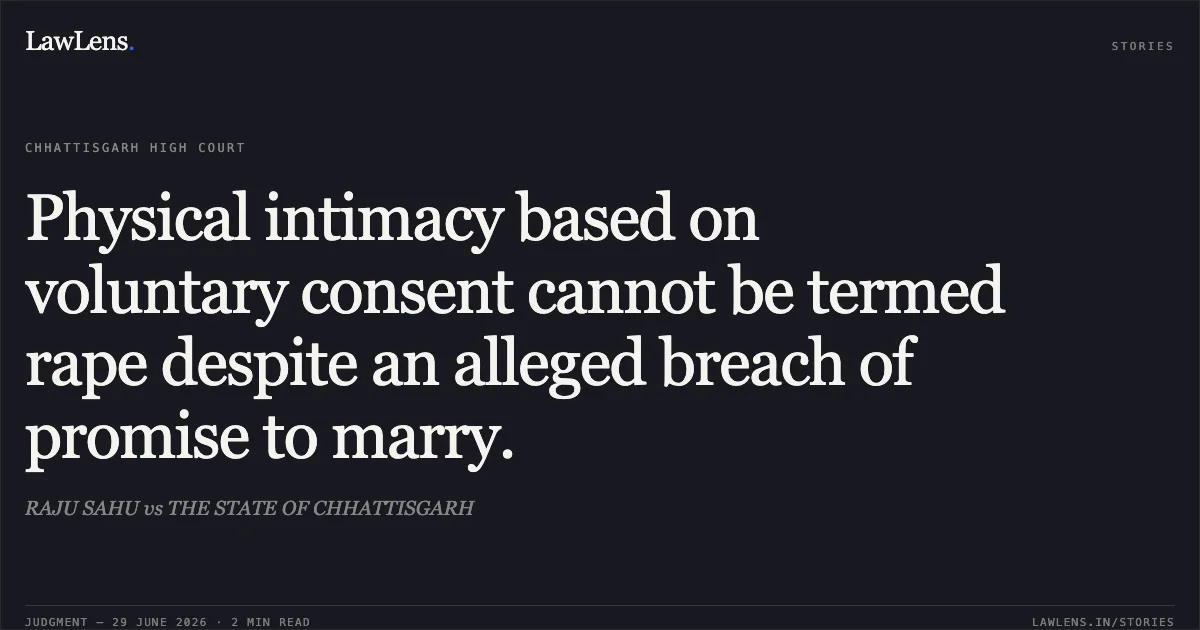
The Court held that the prosecution failed to provide cogent and reliable evidence to prove that consent was obtained through fraud or that the appellant used criminal intimidation.
The High Court allowed the appeal and set aside the judgment of conviction and sentence dated 23.04.2008. The appellant was acquitted of all charges.
Source reference: para. 18Acts & Sections Cited
5 provisions across 2 statutes referred to in this judgment. Each provision opens on LawLens.
Code of Criminal Procedure, 19733
Indian Penal Code, 18602
Original Court PDF
RAJU SAHUvsTHE STATE OF CHHATTISGARH
Click to open original judgment
Original judgment, available to read, download and summarize on LawLens.in


