Facts
The appellant and the victim were in a long-term relationship spanning from approximately 2008 to 2024
Source reference: pp. 1-2The victim alleged that the appellant cohabited with her and maintained physical relations on repeated occasions based on a promise of marriage
Source reference: p. 2The relationship allegedly soured when the appellant ultimately refused to marry the victim, citing caste differences
Source reference: p. 3The victim filed an FIR on 22.06.2024 for offences under Section 376(2)(n) of the IPC and Section 3(2)(v) of the SC ST (POA) Act
Source reference: p. 2Following a charge-sheet and the appellant's release on bail, the appellant filed a discharge application under Section 227 Cr.P.C.
Source reference: p. 3The 4th Additional Sessions Judge, Bhubaneswar, rejected the discharge application on 10.12.2025, leading to the present appeal
Source reference: p. 3Issues
1. Whether the trial court erred in rejecting the discharge application despite a significant delay in filing the FIR and the allegedly consensual nature of the relationship
Source reference: p. 6, p. 132. Whether there are sufficient prima facie materials on record to proceed with charges under Section 376(2)(n) of the IPC and Section 3(2)(v) of the SC ST (POA) Act
Source reference: p. 10, p. 12Law Applied
The Court applied the principles of Sections 227 and 228 of the Cr.P.C. regarding discharge and framing of charges
Source reference: p. 11It relied on Union of India v. Prafulla Kumar Samal, establishing that a judge must sift evidence only to determine if a prima facie case exists, rather than conducting a roving enquiry or trial
Source reference: pp. 11-12It further applied State of Orissa v. Debendra Nath Padhi, which mandates that at the stage of framing charges, the court must primarily consider prosecution materials and not the accused's defense
Source reference: p. 12Regarding "consent" versus "rape on promise of marriage," it referenced Pramod Suryabhan Pawar v. State of Maharashtra and Kunal Chatterjee v. State of West Bengal, distinguishing between a false promise made at inception and a subsequent breach of promise
Source reference: p. 5Reasoning
The Court observed that at the discharge stage, it cannot conduct a meticulous appreciation of evidence or resolve factual disputes such as whether the appellant knew the victim's caste or if the initial promise to marry was made in bad faith
Source reference: pp. 11, 13While the appellant argued the relationship was consensual and the 12-year delay indicated an afterthought, the Court noted the prosecution's materials suggest the victim remained in the relationship under the bona fide belief of marriage, which was only shattered when the appellant cited caste as a bar
Source reference: pp. 8, 13The Court reasoned that these contentions are matters of trial and cannot be adjudicated at a preliminary stage
Source reference: p. 13Since the FIR and statements under Sections 161 and 164 Cr.P.C. provide a prima facie basis for the allegations, the statutory threshold for "sufficient grounds for proceeding" was met
Source reference: p. 14Holding
The High Court dismissed the appeal and upheld the trial court's order dated 10.12.2025
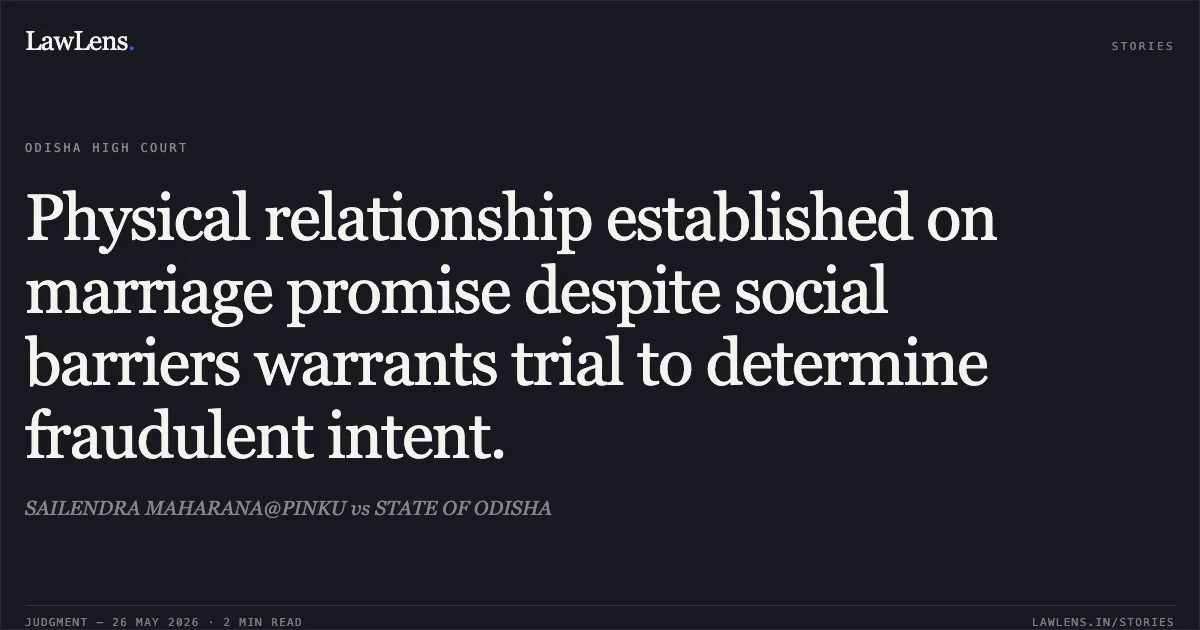
The Court held that the materials collected during the investigation disclose a prima facie case against the appellant, warranting a trial
Source reference: p. 14The Court clarified that the observations made in this judgment are limited to the disposal of the appeal and should not influence the trial court’s independent evaluation of evidence during the full trial
Source reference: p. 14Acts & Sections Cited
7 provisions across 3 statutes referred to in this judgment. Each provision opens on LawLens.
Code of Criminal Procedure, 19734
Indian Penal Code, 18602
Scheduled Castes and the Scheduled Tribes (Prevention of Atrocities) Act, 19891
Original Court PDF
SAILENDRA MAHARANA@PINKUvsSTATE OF ODISHA
Click to open original judgment
Original judgment, available to read, download and summarize on LawLens.in