Facts
The petitioner filed a Public Interest Litigation (PIL) under Article 226 of the Constitution, alleging that untreated sewage from residential colonies was being discharged into Lemehai Talab, a public water body in Raipur
Source reference: para. 1The petitioner sought directions for the cessation of sewage discharge, diversion of drainage, and restoration of the pond
Source reference: para. 2The respondent authorities, specifically Respondent No. 4, contended that the petition was not a genuine PIL but a result of personal grievance
Source reference: para. 7It was revealed that the petitioner had participated in a tender process for fishing rights in the same pond and was declared the L-1 bidder but failed to deposit the lease amount
Source reference: para. 7, 10This material fact was suppressed in the pleadings
Source reference: para. 9Issues
1. Whether the present writ petition constitutes a bona fide Public Interest Litigation or an abuse of the court's process to settle a private grievance
Source reference: para. 9-102. Whether a litigant who suppresses material facts regarding their personal commercial interest in the subject matter is entitled to relief under PIL jurisdiction
Source reference: para. 11-12Law Applied
The Court applied the fundamental principles governing Public Interest Litigation (PIL) as established by the Supreme Court of India. It relied on State of Uttaranchal v. Balwant Singh Chaufal (2010), Kalyaneshwari v. Union of India (2011), and Tehseen Poonawalla v. Union of India (2018), which mandate that frivolous or motivated petitions filed under the guise of public interest must be discouraged with exemplary costs
Source reference: para. 11Furthermore, it applied the doctrine from Dattaraj Nathuji Thaware v. State of Maharashtra (2005), requiring a PIL litigant to approach the court with "clean hands, clean heart and clean objective"
Source reference: para. 11The court also exercised its power under Article 226 to impose costs for the misuse of judicial time
Source reference: para. 12Reasoning
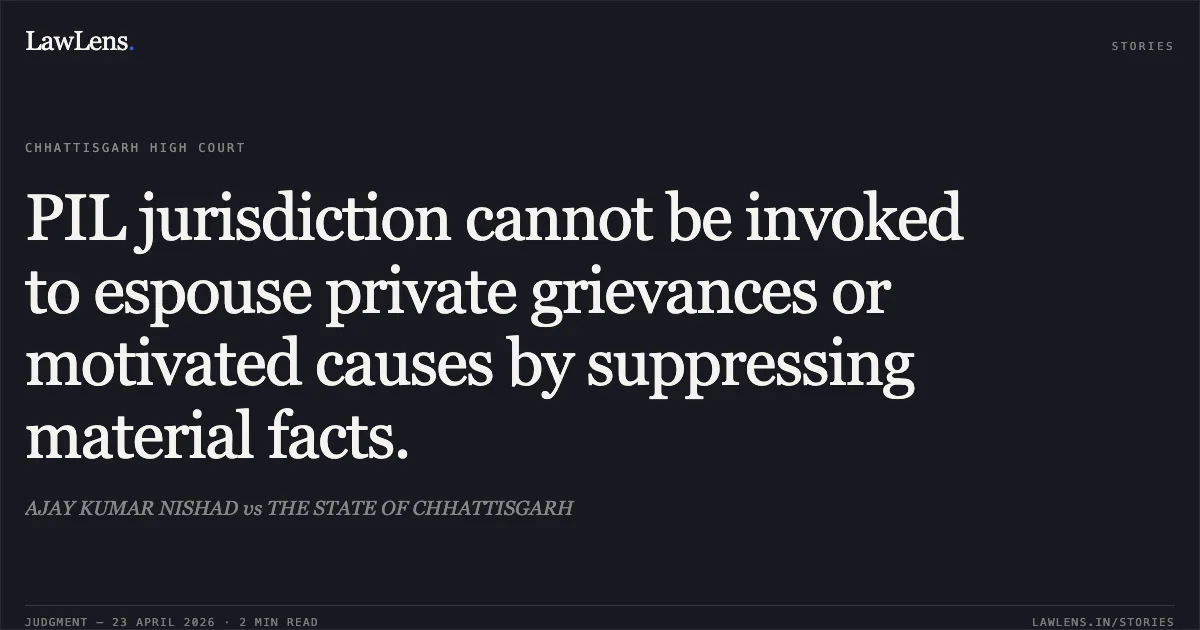
The Court found that while the petition was styled as a PIL concerning environmental degradation, it was "in substance" a private and motivated grievance
Source reference: para. 9The Court noted that the petitioner failed to disclose "with complete candour" his participation in the tender process for the very pond he claimed was being polluted
Source reference: para. 9By being the L-1 bidder for fishing rights, the petitioner had a direct "subsisting personal interest" in the matter
Source reference: para. 10The Court reasoned that invoking PIL jurisdiction to espouse a private cause while suppressing commercial failures (non-payment of lease amounts) constitutes an attempt to "misuse the process of the Court"
Source reference: para. 10, 12Consequently, the lack of bona fides and the wastage of "precious judicial time" necessitated a dismissal with punitive measures
Source reference: para. 12Holding
The Court dismissed the writ petition, holding that it was devoid of bona fide public interest and amounted to an abuse of process
The Court ordered the petitioner to pay exemplary costs of Rs. 50,000/- to be deposited in the Registry for the Government Home for Mentally Underdeveloped Children, Mana Camp, Raipur
Source reference: para. 12Additionally, the court ordered the forfeiture of the petitioner's security deposit of Rs. 15,000/-
Source reference: para. 13Original Court PDF
AJAY KUMAR NISHADvsTHE STATE OF CHHATTISGARH
Click to open original judgment
Original judgment, available to read, download and summarize on LawLens.in


