01Facts
The petitioner, a descendant of Baba Insaan Ali Luthra Sharif, alleged that immovable properties dedicated as waqf under a Waqf Deed dated 24 April 1929 were subsequently entered in the Auqaf Register as Waqf Property No. 40 on 3 June 1997.
¶ 4–5He claimed that portions of the waqf property had been encroached upon and illegally alienated through sale deeds, including transactions concerning several khasra numbers. The alleged alienations included transactions dating back to 1959 and 1966.
¶ 6–7, 9After submitting representations to the waqf authorities in 2021, including a representation dated 19 August 2021, the petitioner filed the present Writ Petition (PIL), seeking recovery of the waqf property, removal of unauthorised occupants, and directions for protective action.
¶ 8The State opposed maintainability, contending that the Waqf Tribunal constituted under Section 83 of the Waqf Act, 1995 was the appropriate forum and that the petition involved stale and disputed factual claims.
¶ 11–12The petitioner also had not deposited the requisite security amount for institution of the PIL.
¶ 2, 1802Issues
i.Whether a Writ Petition (PIL) seeking adjudication of alleged illegal alienations, encroachments, and recovery of specific waqf properties was maintainable when an efficacious statutory remedy was available before the Waqf Tribunal.
¶ 14–16ii.Whether the disputed and substantially delayed claims concerning sale transactions allegedly executed in 1959 and 1966 could be adjudicated in the Court’s extraordinary PIL jurisdiction.
¶ 17iii.Whether non-compliance with the requirement to deposit the requisite security amount constituted an additional ground for declining to entertain the PIL.
¶ 2, 18–1903Law Applied
The Court applied the Waqf Act, 1995. Section 51 renders unauthorised alienation of waqf property void; Section 52 provides for recovery of waqf property transferred in contravention of Section 51; Sections 54 and 55 provide mechanisms for removal of encroachments and enforcement of eviction orders; and Section 83 provides for adjudication of disputes and matters within the jurisdiction of Waqf Tribunals.
¶ 15The Court further applied the settled principle that writ jurisdiction, including PIL jurisdiction, ordinarily should not be invoked where an efficacious alternative statutory remedy exists, particularly where resolution of the dispute requires determination of disputed questions of fact.
¶ 16, 18–19It also treated failure to comply with the applicable security-deposit requirement as a ground for refusing to entertain the PIL.
¶ 16, 18–19Provisions in the judgment · 5
Waqf (Amendment) Act, 2025 Section 51Section 52Section 54Section 55Section 83
04Reasoning
The reliefs sought effectively required determination of the validity and legal effect of specific sale deeds, identification of the alleged waqf property, adjudication of encroachment claims, and recovery or eviction of occupants.
¶ 14These matters fell within the statutory framework of Sections 51, 52, 54, 55 and 83 of the Waqf Act and could appropriately be pursued before the Waqf Tribunal.
¶ 15The Court found no exceptional circumstance justifying exercise of extraordinary PIL jurisdiction merely because the property was claimed to be waqf property.
¶ 16The petitioner had also failed to satisfactorily explain the delay of several decades in challenging transactions allegedly executed in 1959 and 1966, and discrepancies existed between the khasra numbers stated in the petition and those in the 2021 representation.
¶ 17These disputed and stale factual issues were unsuitable for adjudication in PIL proceedings.
¶ 17Independently, the petitioner’s failure to deposit the requisite security amount constituted a further ground for declining admission of the petition.
¶ 1805Holding
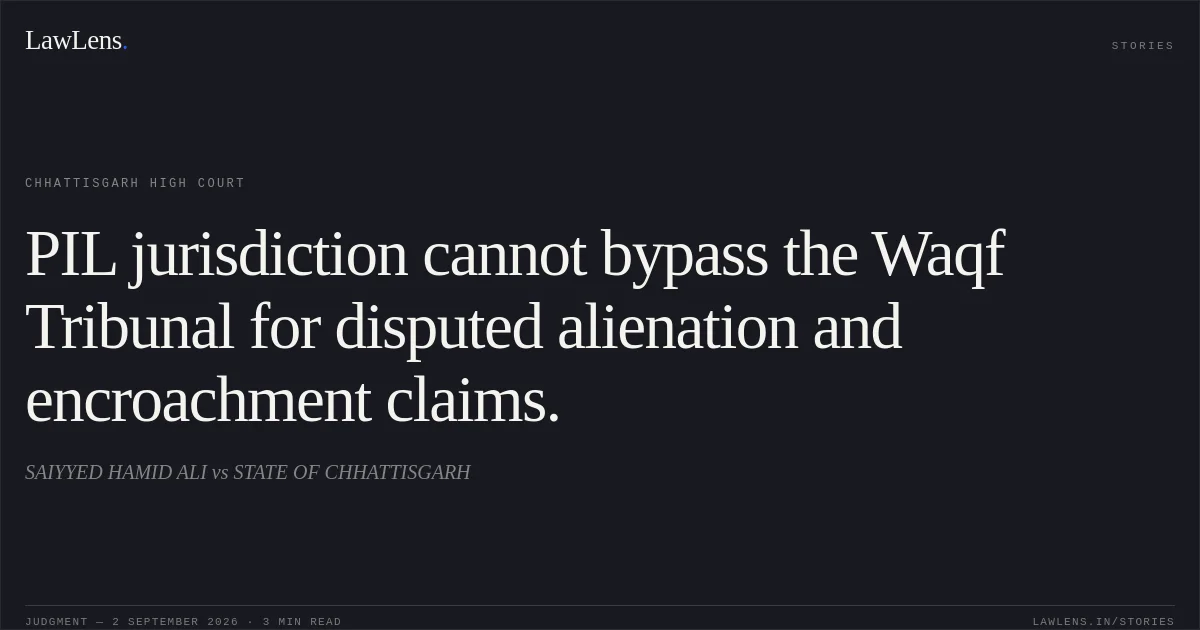
The Court held that the petition, although styled as a PIL, essentially concerned specific disputes relating to alleged illegal alienation and encroachment of waqf properties, for which an efficacious remedy was available before the competent Waqf Tribunal.
¶ 19The petition was dismissed both on the ground of availability of the alternative statutory remedy and on account of non-compliance with the security-deposit requirement.
¶ 19No order as to costs was made.
¶ 20Original Court PDF
SAIYYED HAMID ALIvsSTATE OF CHHATTISGARH
Click to open original judgment
Original judgment, available to read, download and summarize on LawLens.in