Facts
The appellant-claimant, Punuram Sahu, was a pillion rider on a motorcycle owned and driven by Respondent No. 1, which was involved in a road accident.
Source reference: para 6The claimant filed an application for compensation under Section 173 of the Motor Vehicles Act, 1988.
Source reference: para 1On 01.11.2019, the Motor Accident Claims Tribunal rejected the claim.
Source reference: para 1The appellant challenged this rejection, contending that the incident was a case of "composite negligence" rather than "contributory negligence," entitling him to seek full compensation from any of the joint tortfeasors.
Source reference: para 2Issues
1. Whether the accident involving a pillion rider and two vehicles constitutes "composite negligence" or "contributory negligence"
Source reference: para 62. Whether a claimant in a case of composite negligence has the legal right to claim the entire compensation from the owner, driver, or insurer of only one of the involved vehicles
Source reference: para 6Law Applied
Section 173 of the Motor Vehicles Act, 1988
Source reference: para 1legal distinction between "composite negligence" and "contributory negligence" as established by the Supreme Court in T.O. Anthony v. Karvarnan and others (2008) 3 SCC 748
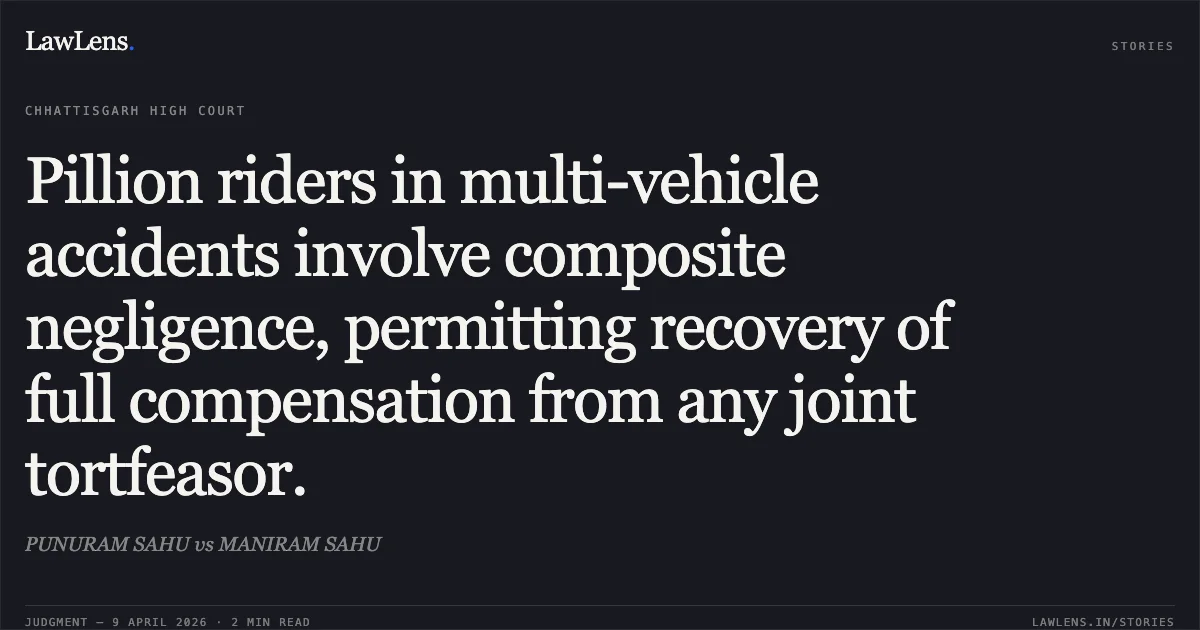
Source reference: para 5composite negligence occurs when two or more persons’ negligence causes injury to a third party, making each wrongdoer jointly and severally liable for the entire damages
Source reference: para 5contributory negligence occurs when the claimant’s own negligence contributes to the accident, leading to a proportional reduction in recoverable damages
Source reference: para 5Reasoning
The Court observed that the appellant was a pillion rider and not the driver of the vehicle, meaning he did not contribute to the accident through his own negligence.
Source reference: para 6Applying the principles from T.O. Anthony, the Court determined this to be a classic case of composite negligence.
Source reference: para 6The Court reasoned that in such instances, the injured party is not required to establish the extent of responsibility for each wrongdoer and holds the "choice of proceeding against all or any of them"
Source reference: para 5Consequently, the Tribunal’s rejection of the claim was deemed "absolutely unjustified" because the claimant exercised his valid legal option to seek the full compensation amount from the insurer, owner, and driver of the specific motorcycle identified in the claim.
Source reference: para 6Holding
The High Court set aside the impugned order dated 01.11.2019.
It held that the respondents (owner, driver, and insurer of the motorcycle) are liable to pay the entire compensation as assessed by law.
Source reference: para 6The matter was remitted to the Claims Tribunal for the assessment of compensation, with a direction to conclude the proceedings within three months from the date of receipt of the order.
Source reference: para 7The appeal was allowed.
Source reference: para 8Acts & Sections Cited
1 provisions across 1 statute referred to in this judgment. Each provision opens on LawLens.
Motor Vehicles Act, 19881
Original Court PDF
PUNURAM SAHUvsMANIRAM SAHU
Click to open original judgment
Original judgment, available to read, download and summarize on LawLens.in


