Facts
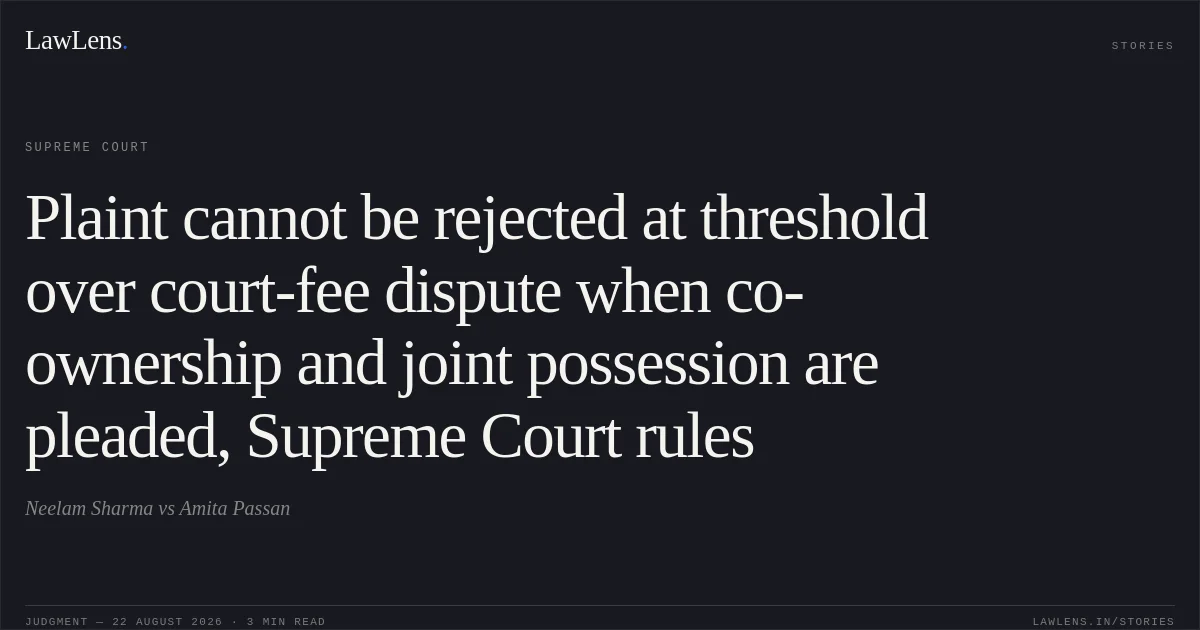
The appellants, original plaintiffs, instituted a suit seeking a declaration that they and the defendants were co-owners of House No. 417, Ground Floor, Sector 11, Panchkula, with each claiming a one-fourth share; a declaration that the transfer of the property in favour of defendant No. 1 was fraudulent, null and void; separate possession of their respective shares; and permanent injunction.
Source reference: pp. 2–3The plaintiffs pleaded that the property was inherited family property, that they were co-owners in joint possession, and that the transfer had been procured through fraud and forged documents.
Source reference: pp. 3–4, 7–8Defendant No. 2 applied under Order VII Rule 11, CPC, contending that, since the plaintiffs sought possession and were not in possession, the plaint was insufficiently stamped and required ad valorem court fee on the market value of the property.
Source reference: pp. 3–4The Trial Court rejected the application, holding that the plaint disclosed joint possession and that the plaintiffs, being non-executants of the impugned transfer, were not required to pay ad valorem court fee at the threshold.
Source reference: pp. 4–5The High Court allowed the defendant’s revision, directed payment of ad valorem court fee within two weeks, and ordered that the plaint would stand rejected upon default.
Source reference: pp. 5–6Issues
Whether the plaint was liable to be rejected under Order VII Rule 11, CPC, on the ground that the plaintiffs had not paid ad valorem court fee for seeking declaratory and possession-related reliefs.
Source reference: pp. 2–4, 9–12Whether, on the averments in the plaint, the plaintiffs were to be treated as being in joint possession of the suit property for determining the court-fee payable.
Source reference: pp. 8–10Whether the question of payment of fixed or ad valorem court fee could be conclusively determined at the stage of considering an application under Order VII Rule 11, CPC, or required adjudication on the basis of evidence.
Source reference: pp. 11–12Law Applied
The Court applied Order VII Rule 11, CPC, under which rejection of a plaint must be considered on the basis of the plaint averments alone, without relying on the defendant’s written statement or disputed factual assertions.
Source reference: p. 9The Court applied the Court Fees Act, 1870, particularly Section 7(iv)(c) and Article 17(iii) of the Second Schedule, as applicable in Punjab and Haryana.
Source reference: pp. 9–11Under the principles laid down in Suhrid Singh alias Sardool Singh v. Randhir Singh, (2010) 12 SCC 112, an executant seeking cancellation of a deed must pay ad valorem court fee, whereas a non-executant seeking a declaration that the deed is void, illegal or not binding is liable only to fixed court fee if in possession; however, a non-executant who is not in possession and seeks consequential possession must pay ad valorem court fee.
Source reference: pp. 9–11The Court further held that where the relevant facts concerning possession and the nature of the impugned transaction are disputed, the question of the proper court fee may be decided after evidence is led.
Source reference: pp. 11–12Reasoning
The Supreme Court examined the plaint as a whole, rather than isolating the prayer for separate possession.
Source reference: pp. 8–9Paragraph 4 of the plaint expressly stated that the plaintiffs and defendants had resided in the property together and had jointly invested in its repair and extension, thereby constituting a clear plea of joint possession.
Source reference: pp. 8–9The plaintiffs were also non-executants of the allegedly fraudulent transfer and sought a declaration that it was not binding upon them.
Source reference: pp. 9–11Applying Suhrid Singh, the Court held that the High Court had incorrectly treated the mere prayer for separate possession as conclusive proof that the plaintiffs were out of possession.
Source reference: pp. 9–11Since the plaint pleaded joint possession, and since the ultimate determination of possession and the legal effect of the alleged transfer depended on evidence, there was no apparent defect warranting rejection under Order VII Rule 11, CPC.
Source reference: pp. 11–12Holding
The appeal was allowed.
The Supreme Court set aside the High Court’s order dated 19.05.2025 and upheld the Trial Court’s refusal to reject the plaint under Order VII Rule 11, CPC.
Source reference: p. 12However, the Court modified the Trial Court’s order by directing that the question whether fixed or ad valorem court fee was payable would be considered and decided after, and on the basis of, the evidence led in the suit.
Source reference: pp. 11–12Acts & Sections Cited
1 provisions across 1 statute referred to in this judgment. Linked provisions open on LawLens.
Court Fees Act, 18701
Original Court PDF
Neelam SharmavsAmita Passan
Click to open original judgment
Original judgment, available to read, download and summarize on LawLens.in