Facts
The Appellant, a real estate developer, purchased land in Chennai and constructed a commercial IT building
Source reference: para. 3The property was mortgaged to Standard Chartered Bank to secure loans, but the account was later classified as a Non-Performing Asset (NPA)
Source reference: paras. 4-5To settle dues, the Appellant negotiated with the Respondents to sell the property through a structured commercial arrangement
Source reference: para. 6A Memorandum of Agreement (MoA) was drafted by the Respondents’ counsel, providing for a total transaction value of approximately ₹105 crores, including the discharge of bank liabilities and a balance payment of ₹53 crores linked to property leasing
Source reference: paras. 7, 20While the Appellant signed the MoA, the Respondents did not, though they proceeded to pay the bank and obtained eight registered sale deeds in favor of their nominees
Source reference: paras. 7-8In 2024, the Appellant filed a suit for mandatory injunction to enforce the MoA/payment of balance or, alternatively, reconveyance of the property
Source reference: para. 9The Respondents filed an application under Order VII Rule 11 of the CPC for rejection of the plaint, citing lack of cause of action and undervaluation
Source reference: para. 10The Trial Court dismissed the application, but the High Court reversed this on revision, holding the MoA was not a concluded contract and the suit was undervalued
Source reference: paras. 11-12Issues
1. Whether the plaint disclosed a legally sustainable cause of action under Order VII Rule 11(a) of the CPC given that the MoA was not signed by the Respondents.
Source reference: para. 12 / para. 182. Whether a plaint can be summarily rejected for undervaluation and insufficient court fees under Order VII Rule 11(b) and (c) without first affording the plaintiff an opportunity to cure the defect.
Source reference: para. 33Law Applied
The Court primarily applied Order VII Rule 11 of the Code of Civil Procedure (CPC), which mandates the rejection of a plaint if it fails to disclose a cause of action or if the plaintiff fails to correct undervaluation/stamp duty within a court-fixed time
Source reference: para. 17It relied on Dahiben v. Arvindbhai Kalyanji Bhanusali, emphasizing that averments in the plaint must be taken as true and read as a whole alongside relied-upon documents
Source reference: para. 18(ii)The Court further applied the principle from T. Arivandandam v. T.V. Satyapal to distinguish between "real" and "merely illusory" causes of action
Source reference: para. 18(v)the statutory safeguard in the Proviso to Order VII Rule 11, which requires the Court to grant time to rectify valuation defects before rejection
Source reference: para. 33Reasoning
The Supreme Court observed that the High Court erred by conducting a "mini-trial" at the threshold stage
Source reference: para. 28Analyzing the WhatsApp communications and the draft MoA, the Court found the Appellant had pleaded a "composite commercial arrangement" where the execution of sale deeds was inextricably linked to post-sale obligations and balance payments
Source reference: paras. 23-24The Court held that the question of whether the unsigned MoA constituted a concluded contract was a triable issue of fact that could not be determined summarily
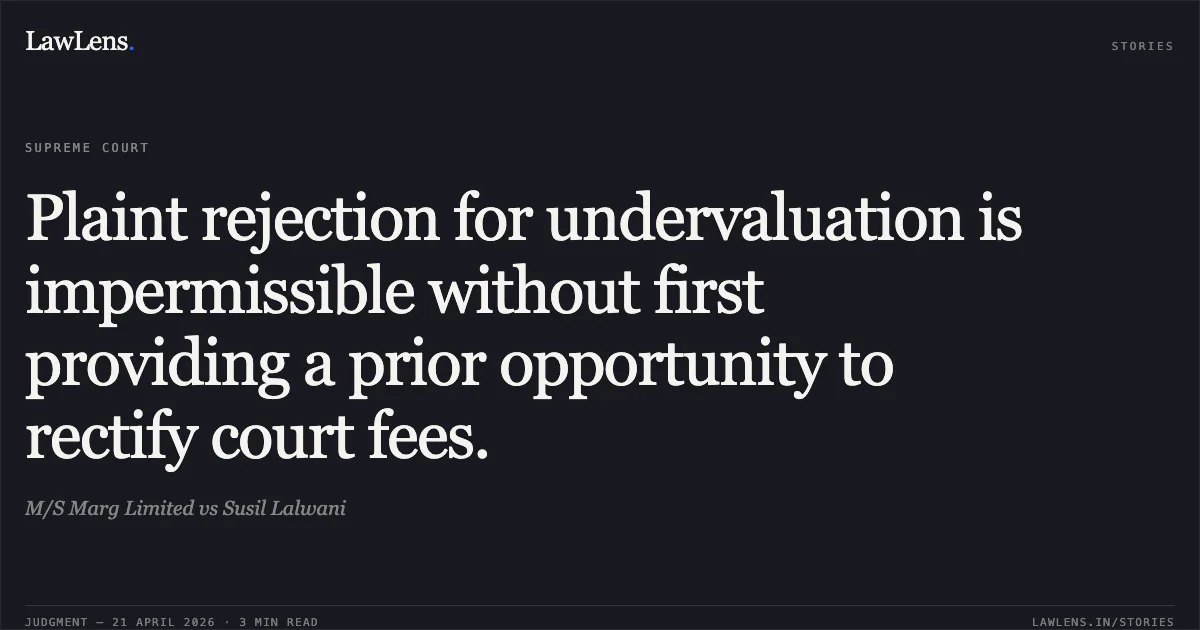
Source reference: para. 27Regarding court fees, the Court noted that under Order VII Rule 11(b) and (c), rejection is a "two-step process"
Source reference: para. 33The Court must first determine the correct valuation and fix a deadline for payment; rejection is only permissible if the plaintiff fails to comply with that specific direction
Source reference: paras. 34-35The High Court’s outright rejection without granting this mandatory opportunity was held to be a manifest error of law
Source reference: para. 35Holding
The Supreme Court allowed the appeal and quashed the High Court’s order
It held that the plaint disclosed a valid cause of action as it pleaded a sequence of material facts and partial performance of a commercial arrangement
Source reference: paras. 26, 29The Court directed the Trial Court to afford the Appellant an opportunity to correct the suit valuation and pay the requisite ad valorem court fees within a fixed time limit
Source reference: para. 36The suit was restored for adjudication on merits
Source reference: para. 37Acts & Sections Cited
2 provisions across 2 statutes referred to in this judgment. Each provision opens on LawLens.
Code of Civil Procedure, 19081
Securitisation and Reconstruction of Financial Assets and Enforcement of Security Interest Act, 20021
Original Court PDF
M/S Marg LimitedvsSusil Lalwani
Click to open original judgment
Original judgment, available to read, download and summarize on LawLens.in