Facts
The Appellant claims title to the suit property via a 1988 sale deed
Source reference: p. 2The dispute arose when a sale deed dated 30.09.1995 was purportedly executed in favor of Respondent No. 1 by impersonators
Source reference: p. 2Discovering this, the Appellant filed Complaint Case No. 134(C)/2001
Source reference: p. 3Subsequently, the property was transferred via multiple deeds in 2010, 2011, and 2017
Source reference: p. 3In 2018, the Appellant filed Title Suit No. 169 of 2018 for a declaration that the 1995 deed and subsequent transactions were forged and void
Source reference: p. 4-5Respondent No. 4 filed an application under Order VII Rule 11(d) of the CPC, arguing the suit was barred by limitation
Source reference: p. 5The Trial Court rejected the plaint, holding that the Appellant had knowledge of the 1995 deed since 2001
Source reference: p. 8Issues
1. Whether the suit was barred by limitation under Article 59 of the Limitation Act, 1963, warranting rejection of the plaint under Order VII Rule 11(d) of the CPC
Source reference: p. 16/para 152. Whether the challenge to subsequent sale deeds (specifically the 2017 deed) could survive if the challenge to the root deed (1995) was barred by limitation
Source reference: p. 14, 28Law Applied
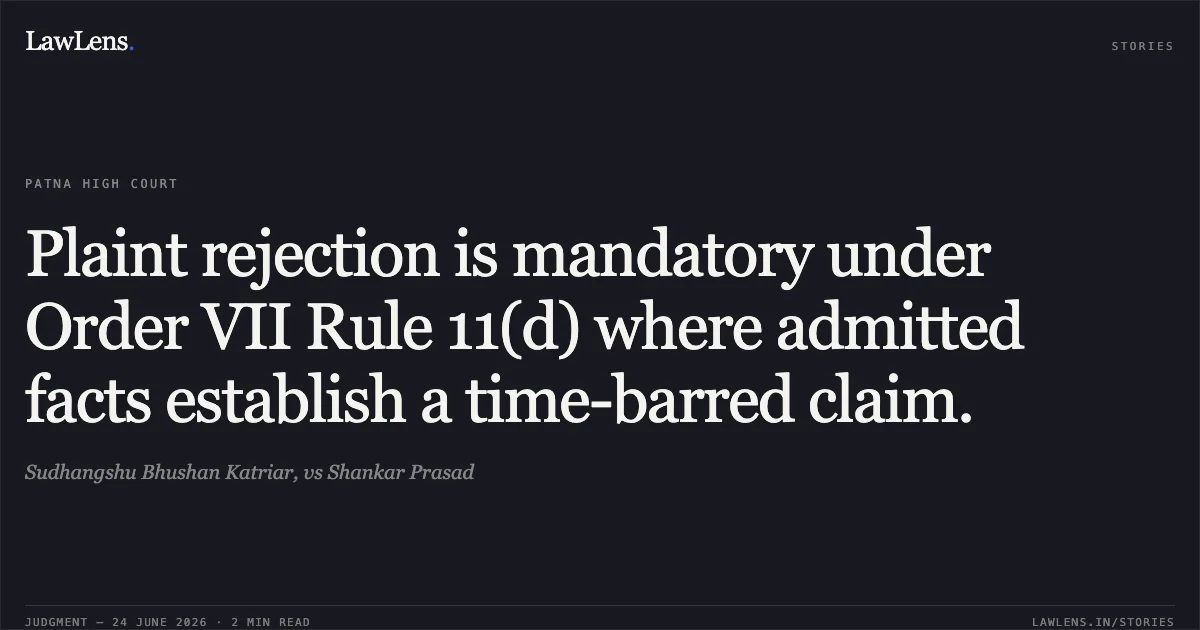
The Court applied Order VII Rule 11(d) of the CPC, which mandates the rejection of a plaint that appears barred by law from its own statements
Source reference: p. 17It relied on Article 59 of the Limitation Act, 1963, prescribing a three-year period to cancel an instrument from the date the facts become known
Source reference: p. 19-20The Court cited Dahiben v. Arvindbhai Kalyanji Bhanusali (2020) regarding the duty to scrutinize documents foundational to the plaint
Source reference: p. 22T. Arivandandam v. T.V. Satyapal (1977) against clever drafting to circumvent limitation
Source reference: p. 14Santosh Devi v. Sunder (2025) on the requirement to plead specific grounds for exemption under Order VII Rule 6
Source reference: p. 21Reasoning
The Court observed that while the Appellant claimed discovery of fraud in 2018, paragraphs 6 and 17 of the plaint admitted the filing of a criminal complaint in 2001 regarding the same 1995 sale deed
Source reference: p. 25This established "actual knowledge" of the alleged fraud at least by 2001, triggering the three-year limitation under Article 59 which expired around 2004
Source reference: p. 25The Court rejected the "mixed question of law and fact" argument, noting that when the bar is apparent from the plaintiff's own admissions in the plaint, no trial is required
Source reference: p. 27It further reasoned that the 1995 deed was the "root deed"; because the challenge to this foundational document was time-barred, all subsequent derivative transactions (including the 2017 deed) could not be independently challenged as their validity depended on the root deed
Source reference: p. 28The Appellant also failed to plead any specific grounds for exemption from limitation as required by Order VII Rule 6
Source reference: p. 27Holding
The Court dismissed the appeal and upheld the Trial Court's order rejecting the plaint
It held that the suit was ex-facie barred by limitation as the Appellant had knowledge of the grounds for cancellation seventeen years prior to filing the suit
Source reference: p. 25, 29The Court affirmed that failure to challenge the root deed within the limitation period renders the entire chain of transactions non-justiciable
Source reference: p. 29No costs were awarded
Source reference: p. 30Acts & Sections Cited
19 provisions across 1 statute referred to in this judgment. Each provision opens on LawLens.
Original Court PDF
Sudhangshu Bhushan Katriar,vsShankar Prasad
Click to open original judgment
Original judgment, available to read, download and summarize on LawLens.in


