Facts
The respondent/plaintiff filed a civil suit (No. 68A/2024) seeking a declaration of her status as the daughter of Late Shri Jagdish Sharanlal Sinha and claiming an equal share in parental properties
Source reference: para. 4.1During the pendency of the suit and an application for temporary injunction, the defendant-petitioners sold portions of the suit property to subsequent purchasers via a registered sale deed dated 25.11.2024
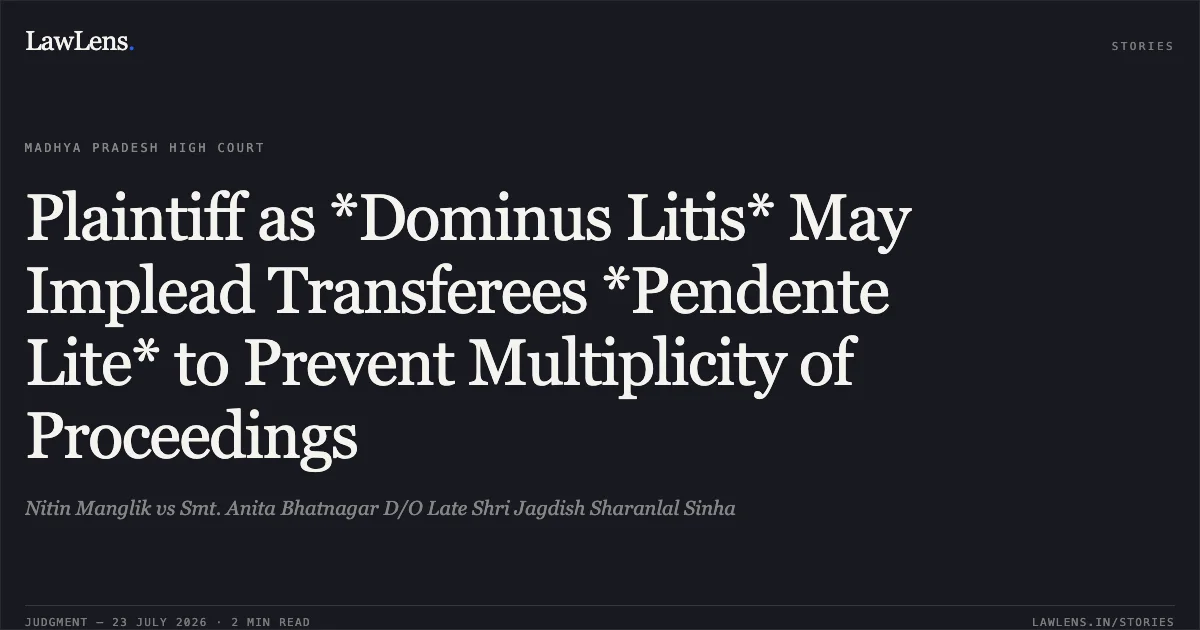
Source reference: paras. 4.2, 7The plaintiff moved an application under Order 1 Rule 10 of the CPC to implead these subsequent purchasers to avoid multiplicity of proceedings
Source reference: para. 4.2The trial court allowed the impleadment on 13.05.2025 and subsequently rejected a review application filed by the purchasers on 20.04.2026
Source reference: paras. 2, 3The petitioners challenged these orders via miscellaneous petitions under Article 227 of the Constitution.
Source reference: no citationIssues
1. Whether subsequent purchasers (transferees pendente lite) are necessary or proper parties to be impleaded under Order 1 Rule 10 CPC when the plaintiff is the dominus litis
Source reference: para. 5, 112. Whether the trial court lost jurisdiction to decide the impleadment application because the sale deed value exceeded the court's pecuniary jurisdiction limit
Source reference: para. 6, 19Law Applied
The court applied Order 1 Rule 10 of the CPC, which grants discretionary power to the court to add parties necessary for effective adjudication and to avoid multiplicity of proceedings
Source reference: para. 10, 16It relied on Robin Ramjibhai Patel v. Anandibai Rama regarding the plaintiff’s status as dominus litis
Source reference: para. 11Yogesh Goyanka v. Govind, which clarifies that while Section 52 of the Transfer of Property Act renders pendente lite transfers subservient to the litigation, it does not bar the impleadment of such purchasers to protect their interests or prevent collusion
Source reference: para. 12The court further cited H. Anjanappa v. A. Prabhakar, establishing that a transferee pendente lite can be impleaded at the instance of any party to the suit depending on the facts
Source reference: para. 14Reasoning
The court reasoned that since the defendants alienated the property despite being aware of the pending litigation and the temporary injunction application, the purchasers (defendants No. 5 and 6) were proper parties
Source reference: para. 9, 13The Court emphasized that the plaintiff is the dominus litis and has the right to implead parties she believes may be adversely affected by the outcome
Source reference: para. 11Regarding the jurisdictional challenge, the Court held that the trial court's jurisdiction is determined by the reliefs claimed at the time of filing; the mere fact that a subsequent sale deed was valued above Rs. 1 Crore does not strip the Civil Judge of the power to decide an impleadment application, especially while an amendment application questioning that sale deed remains pending
Source reference: para. 19The court found the trial court’s exercise of discretion to be just and aimed at settling all questions involved in the suit completely
Source reference: para. 17, 20Holding
The High Court dismissed the miscellaneous petitions, upholding the trial court's orders dated 13.05.2025 and 20.04.2026
The Court held that there is no bar to impleading transferees pendente lite at the initial stage of a suit to avoid multiplicity of proceedings, even if Section 52 of the Transfer of Property Act applies
Source reference: para. 12, 18The court found no jurisdictional error or palpable illegality warranting interference under Article 227
Source reference: para. 18, 19Acts & Sections Cited
1 provisions across 1 statute referred to in this judgment. Each provision opens on LawLens.
Transfer of Property Act, 18821
Original Court PDF
Nitin ManglikvsSmt. Anita Bhatnagar D/O Late Shri Jagdish Sharanlal Sinha
Click to open original judgment
Original judgment, available to read, download and summarize on LawLens.in