Facts
The Plaintiff/Appellant filed a civil suit for declaration of title, permanent injunction, and recovery of possession regarding land in Village Semra
Source reference: para 2The Plaintiff alleged the suit property was ancestral joint family property and that Defendants 1 and 2 had fraudulently recorded their names in revenue records without valid transfer
Source reference: para 3(a)-(b)The Defendants contended they purchased the land 45 years prior from the Plaintiff’s family members and, alternatively, had perfected title via adverse possession
Source reference: para 4(A)-(B)The Trial Court dismissed the suit, holding the Plaintiff failed to prove title via documentary evidence, and the First Appellate Court upheld this dismissal
Source reference: para 6The Plaintiff subsequently filed this Second Appeal before the High Court of Chhattisgarh
Source reference: para 1Issues
1. Whether the lower courts erred in placing the burden of proof on the Plaintiff despite an alleged admission by the Defendants regarding the nature of the property
Source reference: para 7, 102. Whether the rejection of an application for additional evidence under Order 41 Rule 27 CPC was legally sustainable
Source reference: para 133. Whether the appeal involves any substantial question of law as required under Section 100 of the CPC
Source reference: para 15, 19Law Applied
Section 100 of the Code of Civil Procedure (CPC), which limits the scope of a Second Appeal strictly to "substantial questions of law"
Source reference: para 1, 16The principle that the plaintiff in a declaratory suit must succeed on the strength of their own title and cannot rely on the weaknesses of the defendant's case
Source reference: para 11State of Rajasthan v. Shiv Dayal (2019) regarding the limited grounds for interfering with concurrent findings of fact
Source reference: para 21Russi Fisheries Pvt. Ltd. v. Bhavna Seth (2026) to reiterate that even erroneous findings of fact do not justify interference in a second appeal unless vitiated by perversity
Source reference: para 22Reasoning
The Court observed that the Plaintiff failed to produce cogent documentary evidence, such as revenue records or title deeds, to substantiate the claim of ancestral ownership
Source reference: para 9The Court rejected the argument regarding the Defendants' admission, noting the admission was merely that the land was part of a larger survey number, not a concession of the Plaintiff's title
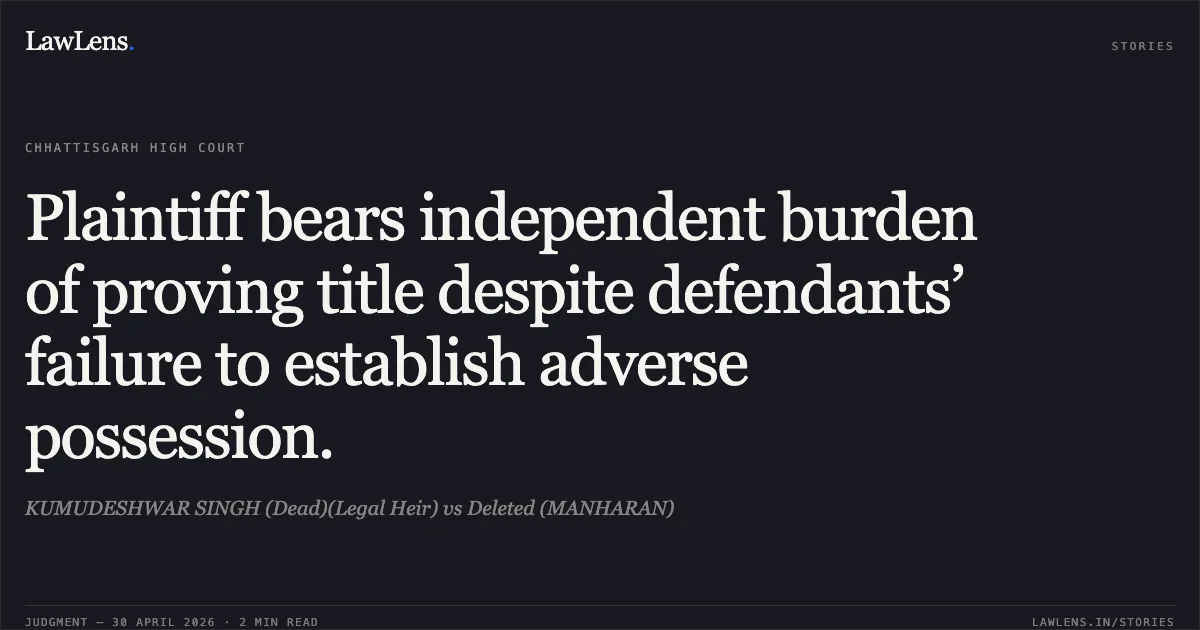
Source reference: para 10Regarding the burden of proof, the Court held that the failure of the Defendants to prove their plea of purchase or adverse possession did not automatically entitle the Plaintiff to a decree
Source reference: para 11-12Furthermore, the rejection of the Order 41 Rule 27 application was upheld because the Plaintiff failed to show "due diligence" or sufficient cause for not producing the documents during the trial
Source reference: para 13-14The Court concluded that the findings were concurrent findings of fact based on evidence and lacked any perversity or misapplication of law
Source reference: para 15, 18Holding
The High Court dismissed the appeal at the motion stage, holding that no substantial question of law arose for consideration
The Court affirmed that concurrent findings of fact by the lower courts are binding unless shown to be perverse or contrary to law, which the Appellant failed to demonstrate. The judgments and decrees of the Trial Court and the First Appellate Court were upheld
Source reference: para 17-18, 23Acts & Sections Cited
3 provisions across 1 statute referred to in this judgment. Each provision opens on LawLens.
Code of Civil Procedure, 19083
Original Court PDF
KUMUDESHWAR SINGH (Dead)(Legal Heir)vsDeleted (MANHARAN)
Click to open original judgment
Original judgment, available to read, download and summarize on LawLens.in