Facts
The petitioners, who were plaintiffs in Regular Civil Suit No. 170 of 2024 before the Principal Senior Civil Judge, Olpad, challenged the order dated 29 June 2026 passed below Exh. 27.
Source reference: paras. 2–5; pp. 1–3The plaintiffs sought deletion of Issue No. 4, contending that the burden of proving limitation had already been placed upon the defendants through Issue No. 3 and could not also be imposed upon the plaintiffs.
Source reference: paras. 2–5; pp. 1–3In the plaint, the plaintiffs had specifically pleaded that the partition suit was within limitation on the ground that the right to partition was continuous; the defendants disputed that assertion in their written statement.
Source reference: paras. 2–5; pp. 1–3The Trial Court therefore framed separate issues concerning whether the suit was barred by limitation and whether it was within limitation, and rejected the application for deletion of Issue No. 4.
Source reference: paras. 2–5; pp. 1–3Issues
1. Whether the Trial Court erred in refusing to strike out Issue No. 4, which required the plaintiffs to prove that the suit was filed within limitation, when Issue No. 3 already placed the burden on the defendants to prove that the suit was barred by limitation?
Source reference: paras. 3–5; pp. 2–32. Whether the Trial Court’s order warranted interference under Article 227 of the Constitution of India?
Source reference: paras. 6–9; pp. 3–4Law Applied
The Court applied Section 3 of the Limitation Act, 1963, under which the Court is required to examine limitation independently, irrespective of whether the defendant raises a limitation defence.
Source reference: para. 7; p. 3It further applied the principles governing supervisory jurisdiction under Article 227 of the Constitution, namely that interference is justified only where the subordinate court’s order is perverse, grossly erroneous, legally unsustainable, or affected by serious irregularity; a mere error of law is insufficient.
Source reference: paras. 6, 8–9; pp. 3–4In this regard, the Court relied on Sameer Suresh Gupta Through PA Holder v. Rahul Kumar Agarwal, 2023 (9) SCC 374, and M/s Garment Craft v. Prakash Chand Goel, 2022 (4) SCC 181.
Source reference: paras. 6, 8–9; pp. 3–4Reasoning
The Court noted that the plaintiffs themselves had pleaded, under the heading “limitation,” why the suit was within time, relying on the alleged continuous nature of the right to partition.
Source reference: paras. 4–6; pp. 2–3Since the defendants specifically denied that plea, the question of limitation became a disputed factual and legal issue requiring adjudication.
Source reference: paras. 4–6; pp. 2–3The Court held that framing one issue placing the burden on the defendants to establish that the suit was time-barred did not preclude framing another issue requiring the plaintiffs to establish the affirmative case pleaded by them—that the suit was within limitation.
Source reference: paras. 4–6; pp. 2–3Additionally, Section 3 of the Limitation Act independently obliged the Trial Court to examine limitation.
Source reference: para. 7; p. 3The impugned order was therefore neither perverse nor grossly erroneous, and no ground for supervisory interference under Article 227 was established.
Source reference: paras. 7–9; pp. 3–4Holding
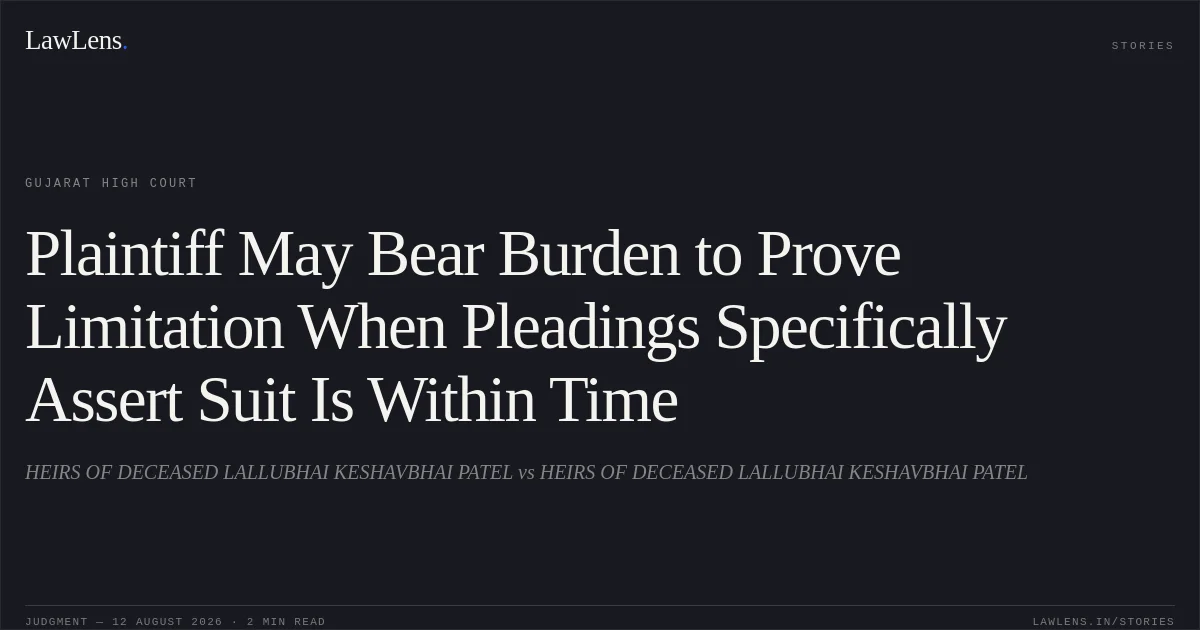
The High Court held that the Trial Court was justified in retaining Issue No. 4 and in requiring the plaintiffs to prove their pleaded case that the suit was within limitation.
The petition under Article 227 was dismissed for lack of merit, and the order dated 29 June 2026 below Exh. 27 in Regular Civil Suit No. 170 of 2024 was not interfered with.
Source reference: para. 10; p. 4No order as to costs was made.
Source reference: para. 10; p. 4Acts & Sections Cited
1 provisions across 1 statute referred to in this judgment. Each provision opens on LawLens.
Limitation Act, 19631
Original Court PDF
HEIRS OF DECEASED LALLUBHAI KESHAVBHAI PATELvsHEIRS OF DECEASED LALLUBHAI KESHAVBHAI PATEL
Click to open original judgment
Original judgment, available to read, download and summarize on LawLens.in