Facts
The plaintiffs claimed title and possession over portions of C.S. Plot Nos. 476 and 477 at Mauza Damodarpur.
Source reference: paras. 4, 15Their case was that Plot No. 476 belonged to Lalji Purbey, whose widow, Reshma Purbain, executed a registered Will dated 14 August 1948 in favour of her grandsons; after the subsequent devolution of the property, Jageshwar Mandal executed three registered sale deeds dated 7 January 1987 in favour of the plaintiffs.
Source reference: paras. 4, 15Plot No. 477 was claimed through a registered sale deed dated 21 April 1917 in favour of Dayanand Mandal.
Source reference: paras. 4, 15Defendant No. 1 denied the plaintiffs’ title and claimed title through Ram Lal Purbey and a registered sale deed dated 10 April 1924, besides subsequent conveyances, revenue records and long possession.
Source reference: para. 5The Trial Court decreed the suit for declaration of title, confirmation of possession and permanent injunction in favour of the plaintiffs on 12 December 2008, with the decree drawn on 23 December 2008.
Source reference: paras. 2, 12Defendant No. 1 preferred the present first appeal under Section 96 CPC and also sought permission to adduce additional evidence under Order XLI Rule 27 CPC.
Source reference: para. 13Issues
Whether the plaintiffs established their right, title and possession over C.S. Plot Nos. 476 and 477 through Lalji Purbey, the registered Will dated 14 August 1948, probate proceedings and the registered sale deeds dated 7 January 1987?
Source reference: para. 16(i)Whether the Trial Court correctly appreciated the evidence concerning the registered sale deed dated 10 April 1924 and the rival claims over Plots Nos. 476 and 477, and whether its findings suffered from perversity, illegality or misappreciation of evidence?
Source reference: para. 16(ii)Whether the appellants satisfied the requirements for reception of additional evidence under Order XLI Rule 27 CPC?
Source reference: para. 16(iii)Law Applied
The Court applied Section 96 CPC, recognising that a first appellate court may independently reconsider questions of fact and law, while ordinarily respecting findings based on properly appreciated oral evidence.
Source reference: paras. 17–19In a suit for declaration of title, the plaintiff bears the burden of establishing an independent and clear title; the weakness of the defendant’s case cannot itself justify relief, as stated in Union of India v. Vasavi Co-operative Housing Society Ltd., (2014) 2 SCC 269.
Source reference: para. 23Clear admissions in pleadings are binding and may constitute a waiver of proof under Section 58 of the Evidence Act, as explained in Nagindas Ramdas v. Dalpatram Ichharam, (1974) 1 SCC 242.
Source reference: para. 25A registered document carries a prima facie presumption of valid execution until rebutted, following Prem Singh v. Birbal, (2006) 5 SCC 353.
Source reference: para. 29Revenue entries are relevant for fiscal purposes but neither create nor extinguish title, following Guru Amarjit Singh v. Rattan Chand, (1993) 4 SCC 349.
Source reference: para. 27Additional evidence under Order XLI Rule 27 CPC is exceptional and cannot be admitted merely to fill gaps or cure a party’s failure to produce evidence at trial; it must be necessary for pronouncing judgment, as held in Union of India v. Ibrahim Uddin, (2012) 8 SCC 148.
Source reference: paras. 33–34The Court also referred to Sections 61 and 63 of the Evidence Act concerning proof by primary and secondary evidence.
Source reference: paras. 31–32Reasoning
The Court held that the plaintiffs’ title over Plot No. 476 was supported by the Cadastral Survey Khesra Panji, documentary evidence, the registered Will and probate proceedings, and by admissions in the appellants’ written statement acknowledging Lalji Purbey’s possession and interest in the property.
Source reference: paras. 21–22The appellants failed to produce reliable contemporaneous records establishing that the entire plot exclusively belonged to Ram Lal Purbey.
Source reference: para. 24Regarding Plot No. 477, the Court relied on the registered deed in favour of Dayanand Mandal and found that the appellants had not adequately proved either Dayanand’s minority or Bulaki Mandal’s lawful authority to alienate the property through the 1924 deed.
Source reference: para. 26The plaintiffs’ subsequent sale deeds dated 7 January 1987, execution of which was admitted by Jageshwar Mandal, remained unchallenged for decades, while the appellants’ revenue records could not independently establish title.
Source reference: paras. 26–30The Court found no perversity or material misappreciation in the Trial Court’s findings.
Source reference: paras. 32–34It rejected the Order XLI Rule 27 application because the documents were old, could have been produced at trial with due diligence, were not shown to be indispensable, and some were not admissible certified copies.
Source reference: paras. 32–34Holding
The appeal was dismissed.
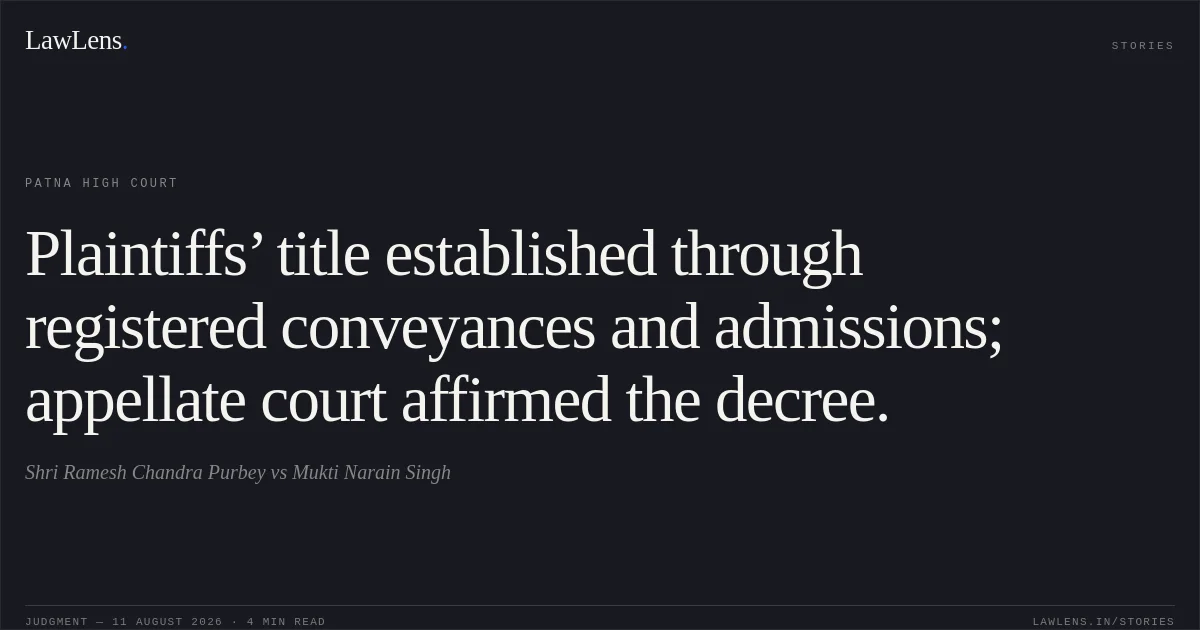
The High Court affirmed the Trial Court’s judgment dated 12 December 2008 and decree dated 23 December 2008 declaring the plaintiffs’ right, title and possession over the suit property and granting permanent injunction against Defendant No. 1.
Source reference: paras. 35–38The application for additional evidence under Order XLI Rule 27 CPC was rejected, and any interim order or injunction concerning the disputed land was directed to stand set aside in light of the judgment.
Source reference: paras. 33, 39–40There was no order as to costs.
Source reference: para. 42Acts & Sections Cited
5 provisions across 2 statutes referred to in this judgment. Each provision opens on LawLens.
Code of Civil Procedure, 19083
Code of Criminal Procedure, 19732
Original Court PDF
Shri Ramesh Chandra PurbeyvsMukti Narain Singh
Click to open original judgment
Original judgment, available to read, download and summarize on LawLens.in