Facts
The petitioners obtained planning permission and building approval on 17 October 2025 to demolish and reconstruct their property.
Source reference: p. 2The adjoining owner objected, citing a common wall, structural stability and covenants in the original TNHB sale deed requiring the other owners’ consent before alteration.
Source reference: pp. 3–4The petitioners had also submitted an affidavit undertaking to obtain the adjoining owner’s NOC and defer demolition until then.
Source reference: pp. 2–4After issuing a show-cause notice, the Corporation revoked the permission on 6 February 2026.
Source reference: no citationCompeting technical reports were before the Court, but the Court considered them inadequate to resolve the safety question.
Source reference: p. 9Issues
Whether the Corporation could revoke planning permission under Section 54 based on the absence of the adjoining owner’s NOC or alleged breach of the petitioners’ undertaking, without an independent determination of the statutory grounds for revocation.
Source reference: pp. 5, 7–8Whether the disputed structural-safety consequences of the proposed demolition and reconstruction could be determined on the competing reports before the Court, or required an independent technical assessment.
Source reference: pp. 9–10Whether the validity or enforceability of the sale-deed covenants and the parties’ rights under Section 40 of the Transfer of Property Act, 1882, should be decided in the writ proceedings.
Source reference: pp. 6–7, 12Law Applied
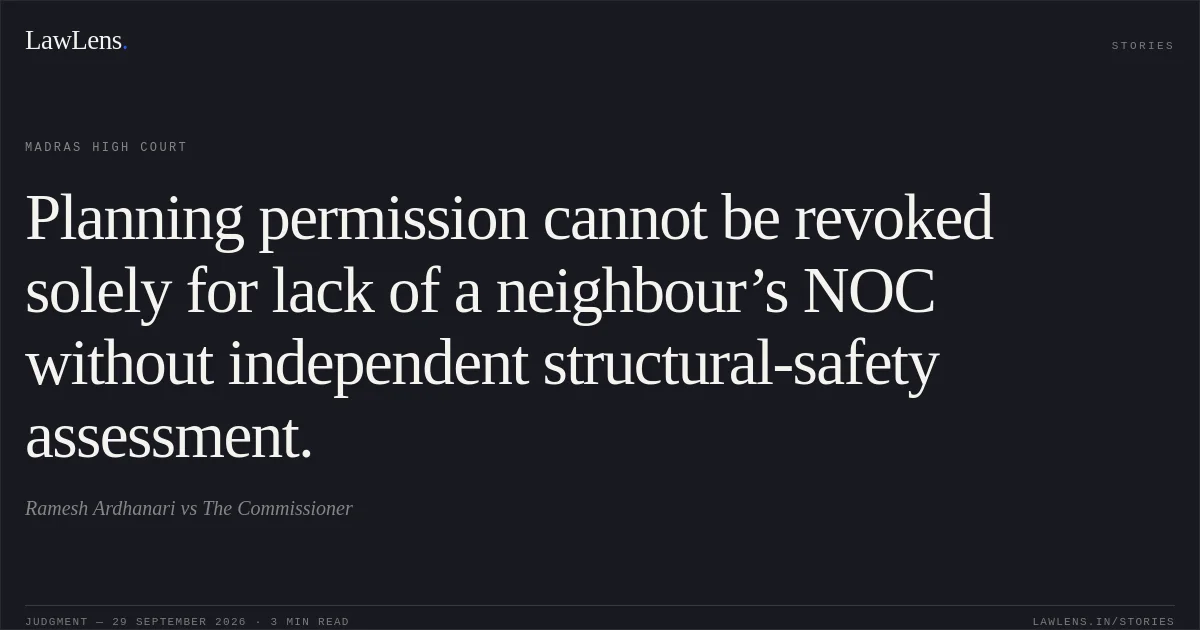
Section 54(1) of the Tamil Nadu Town and Country Planning Act, 1971 permits revocation or modification of planning permission, after an opportunity of hearing, only for statutory purposes and on relevant considerations; it does not authorize revocation merely because neighbouring owners are in dispute.
Source reference: p. 5Rule 11 of the Tamil Nadu Combined Development and Building Rules, 2019 provides that planning permission does not determine title, ownership, easement rights or structural matters; Rule 6(10), as considered in R. Umadevi v. The Commissioner, Greater Chennai Corporation, treats co-owner consent or an NOC as not generally mandatory, though further particulars may be sought where necessary.
Source reference: pp. 6–7Section 40 of the Transfer of Property Act, 1882 concerns the enforceability of certain obligations attached to property against a transferee with notice; disputed covenant rights were left for civil adjudication.
Source reference: p. 7K.D. Sharma v. Steel Authority of India Ltd., (2008) 12 SCC 481, states the duty of a litigant invoking writ jurisdiction to disclose material facts and approach the Court candidly.
Source reference: p. 8Reasoning
The Court held that the undertaking and the private covenants could be relevant to the parties’ civil rights, but neither could enlarge the Corporation’s statutory power under Section 54 or independently justify revocation.
Source reference: pp. 7–8The authority had to consider the petitioners’ material and independently assess whether the proposed work presented a genuine structural or safety concern; the competing reports, based on differing and inadequate inspections, did not enable the Court to resolve that technical question.
Source reference: pp. 8–10The appropriate course was therefore to obtain an independent assessment from IIT Madras and require the Corporation to reconsider the permission on the technical evidence and the parties’ submissions, without determining the private covenant dispute.
Source reference: pp. 9–12Holding
The writ petition was allowed to the stated extent, and the revocation order dated 6 February 2026 was set aside.
The petitioners were barred from demolition or structural work pending a fresh decision.
Source reference: pp. 10–12The Corporation was directed to obtain an IIT Madras report following inspection of both properties, provide the parties an opportunity to submit material and objections, and pass a reasoned decision under Section 54 within eight weeks of receipt of the order, subject to the time required for inspection and preparation of the report.
Source reference: pp. 10–12The validity and enforceability of the sale-deed covenants, rights under Section 40, and legal consequences of the undertaking were left open for determination by the competent civil court.
Source reference: pp. 7, 12No order as to costs.
Source reference: p. 13Acts & Sections Cited
1 provisions across 1 statute referred to in this judgment. Each provision opens on LawLens.
Transfer of Property Act, 18821
Original Court PDF
Ramesh ArdhanarivsThe Commissioner
Click to open original judgment
Original judgment, available to read, download and summarize on LawLens.in