Facts
The plaintiff filed a suit seeking declaration of title and permanent injunction concerning portions of Khasra Nos. 350 and 368 situated at Village Mahora, which were recorded as unoccupied Government land in the revenue records.
Source reference: paras. 2–4He claimed that his forefathers had developed the plateau/mountainous land, planted fruit-bearing trees, and continuously cared for them.
Source reference: para. 4The plaintiff alleged that the Gram Panchayat interfered with his right to harvest the fruits and commenced construction on the land during the pendency of revenue proceedings.
Source reference: para. 4The State denied that the trees had been planted by the plaintiff’s ancestors and maintained that the land was Government property.
Source reference: para. 5The trial court dismissed the suit, holding that the plaintiff failed to prove his right to harvest the fruits or entitlement to an injunction.
Source reference: paras. 7–8, 13–15The first appellate court affirmed the decree, leading to the present second appeal under Section 100 CPC.
Source reference: para. 2Issues
1. Whether the plaintiff established any legal right to harvest fruits from the trees standing on the Government land comprised in Khasra No. 350.
Source reference: paras. 7, 13–162. Whether the plaintiff was entitled to a permanent injunction restraining the defendants, particularly the Gram Panchayat, from undertaking construction or other activities on the suit land.
Source reference: paras. 7, 14–153. Whether the concurrent findings of the courts below gave rise to any substantial question of law warranting admission of the second appeal under Section 100 CPC.
Source reference: paras. 17–18Law Applied
The Court applied Section 100 of the Code of Civil Procedure, 1908, under which a second appeal is maintainable only when the case involves a substantial question of law; formulation of such a question is a condition precedent for admission.
Source reference: para. 18The Court relied on Sir Chunilal V. Mehta & Sons Ltd. v. Century Spinning & Manufacturing Co. Ltd., AIR 1962 SC 1314, and Chandrabhan (Deceased) Through LRs v. Saraswati, 2022 SCC OnLine SC 1273, for this principle.
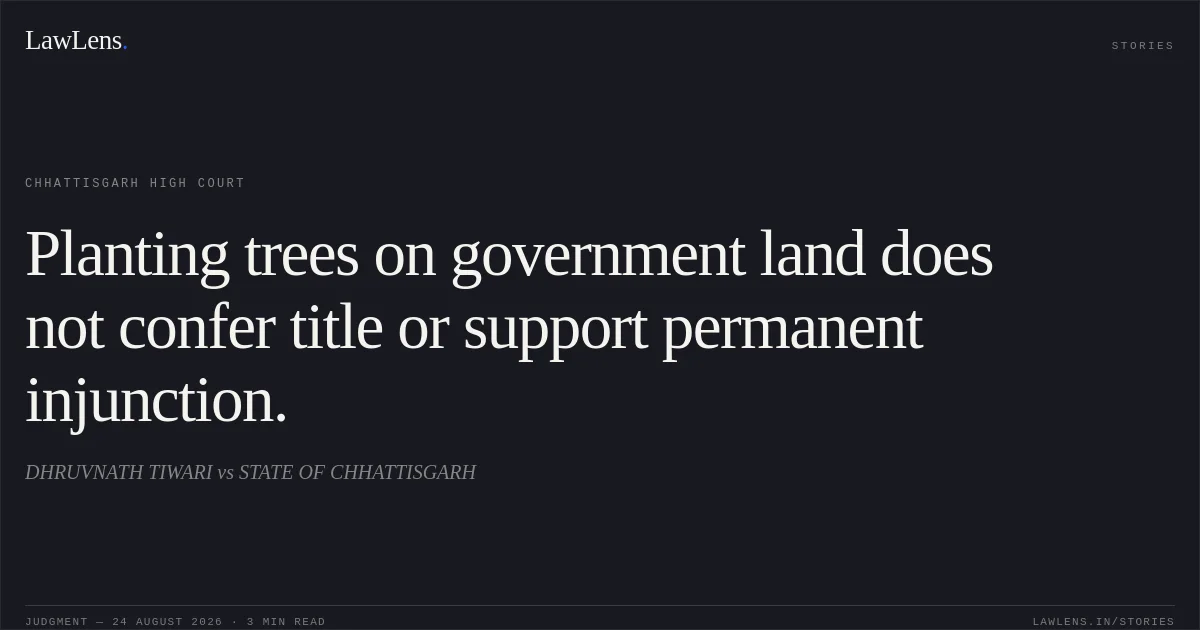
Source reference: para. 18The Court further affirmed the general rule that mere planting or maintenance of trees on Government land, without proof of title, lawful permission, or another recognised legal right, does not create ownership or an enforceable right to seek a declaration of title or injunction.
Source reference: paras. 13–16Reasoning
The plaintiff relied primarily on the alleged acts of his forefathers in planting and maintaining fruit trees.
Source reference: no citationHowever, the trial court found no evidence establishing that the land belonged to the plaintiff’s ancestors or that the competent authority had granted permission for plantation on the Government land.
Source reference: paras. 13–14The High Court held that the plaintiff’s asserted long-standing care of the trees did not confer title or any legally enforceable interest in the land.
Source reference: paras. 14, 16–17Since the revenue records described the property as Government land and the plaintiff did not base his claim on adverse possession or prove any independent legal entitlement, the injunction claim also failed.
Source reference: paras. 16–18The concurrent findings were based on appreciation of evidence and were neither perverse nor contrary to law.
Source reference: paras. 16–18Consequently, no substantial question of law arose for consideration under Section 100 CPC.
Source reference: paras. 16–18Holding
The High Court answered the issues against the plaintiff.
It held that the plaintiff had neither proved title to the suit land nor established a legal right to harvest fruits from the trees or restrain the Gram Panchayat from carrying out construction or other activities on the Government land.
Source reference: paras. 13–17Finding no substantial question of law, the Court dismissed the second appeal as meritless and disposed of any pending interlocutory applications.
Source reference: paras. 18–20Acts & Sections Cited
2 provisions across 1 statute referred to in this judgment. Linked provisions open on LawLens.
Code of Civil Procedure, 19082
Original Court PDF
DHRUVNATH TIWARIvsSTATE OF CHHATTISGARH
Click to open original judgment
Original judgment, available to read, download and summarize on LawLens.in