Facts
Deepakkumar Babuji Sajiya, aged 27 years and employed as a Junior Assistant with UGVCL, was riding motorcycle No. GJ-8-L-8043 towards Ambaji on 16 August 2014 when a jeep bearing No. GJ-8-AE-4087, allegedly driven rashly and negligently at excessive speed, collided with him on the Danapura Pimpali–Gola Highway road.
Source reference: paras. 1; p. 1He died at the spot, and an FIR was registered against the jeep driver.
Source reference: para. 1; p. 1The deceased left behind his widow, minor son and mother and was earning approximately Rs.26,449 per month.
Source reference: para. 1; p. 1The Motor Accident Claims Tribunal awarded Rs.46,55,856 with interest at 7.5% per annum.
Source reference: paras. 1–2; pp. 1–2The insurer challenged the award under Section 173 of the Motor Vehicles Act, principally alleging that the jeep driver did not possess a valid and effective driving licence.
Source reference: paras. 1–2; pp. 1–2The claimants filed cross-objections under Order XLI Rule 22 CPC seeking enhancement on the ground that the Tribunal had excluded certain salary components and had improperly deducted income tax.
Source reference: paras. 3, 6.1–6.2; pp. 2–4Issues
Whether the insurer established that the jeep driver did not possess a valid and effective driving licence on the date of the accident, thereby proving a breach of the insurance policy conditions?
Source reference: paras. 5–7; pp. 2–4Whether the Tribunal correctly assessed the deceased’s income for calculating loss of dependency, particularly regarding allowances, professional tax, income tax and future prospects?
Source reference: paras. 6.1–6.2, 8–10; pp. 3–7Whether the claimants were entitled to enhancement under the conventional heads of compensation, including loss of consortium, funeral expenses and loss of estate?
Source reference: paras. 10–12; pp. 7–8Law Applied
The Court exercised appellate jurisdiction under Section 173 of the Motor Vehicles Act and considered the claimants’ cross-objection under Order XLI Rule 22 CPC.
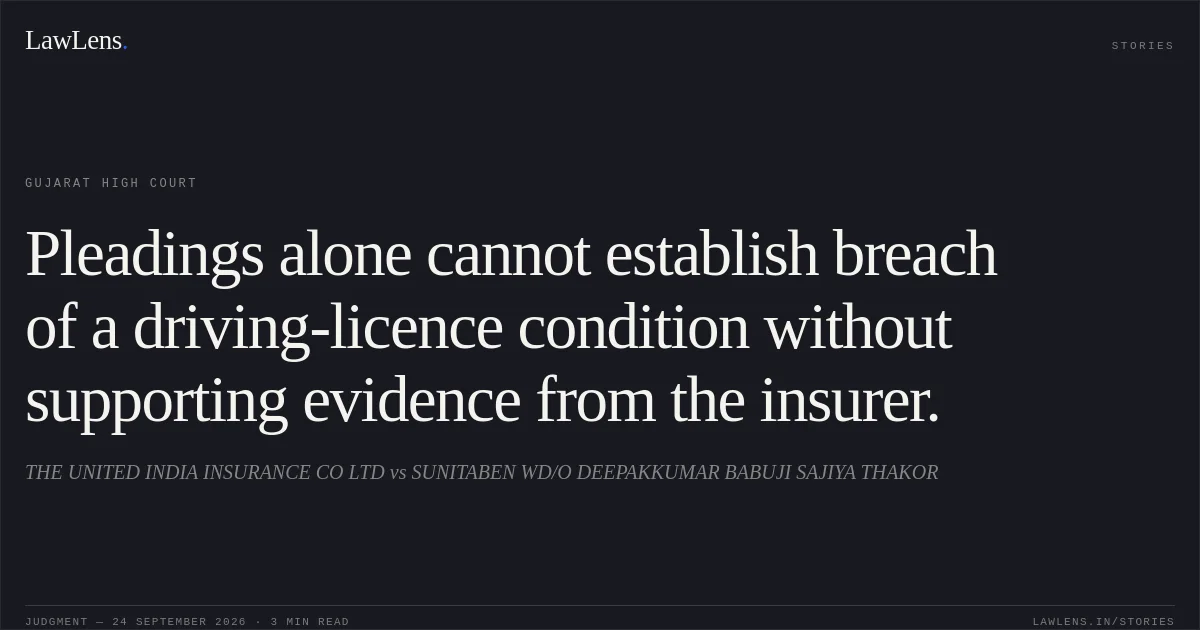
Source reference: paras. 2–3; p. 2A plea in the insurer’s written statement alleging absence of a valid driving licence does not, by itself, constitute proof of the alleged policy breach; the insurer must produce evidence establishing the violation.
Source reference: para. 7; p. 4For computation of motor accident compensation, salary components such as dearness allowance, house rent allowance, transport allowance, special allowance, provident fund-related contributions and other employment benefits may be included where they form part of the deceased’s income or benefit the family.
Source reference: paras. 9–10; pp. 4–7The Court relied on Meenakshi v. The Oriental Insurance Co. Ltd., 2024 INSC 573; Raghuvir Singh Matolya v. Hari Singh Malviya; National Insurance Co. Ltd. v. Indira Srivastava, (2008) 2 SCC 763; and National Insurance Co. Ltd. v. Nalini, decided on 11 July 2024.
Source reference: paras. 9–10; pp. 4–7The Court also applied a 50% addition for future prospects, a 17-year multiplier, a one-third deduction towards personal expenses, and the applicable conventional amounts for consortium, funeral expenses and loss of estate.
Source reference: para. 11; p. 7Reasoning
The insurer failed to produce any documentary or oral evidence demonstrating that the jeep driver lacked a valid and effective licence.
Source reference: para. 7; p. 4Although the driver had been served, he did not enter the witness box, and the insurer did not summon or examine him to prove the alleged breach.
Source reference: para. 7; p. 4The Court therefore held that the plea could not be sustained merely on the basis of the written statement, which is not evidence by itself.
Source reference: para. 7; p. 4On quantum, the salary slip showed total earnings of Rs.26,449.94.
Source reference: paras. 8–11; pp. 4–7The Tribunal had considered only basic salary, dearness allowance and house rent allowance and had deducted income tax, even though the employer had not deducted such tax.
Source reference: paras. 8–11; pp. 4–7Applying the cited Supreme Court authorities, the Court treated the relevant salary benefits as part of the deceased’s income, deducted only Rs.200 towards professional tax, added 50% for future prospects, applied the multiplier of 17 and deducted one-third for personal expenses.
Source reference: paras. 8–11; pp. 4–7The resulting loss of dependency was calculated at Rs.53,54,728, and additional amounts were awarded under the conventional heads.
Source reference: para. 11; p. 7Holding
The appeal filed by the insurance company was dismissed because the alleged breach concerning the driver’s licence was not proved.
The claimants’ cross-objection was allowed to the extent that the total compensation was enhanced from Rs.46,55,856 to Rs.55,36,228, comprising Rs.53,54,728 for loss of dependency, Rs.1,45,200 for loss of consortium, Rs.18,150 for funeral expenses and Rs.18,150 for loss of estate.
Source reference: para. 11; p. 7The enhanced amount of Rs.8,80,372 was directed to be deposited by the insurer before the Tribunal within eight weeks, with interest at 7.5% per annum from the date of filing of the claim petition until realization.
Source reference: paras. 12–13.5; pp. 8–9The Tribunal was directed to disburse the awarded amount, subject to verification, procedure and deduction of applicable court fees.
Source reference: paras. 12–13.5; pp. 8–9Acts & Sections Cited
1 provisions across 1 statute referred to in this judgment. Each provision opens on LawLens.
Motor Vehicles Act, 19881
Original Court PDF
THE UNITED INDIA INSURANCE CO LTDvsSUNITABEN WD/O DEEPAKKUMAR BABUJI SAJIYA THAKOR
Click to open original judgment
Original judgment, available to read, download and summarize on LawLens.in