Facts
The petitioner, a women’s Self-Help Group, had been engaged in supplying mid-day meals/PM Poshan to students of Government Primary and Middle School, Toda, including the local Anganwadi Centre.
Source reference: p. 2On 29 June 2026, the authorities issued a show-cause notice alleging irregular supply, non-compliance with the prescribed menu, and poor quality and insufficient quantity of food and cooking material.
Source reference: p. 2The petitioner denied the allegations and relied upon certificates issued by the Headmaster and Sarpanch stating that the food was regularly supplied in accordance with the prescribed menu and was of satisfactory quality.
Source reference: p. 2Nevertheless, respondent No. 2 passed an order dated 1 July 2026 discontinuing the petitioner and assigning the work to respondent No. 3 as an alternative arrangement.
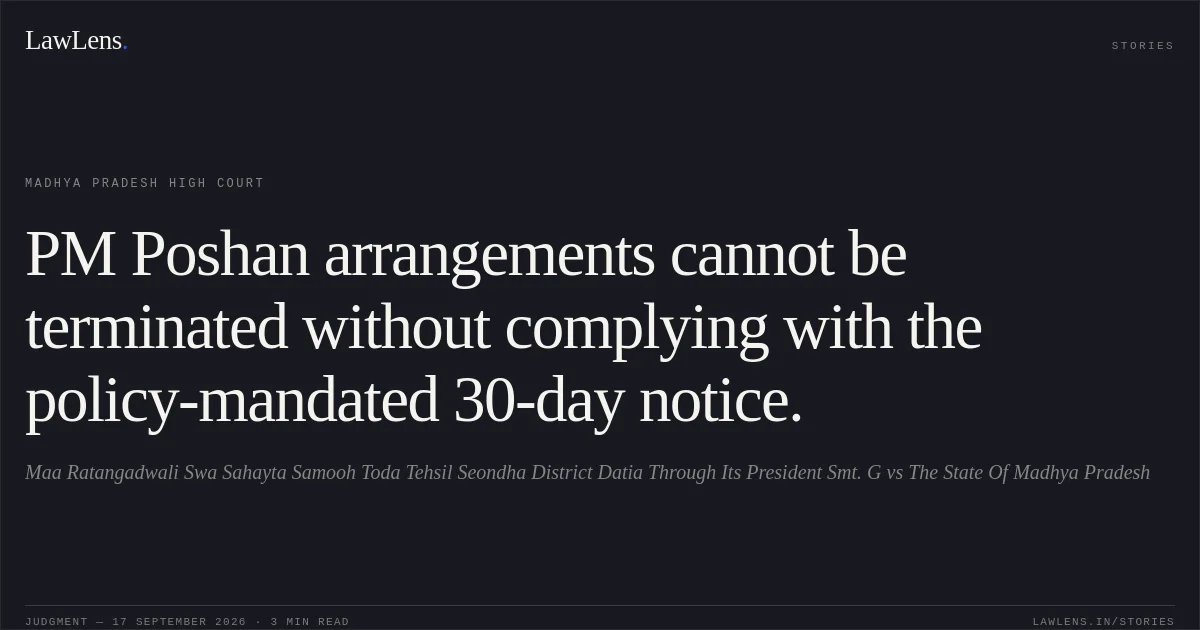
Source reference: p. 2The petitioner challenged the order under Article 226, principally alleging violation of Clause 8.3 of the Circular/Policy dated 8 June 2017, which required 30 days’ notice for modification or termination during the contract period.
Source reference: pp. 3–4Issues
Whether the petitioner could be discontinued from PM Poshan work without compliance with the 30-day notice requirement under Clause 8.3 of the Circular/Policy dated 8 June 2017.
Source reference: pp. 5–6Whether the impugned order was vitiated by failure to properly consider the petitioner’s reply and supporting certificates before discontinuing it from the work.
Source reference: p. 6Whether the High Court should adjudicate the disputed factual allegations concerning the quality, quantity, and regularity of the food supplied.
Source reference: p. 5Law Applied
The Court applied Clause 8.3 of the Circular/Policy dated 8 June 2017, which requires 30 days’ notice before the arrangement is modified or terminated during the contract period.
Source reference: pp. 3, 5–6It further applied the principles of procedural fairness and natural justice, requiring the competent authority to consider the affected party’s explanation and supporting material before passing an adverse, reasoned, and speaking order.
Source reference: p. 6The Court also recognised the settled limitation on writ-court review that disputed factual allegations, such as the quality or quantity of food supplied, should ordinarily be examined by the competent authority in accordance with the governing policy rather than adjudicated conclusively in writ proceedings.
Source reference: p. 5Reasoning
The Court found that the show-cause notice was issued on 29 June 2026 and the discontinuation order was passed only two days later, on 1 July 2026. This chronology did not establish compliance with the mandatory 30-day notice contemplated by Clause 8.3; nor could the immediate show-cause process itself be treated as satisfaction of that contractual/policy requirement.
Source reference: pp. 5–6Further, although the petitioner had submitted a reply supported by certificates from the Headmaster and Sarpanch, the record did not demonstrate that these materials had been duly considered before the adverse order was made.
Source reference: p. 6The Court therefore declined to determine whether the allegations of poor-quality or irregular food supply were factually correct, leaving that question to the competent authority in properly conducted proceedings.
Source reference: p. 5Holding
The Court held that the order dated 1 July 2026 discontinuing the petitioner from PM Poshan work was unsustainable for non-compliance with Clause 8.3 and inadequate consideration of the petitioner’s explanation.
The order was quashed.
Source reference: p. 7The competent authority was permitted to initiate fresh proceedings by issuing a proper show-cause notice in accordance with Clause 8.3 and applicable instructions, granting an effective opportunity to reply, considering the relevant material, and passing a reasoned and speaking order within six weeks from receipt of the certified copy of the judgment.
Source reference: p. 7Pending that decision, respondent No. 3 was permitted to continue supplying PM Poshan meals as an interim arrangement so that meal distribution was not interrupted; such continuation would create no equity, vested right, or permanent entitlement in its favour.
Source reference: p. 8The petition was accordingly disposed of, with no order as to costs.
Source reference: p. 8Original Court PDF
Maa Ratangadwali Swa Sahayta Samooh Toda Tehsil Seondha District Datia Through Its President Smt. GvsThe State Of Madhya Pradesh
Click to open original judgment
Original judgment, available to read, download and summarize on LawLens.in