01Facts
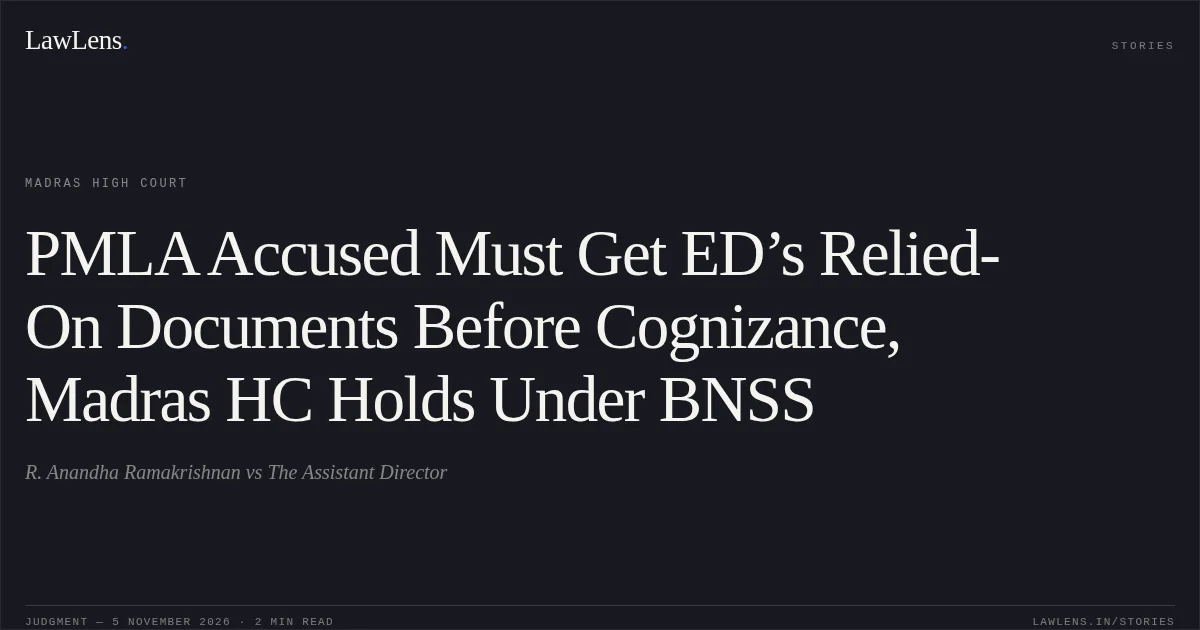
The petitioner, arrayed as the fourth accused in an unnumbered PMLA complaint, sought an order directing the Enforcement Directorate (ED) to provide copies of the documents relied upon in its complaint before cognizance was taken.
pp. 1–4, paras 1–3The Principal District and Sessions Judge, Madurai, rejected the request, relying on *Sarla Gupta v. Directorate of Enforcement*.
pp. 1–4, paras 1–3The petitioner challenged that order under Section 528 BNSS, contending that the first proviso to Section 223(1) BNSS required a meaningful pre-cognizance hearing, which included access to the relied-upon documents.
pp. 1–4, paras 1–3The ED opposed the petition, arguing that document disclosure was available only after cognizance.
pp. 5–7, paras 9–1102Issues
i.Whether the first proviso to Section 223(1) BNSS entitles an accused in a PMLA complaint to receive copies of the prosecution’s relied-upon documents before cognizance is taken
pp. 8–10, paras 13–14ii.Whether the trial court erred in rejecting the petitioner’s request by relying on *Sarla Gupta*
pp. 14–15, 20, paras 18, 2703Law Applied
The first proviso to Section 223(1) BNSS bars a Magistrate from taking cognizance on a complaint without giving the accused an opportunity of being heard; the Court treated this safeguard as mandatory and applicable to PMLA complaints.
pp. 9–12, paras 13–17Sections 223–228 BNSS apply to PMLA proceedings where not inconsistent with the PMLA, consistently with Section 65 PMLA and the procedural framework for complaints.
pp. 11–12, 18–19, paras 16, 23–24The Court relied on *Parvinder Singh v. Directorate of Enforcement* for the applicability and mandatory character of the pre-cognizance hearing, and distinguished *Sarla Gupta v. Directorate of Enforcement* as concerning disclosure at the post-cognizance stage under the earlier procedural regime.
pp. 10–17, 20, paras 15–17, 20–22It held that the hearing must be meaningful, requiring disclosure of the relied-upon documents, but is confined to whether the complaint and those documents disclose a prima facie case or face a legal bar; it is not a trial of the defence or an assessment of evidentiary merits.
pp. 14, 19–23, paras 19, 25–31Provisions in the judgment · 18 · Linked ones open on LawLens
Bharatiya Nagarik Suraksha Sanhita, 2023 Section 528Section 223Section 212Section 224Section 225Section 226Section 227Section 228
Prevention of Money-Laundering Act, 2002 Section 3Section 17Section 18Section 24Section 44Section 65
Code of Criminal Procedure, 1973 Section 200Section 204Section 233Section 243
04Reasoning
The Court held that *Sarla Gupta* did not determine whether relied-upon documents must be supplied before cognizance, because it addressed disclosure after cognizance and under the CrPC.
pp. 14–17, 20, paras 18, 20–22Given that Section 223 BNSS applies to PMLA complaints and creates a mandatory pre-cognizance hearing, the Court reasoned that withholding the documents on which the complaint rests would make that hearing ineffective.
pp. 18–23, paras 18–31It therefore adopted the view that disclosure of relied-upon documents is necessary for the accused to address whether a prima facie case exists, while clarifying that the hearing does not permit the accused to lead a defence or invite the court to weigh the evidence.
pp. 18–23, paras 18–3105Holding
The Court answered that an accused in a PMLA complaint is entitled to copies of the prosecution’s relied-upon documents at the pre-cognizance stage under the first proviso to Section 223(1) BNSS.
pp. 23–24, paras 32–33It quashed the trial court’s order and directed the ED to furnish the petitioner copies of all relied-upon documents within four weeks of receiving the order; the connected miscellaneous petition was closed.
pp. 23–24, paras 32–33Original Court PDF
R. Anandha RamakrishnanvsThe Assistant Director
Click to open original judgment
Original judgment, available to read, download and summarize on LawLens.in