Facts
The appellant was convicted by the Additional Sessions Judge-cum-Special Judge (POCSO), Simdega, for offences under Sections 376(2)(f), 323 and 506 of the Indian Penal Code (IPC), and Section 4 of the Protection of Children from Sexual Offences Act, 2012 (POCSO Act).
Source reference: p. 2The trial court imposed, among other sentences, ten years’ rigorous imprisonment each under Section 376(2)(f) IPC and Section 4 of the POCSO Act, and directed all sentences to run consecutively.
Source reference: p. 2In his appeal, the appellant did not challenge his convictions; he challenged the consecutive operation of the sentences for the IPC and POCSO offences, relying on Section 42 of the POCSO Act.
Source reference: p. 2–3The State accepted that the sentences for those overlapping offences should not run consecutively.
Source reference: p. 3Issues
1. Whether, in light of Section 42 of the POCSO Act, separate sentences could be imposed under Section 4 of that Act and Section 376(2)(f) IPC for the same act, to run consecutively.
Source reference: p. 3, 5–62. Whether the appellant, having undergone 13 years’ imprisonment, was entitled to release after the POCSO sentence was set aside.
Source reference: p. 6Law Applied
Section 42 of the POCSO Act provides that where an act constitutes an offence under that Act and also under specified IPC provisions—including Section 376—the offender is liable to punishment under the Act or the IPC provision that prescribes the greater punishment.
Source reference: p. 5For the offence as it stood at the time of the incident, Section 4 of the POCSO Act prescribed imprisonment of at least seven years, extendable to life, while Section 376(2)(f) IPC prescribed rigorous imprisonment of at least ten years, extendable to life.
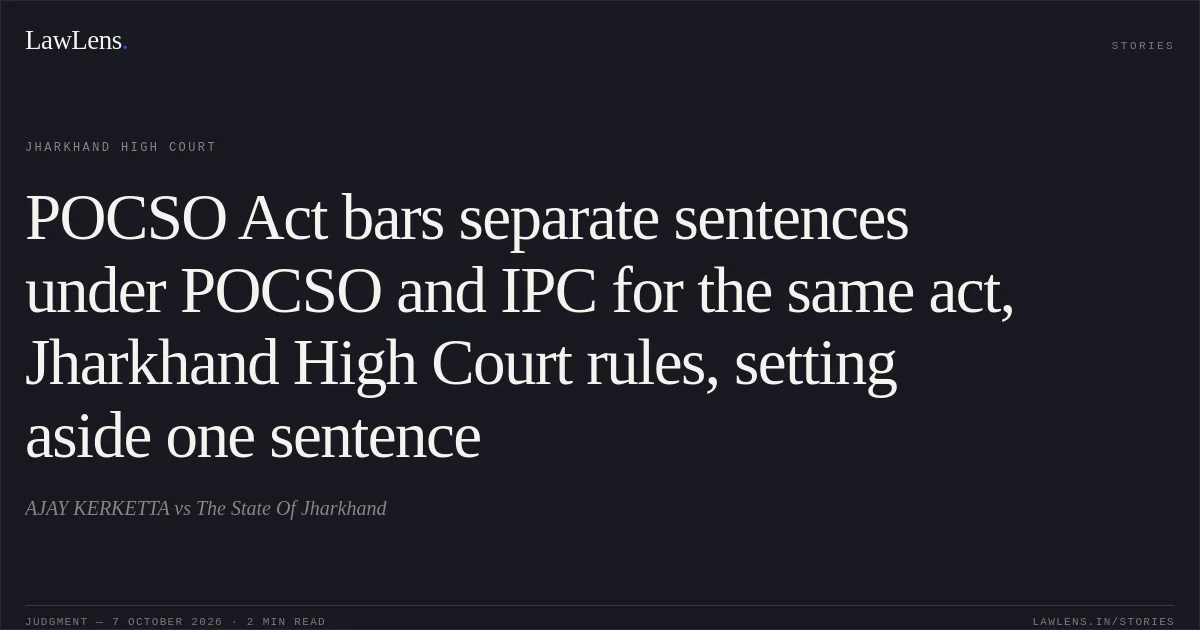
Source reference: p. 4–5The court held that Section 42 required the greater prescribed punishment to be imposed under Section 376(2)(f) IPC, rather than separate sentences under both provisions for the same act.
Source reference: p. 5–6Reasoning
The court confined its consideration to the sentence, as the appellant did not contest the convictions.
Source reference: p. 2–3, 5It compared the punishments applicable at the time of the offence and found that Section 376(2)(f) IPC prescribed the greater minimum term.
Source reference: p. 4–6Applying Section 42, the court concluded that the trial court should not have imposed an additional sentence under Section 4 of the POCSO Act for the same act, with that sentence running consecutively to the IPC sentence.
Source reference: p. 4–6Since the appellant had already undergone 13 years in custody, the court considered him to have served the maximum sentence maintained by its order.
Source reference: p. 6Holding
The High Court maintained the appellant’s convictions under Sections 376(2)(f), 323 and 506 IPC and Section 4 of the POCSO Act, but set aside the sentence imposed under Section 4 of the POCSO Act; the sentences under the three IPC provisions were maintained.
Finding that the appellant had undergone 13 years’ imprisonment, the court directed his release forthwith, unless required in another case.
Source reference: p. 6The appeal was dismissed with this modification to the sentence.
Source reference: p. 6Acts & Sections Cited
8 provisions across 2 statutes referred to in this judgment. Each provision opens on LawLens.
Indian Penal Code, 18606
Protection of Children from Sexual Offences Act, 20122
Original Court PDF
AJAY KERKETTAvsThe State Of Jharkhand
Click to open original judgment
Original judgment, available to read, download and summarize on LawLens.in