Facts
The appellant, Accused No. 1, was prosecuted for allegedly committing repeated penetrative sexual assault on PW3, stated to be a minor girl, at knife point, and for criminal intimidation at Mahendra Park, Delhi, on dates preceding and including 10.07.2016.
Source reference: paras. 2–3; pp. 2–3An FIR was registered on the basis of PW3’s complaint, and the appellant was charged under Sections 5(h) and 5(l) read with Section 6 of the Protection of Children from Sexual Offences Act, 2012 (POCSO), Sections 376(2)(n) and 506 IPC.
Source reference: para. 4; p. 3The co-accused was discharged.
Source reference: para. 4; p. 3The Trial Court convicted the appellant under Section 6 POCSO and Sections 376(2)(n) and 506 IPC, sentencing him to 12 years’ rigorous imprisonment and fine under Section 6 POCSO, and five years’ rigorous imprisonment under Section 506 IPC, with concurrent sentences.
Source reference: para. 9; p. 5In appeal, the appellant challenged the conviction on grounds including delay in registration of the FIR, non-examination of his brother, absence of scientific evidence, and failure to satisfactorily establish PW3’s age.
Source reference: para. 10; p. 6Issues
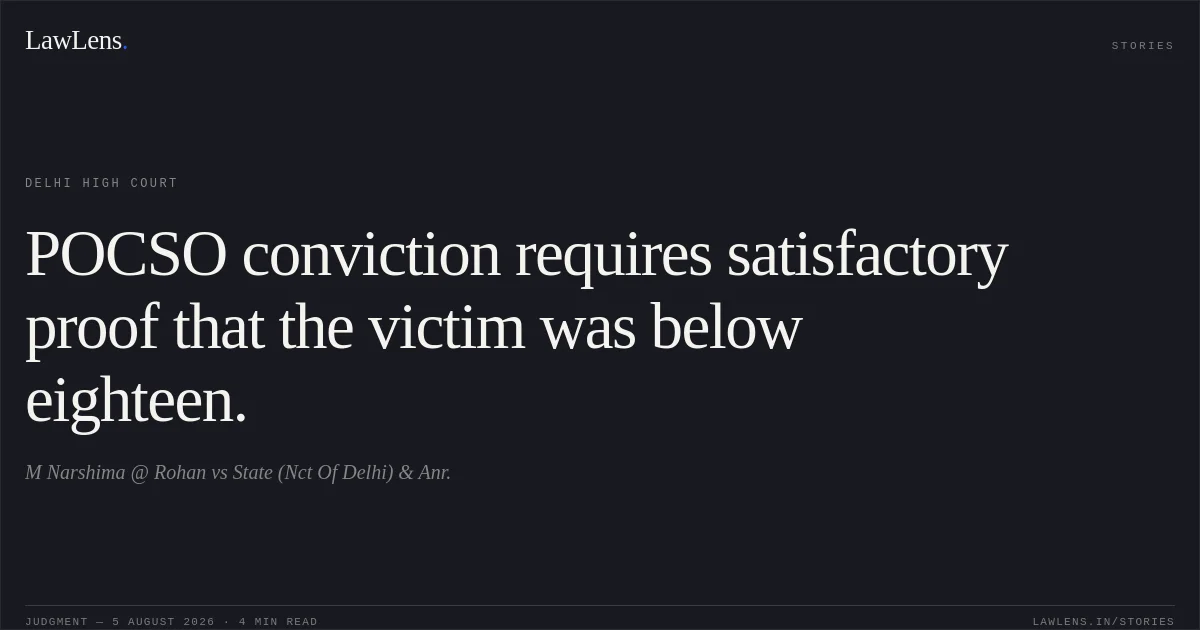
Whether the prosecution proved beyond reasonable doubt that PW3 was below eighteen years of age on the date of the alleged occurrence, thereby attracting the provisions of the POCSO Act?
Source reference: paras. 13, 19–19.1; pp. 6, 21–23Whether the testimonies of PW3, PW2 and PW6 were sufficiently consistent and reliable to establish the offences under Section 376(2)(n) IPC and Section 6 POCSO?
Source reference: paras. 13, 20–22; pp. 6, 23–27Whether the prosecution proved the offence of criminal intimidation under Section 506 IPC beyond reasonable doubt?
Source reference: paras. 2, 9, 20–23; pp. 2, 5, 23–28Law Applied
The Court applied Section 6 of the POCSO Act, read with Sections 5(h) and 5(l), which requires proof of aggravated penetrative sexual assault against a “child,” namely, a person below eighteen years of age.
Source reference: paras. 4, 19; pp. 3, 21It considered Sections 376(2)(n) and 506 IPC concerning repeated rape and criminal intimidation, respectively.
Source reference: paras. 1–2; p. 1–2Under the criminal law standard, the prosecution was required to prove the charges beyond reasonable doubt, and material uncertainty regarding age, occurrence, or credibility had to enure to the accused’s benefit.
Source reference: para. 23; p. 27–28The Court also noted that non-compliance with the hearing contemplated under Section 232 Cr.P.C. does not automatically vitiate a trial unless resulting prejudice is shown, relying on Moidu K. v. State of Kerala , 2009 (3) KHC 89 : 2009 SCC OnLine Ker 2888.
Source reference: para. 7; pp. 4–5Section 42 of the POCSO Act was applied by the Trial Court to avoid imposing a separate sentence under Section 376(2)(n) IPC.
Source reference: para. 9; p. 5Reasoning
The Court found that the prosecution had not satisfactorily established PW3’s age.
Source reference: paras. 18–19; pp. 20–23Although the school admission register recorded her date of birth as 24.02.2002, the relevant entries contained corrections made with correction fluid, without initials or evidence identifying the person who made them, and no contemporaneous municipal birth certificate or equivalent document had been produced at the time of admission.
Source reference: paras. 18–19; pp. 20–23PW2’s account regarding the ages and birth sequence of her children was also inconsistent with the recorded date of birth.
Source reference: para. 19.1; pp. 23Consequently, the Court held that the POCSO offence was not established.
Source reference: para. 19.1; pp. 23The Court further found material inconsistencies between PW3’s FIR, her Section 164 Cr.P.C. statement, and her trial testimony regarding the dates, manner and circumstances of the alleged assaults, including whether the appellant used a knife or firearm, whether photographs were taken, and whether PW3 was forcibly taken to the premises.
Source reference: para. 20; pp. 23–25PW2’s account of an attempted kidnapping at the residence was not supported by PW3 or PW6, while PW6’s evidence suggested that PW3 left the house without informing family members and returned later.
Source reference: para. 20; pp. 24–25The Court also considered PW3’s failure to disclose the alleged sexual assault to her family or police during the initial police interactions, and found the explanation inadequate in the circumstances.
Source reference: paras. 15.1–15.2, 16.1, 21; pp. 13–17, 25–26The medical evidence did not satisfactorily corroborate the prosecution case: PW3’s earlier statements referred to a knife injury, whereas her trial version referred merely to being hit, and the examining doctor found a sutured and bandaged injury without clarity as to who had initially treated it.
Source reference: para. 22; pp. 26–27These cumulative inconsistencies and evidentiary deficiencies created reasonable doubt regarding the alleged sexual assault and intimidation.
Source reference: paras. 20–23; pp. 23–28Holding
The Court answered the issues in favour of the appellant, holding that the prosecution failed to prove PW3’s minority and failed to establish the alleged sexual assault, repeated rape, or criminal intimidation beyond reasonable doubt.
The appeal was allowed, the conviction and sentence under Section 6 POCSO and Sections 376(2)(n) and 506 IPC were set aside, and the appellant was acquitted under Section 235(1) Cr.P.C.
Source reference: para. 24; p. 28Original Court PDF
M Narshima @ RohanvsState (Nct Of Delhi) & Anr.
Click to open original judgment
Original judgment, available to read, download and summarize on LawLens.in