Facts
The appellant was prosecuted under Sections 376 and 506 of the IPC and Section 4 of the POCSO Act for allegedly committing rape and threatening an 11-year-old girl on 9 April 2015 at approximately 7:00 a.m.
Source reference: paras. 4–6; pp. 2–4The prosecution examined seven witnesses, including the medical officer, investigating officers, the victim’s mother and maternal grandmother, and the victim.
Source reference: para. 7; p. 4The trial court found the appellant guilty under Section 4 of the POCSO Act and sentenced him to 20 years’ rigorous imprisonment with a fine of ₹25,000, while acquitting him under Sections 376 and 506 IPC.
Source reference: paras. 9–13; pp. 5–7In appeal, the victim denied that any occurrence had taken place, stated that she had not made any incriminating statement to the police, and acknowledged that she and her mother had compromised the matter.
Source reference: para. 22; pp. 10–11The medical examination found no external injury, an intact hymen, no spermatozoa, and only redness on the right labia minora; the doctor opined that attempted sexual intercourse “might have been done,” explaining that this meant it “may or may not be done”.
Source reference: para. 25; pp. 12–13The mother and grandmother also did not provide reliable direct evidence, and the grandmother’s testimony indicated that she was present in the house at the alleged time of occurrence, contrary to the prosecution case that the victim was alone.
Source reference: paras. 28–29; pp. 13–15Issues
Whether the prosecution proved beyond reasonable doubt that the appellant committed penetrative sexual assault punishable under Section 4 of the POCSO Act.
Source reference: paras. 20–34; pp. 9–20Whether the statutory presumptions under Sections 29 and 30 of the POCSO Act could be invoked without the prosecution first establishing the foundational facts of the alleged offence.
Source reference: paras. 30–33; pp. 15–19Whether the sentence of 20 years’ rigorous imprisonment was legally permissible for an alleged offence committed in 2015, when the enhanced punishment under Section 4 of the POCSO Act came into force only on 16 August 2019.
Source reference: para. 35; p. 20Law Applied
The Court applied Section 4 of the POCSO Act, which, before its amendment effective from 16 August 2019, prescribed imprisonment of not less than seven years and up to life imprisonment for penetrative sexual assault.
Source reference: para. 35; p. 20Sections 29 and 30 of the POCSO Act permit presumptions regarding culpable mental state and commission of the offence, but such presumptions arise only after the prosecution establishes the foundational facts of the alleged offence.
Source reference: paras. 30–33; pp. 15–19The Court reaffirmed the presumption of innocence and the prosecution’s obligation to prove guilt beyond reasonable doubt, relying on Ramanand v. State of U.P., AIR 2022 SC 5273, including the principle that the accused may rebut the statutory burden on a preponderance of probabilities.
Source reference: para. 30; pp. 15–17It also considered Section 22 of the POCSO Act, which provides punishment for false complaints or false information made with the intention to humiliate, extort, threaten or defame.
Source reference: para. 34; pp. 19–20The enhanced punishment introduced by the 2019 amendment could not be applied to an alleged offence committed in 2015.
Source reference: para. 35; p. 20Reasoning
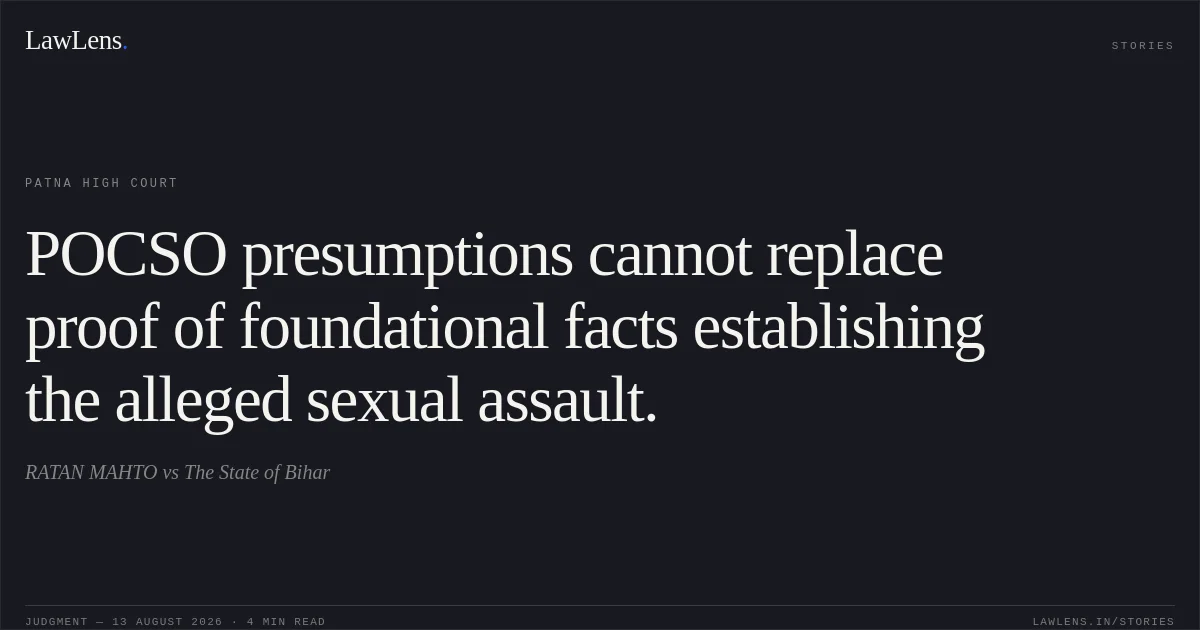
The Court held that the prosecution failed to establish the basic facts necessary to attract the presumptions under Sections 29 and 30.
Source reference: paras. 22–24; pp. 10–12The victim, the principal witness, completely denied the occurrence and stated that she had not made any incriminating statement to the police; moreover, the prosecution failed to prove through the investigating officer the alleged prior statement attributed to her.
Source reference: paras. 22–24; pp. 10–12The medical evidence was inconclusive: there was no injury, the hymen was intact, no spermatozoa were detected, and the opinion that intercourse “might have been done” expressly included the possibility that it may not have occurred.
Source reference: para. 25; pp. 12–13The neighbour was merely a hearsay witness, while the mother admitted that she had not witnessed the occurrence, had compromised the case, and did not know who had informed her.
Source reference: paras. 27 and 29; pp. 13–15The grandmother’s evidence further contradicted the prosecution’s assertion that the victim was alone at the relevant time.
Source reference: para. 28; pp. 13–14In these circumstances, the trial court erred by relying on the POCSO presumptions to supply the missing proof and by simultaneously finding that the prosecution had not proved the appellant’s involvement under Section 376 IPC.
Source reference: paras. 32–33; pp. 18–19The Court also held that the 20-year sentence was based on an amendment that was not in force when the alleged offence occurred.
Source reference: para. 35; p. 20Holding
The High Court allowed the appeal, set aside the judgment of conviction dated 15 February 2023 and the order of sentence dated 21 February 2023, and acquitted the appellant of the charge under Section 4 of the POCSO Act and all other charges.
The appellant was directed to be released forthwith unless wanted in another case.
Source reference: para. 37; p. 21The Court granted him liberty to take appropriate legal steps under Section 22 of the POCSO Act in respect of the alleged false complaint, subject to consideration by the competent court or investigating agency on its own merits and in accordance with law.
Source reference: paras. 34 and 36; pp. 19–20Acts & Sections Cited
11 provisions across 3 statutes referred to in this judgment. Each provision opens on LawLens.
Protection of Children from Sexual Offences Act, 20128
Indian Penal Code, 18602
Code of Criminal Procedure, 19731
Original Court PDF
RATAN MAHTOvsThe State of Bihar
Click to open original judgment
Original judgment, available to read, download and summarize on LawLens.in