Facts
The petitioner invoked Section 528 of the Bharatiya Nagarik Suraksha Sanhita, 2023, seeking quashing of FIR Crime No. 77/2026 registered at Police Station Dabra Dehat, District Gwalior, for offences under Sections 137(2), 64(1) and 3(5) of the Bharatiya Nyaya Sanhita, 2023, and Sections 5/6 of the Protection of Children from Sexual Offences Act, 2012, along with consequential proceedings in Sessions Case No. 18/2026, on the basis of compromise.
Source reference: para. 1The prosecution case arose from a missing report lodged by the complainant concerning her minor daughter’s disappearance during the night of 29–30 June 2026; during investigation, the prosecutrix was recovered, and the prosecution alleged that the petitioner had taken her away.
Source reference: para. 2After filing of the charge-sheet and commencement of trial, the prosecutrix and her father sought to settle the dispute with the petitioner through an application supported by affidavits.
Source reference: para. 3The Principal Registrar verified the parties, their signatures, and the voluntariness of the compromise, finding no threat, inducement, or coercion.
Source reference: para. 4Issues
Whether the High Court should exercise its inherent jurisdiction under Section 528 of the BNSS to quash the FIR and consequential proceedings for offences under the POCSO Act solely on the basis of a compromise between the parties?
Source reference: paras. 9, 13–16Whether the precedents permitting quashing of POCSO proceedings after the accused’s marriage with the prosecutrix applied where the petitioner had not married the prosecutrix?
Source reference: paras. 10–12Law Applied
The Court applied Section 528 of the BNSS, which preserves the High Court’s inherent power to make orders necessary to secure the ends of justice or prevent abuse of the process of the court; this power must be exercised sparingly and with circumspection.
Source reference: para. 13Relying on Gian Singh v. State of Punjab, (2012) 10 SCC 303, Narinder Singh v. State of Punjab, (2014) 6 SCC 466, and State of Madhya Pradesh v. Laxmi Narayan, (2019) 5 SCC 688, the Court reiterated that heinous or serious offences having a social impact ordinarily cannot be quashed merely because the parties have compromised.
Source reference: para. 13The Court also considered Mahesh Mukund Patel v. State of U.P., 2025 SCC OnLine SC 614, and Ajay Mohan v. State of U.P., 2026 AHC 103624, but treated them as fact-specific decisions involving marriage between the accused and the prosecutrix.
Source reference: paras. 10–12Offences under the POCSO Act were regarded as offences against society and not merely private disputes, such that a private compromise cannot override the statutory object of protecting children from sexual offences.
Source reference: paras. 14–15Reasoning
Although the compromise was verified as voluntary, the allegations involved offences under the POCSO Act concerning a minor prosecutrix.
Source reference: paras. 3–4, 14The Court distinguished Mahesh Mukund Patel and Ajay Mohan because, unlike those cases, the petitioner had not married the prosecutrix; consequently, the factual basis for permitting quashing in those decisions was absent.
Source reference: para. 12Applying the principles governing inherent jurisdiction, the Court held that the serious and socially injurious nature of POCSO offences made them unsuitable for quashing merely on the basis of settlement.
Source reference: paras. 13–16Permitting such quashing would undermine the protective purpose of the POCSO Act and conflict with the Supreme Court’s limitations on the exercise of inherent powers in serious offences.
Source reference: paras. 13–16Holding
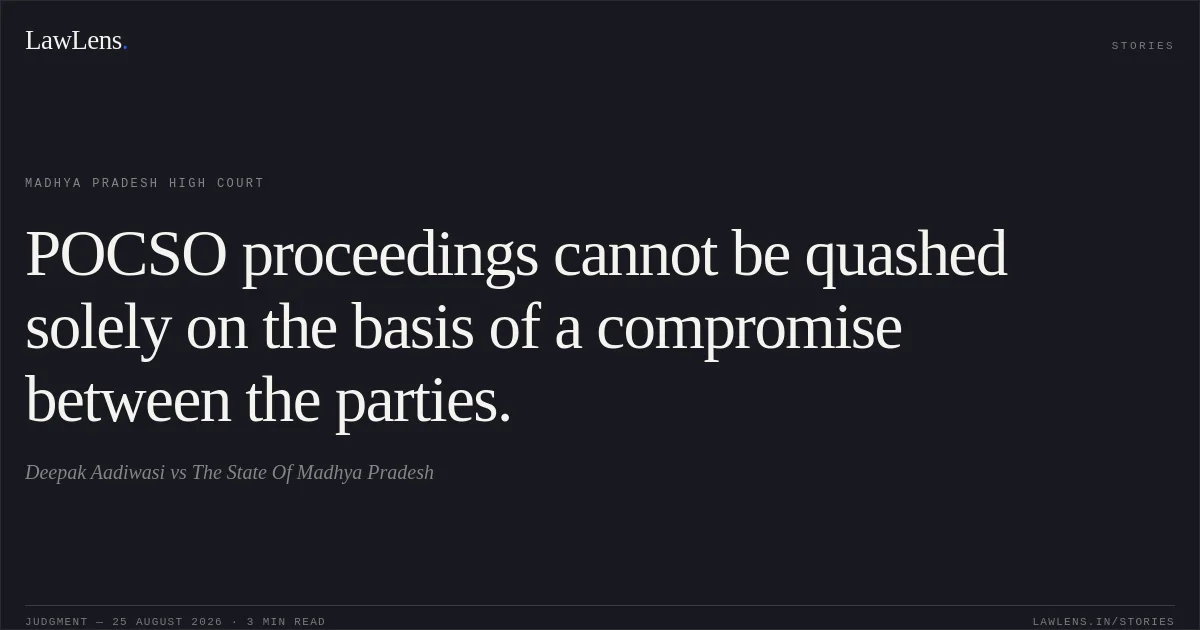
The Court answered the issues against the petitioner. It held that a voluntary compromise between the parties was insufficient to justify quashing the FIR and proceedings involving POCSO offences, particularly where the petitioner had not married the prosecutrix.
The petition under Section 528 of the BNSS was therefore dismissed, and all pending interlocutory applications were disposed of.
Source reference: paras. 16–18Acts & Sections Cited
6 provisions across 3 statutes referred to in this judgment. Linked provisions open on LawLens.
Bharatiya Nagarik Suraksha Sanhita, 20231
Bharatiya Nyaya Sanhita, 20233
Protection of Children from Sexual Offences Act, 20122
Original Court PDF
Deepak AadiwasivsThe State Of Madhya Pradesh
Click to open original judgment
Original judgment, available to read, download and summarize on LawLens.in
![Courts will not interfere with transfers absent mala fides or violation of statutory rules.. M Ramya vs EMPLOYEES STATE INSURANCE CORPORATION (ESIC). CAT - ['Chennai']. LawLens](/stories/thumbnails/courts-will-not-interfere-with-transfers-absent-mala-fides-or-violation-of-statutory-rules-a6845e9ca6f548fca284c51c8351957f.webp)
![Courts cannot direct one-time recruitment age relaxation absent authority in the governing rules or advertisement.. UT OF PUDUCHERRY vs M ANDAL. CAT - ['Chennai']. LawLens](/stories/thumbnails/courts-cannot-direct-one-time-recruitment-age-relaxation-absent-authority-in-the-governing-895d78fde47143e2a8ed0207c4b6a44f.webp)
![A review cannot correct an allegedly erroneous decision absent an error apparent on the record.. Ajit Kumar Jha vs RAILWAY BOARD. CAT - ['Delhi']. LawLens](/stories/thumbnails/a-review-cannot-correct-an-allegedly-erroneous-decision-absent-an-error-apparent-on-the-re-8ac952fd4eba470c92f7da20af72a220.webp)