Facts
The prosecutrix, a Class IX student, was reported missing on 16 August 2023, pursuant to which FIR No. 695/2023 was registered at P.S. Bawana under Section 363 IPC.
Source reference: para. 2She was recovered with the appellant from Ambala Railway Station on 23 August 2023.
Source reference: para. 3In her Section 161 Cr.P.C. statement, she stated that she and the appellant were in a relationship, had voluntarily travelled to Ambala, established physical relations consensually, and married at a temple.
Source reference: paras. 4–6, 27–28In her subsequent Section 164 Cr.P.C. statement and trial testimony, she alleged that the appellant had threatened her with a knife, taken her to a factory, committed sexual acts against her, and threatened her family.
Source reference: paras. 29–30The appellant was charged under Sections 366, 376(2)(n) and 506(II) IPC and Sections 5(l)/6 of the POCSO Act.
Source reference: para. 7The Trial Court convicted him on 6 October 2025 and sentenced him, inter alia, to 20 years’ rigorous imprisonment under Section 6 POCSO, with sentences running concurrently.
Source reference: paras. 11–12The appellant challenged the conviction and sentence in the present appeal under Sections 415(2) and 528 BNSS.
Source reference: para. 1Issues
1. Whether the material inconsistencies between the prosecutrix’s statements under Sections 161 and 164 Cr.P.C. and her trial testimony rendered her evidence unreliable for sustaining the appellant’s conviction
Source reference: paras. 26–29, 372. Whether the statutory presumptions under Sections 29 and 30 of the POCSO Act could be invoked without the prosecution first proving the foundational facts constituting the alleged offences
Source reference: paras. 30–313. Whether the investigative deficiencies, including failure to establish the alleged place of occurrence and produce independent corroborative evidence, created a reasonable doubt in the prosecution case
Source reference: para. 324. Whether the appellant was entitled to acquittal on the benefit of doubt
Source reference: paras. 33–37Law Applied
The Court considered Sections 366, 376(2)(n) and 506(II) IPC and Sections 5(l) and 6 of the POCSO Act, under which the appellant had been convicted.
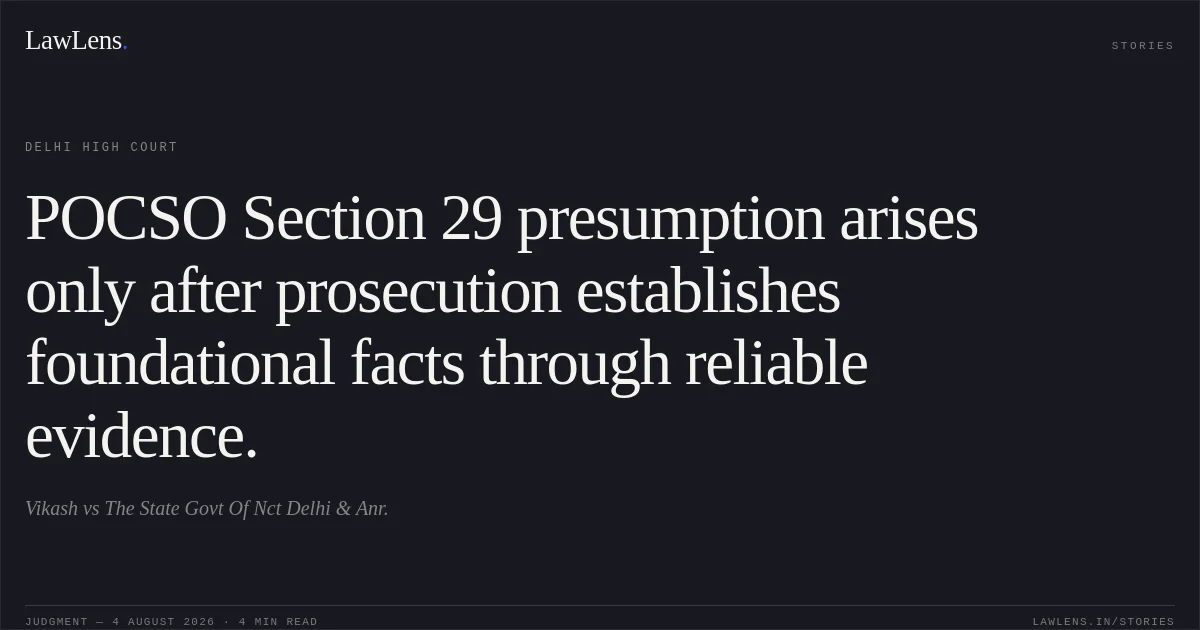
Source reference: paras. 1, 7It applied Sections 29 and 30 of the POCSO Act, holding that the presumptions regarding commission of the offence and culpable mental state do not arise automatically upon registration of a POCSO case; the prosecution must first establish the foundational facts through cogent and reliable evidence.
Source reference: paras. 30–31The Court relied on Debraj Dutta v. State of West Bengal, which reiterated this limitation on the statutory presumptions.
Source reference: para. 30The Court relied on Nirmal Kumar v. State (NCT of Delhi), which held that materially inconsistent testimony and failure to prove foundational facts warrant benefit of doubt.
Source reference: para. 34The Court relied on State of Uttarakhand v. Sanjay Ram Tamta, which held that material omissions and subsequent improvements may undermine the prosecution case.
Source reference: para. 35The Court relied on Alamelu v. State, which recognised that conviction may rest solely on the prosecutrix’s testimony only when it is free from material infirmities and inherent improbabilities.
Source reference: para. 36Although the prosecutrix’s minority made consent legally immaterial, it did not dispense with the prosecution’s obligation to prove the essential ingredients of the charged offences.
Source reference: para. 31Reasoning
The Court found that the prosecutrix’s Section 161 statement described a voluntary relationship, consensual physical relations, travel to Ambala, and a temple marriage, whereas her Section 164 statement attributed forcible abduction, threats, and sexual assault to the appellant.
Source reference: paras. 27–29These differences concerned the genesis and essential circumstances of the prosecution case, rather than minor discrepancies.
Source reference: para. 37Since the prosecution’s case substantially depended on the prosecutrix’s testimony, the material improvements required heightened scrutiny under the applicable principles.
Source reference: paras. 33, 36The Trial Court had incorrectly treated the Section 29 presumption as automatically applicable merely because the appellant was being tried under Section 6 POCSO, without first determining whether the foundational facts had been reliably established.
Source reference: paras. 30–31The failure to identify and prove the alleged place of occurrence, prepare a site plan, examine the factory owner or witness Ranjeet, or produce call-detail records and other independent corroboration further weakened the prosecution case, particularly in light of the inconsistent testimony.
Source reference: para. 32Accordingly, the prosecution failed to prove the charged offences beyond reasonable doubt.
Source reference: para. 37Holding
The appeal was allowed.
The High Court set aside the judgment of conviction dated 6 October 2025 and the order on sentence dated 3 December 2025.
Source reference: para. 38The appellant was acquitted of the offences under Sections 366, 376(2)(n) and 506(II) IPC and Section 5(l), punishable under Section 6 of the POCSO Act, by extending to him the benefit of doubt.
Source reference: para. 39He was directed to be released forthwith unless required in another case, and all pending applications were disposed of.
Source reference: paras. 40–42Original Court PDF
VikashvsThe State Govt Of Nct Delhi & Anr.
Click to open original judgment
Original judgment, available to read, download and summarize on LawLens.in