01Facts
The State appealed under s. 378 CrPC/s. 419 BNSS against the judgment dated 08.01.2024 in Special Case (POCSO) No. 16 of 2023, by which the Fast Track Special Court-I, Vijayapura, acquitted Respondent No. 1 (the accused) of offences under ss. 363, 279, 337, 343 and 376(2)(n) IPC and s. 6 POCSO Act.
p. 3 · ¶ 1The prosecution case was that the victim, then 16 years 9 months old, was taken on a motorcycle by the accused and a Child in Conflict with Law (CICL) after a road accident. She was then allegedly taken to Bengaluru, where she was kept in a rented room and raped repeatedly between 26.01.2023 and 28.01.2023.
p. 4 · ¶ 3 · p. 5 · ¶ 4The prosecution examined 33 witnesses and marked Exhibits P1–P38.
p. 5 · ¶ 7The accused denied the incriminating evidence under s. 313 CrPC and led no defence evidence.
p. 6 · ¶ 8The Special Court answered all charge points in the negative.
p. 8 · ¶ 10The victim's accounts of how she was transported diverged between her police statement, her s. 164 statement and her deposition.
¶ 20 · ¶ 21 · ¶ 23PW-1 was unconscious after the accident, yet did not raise an alarm on the train.
¶ 22The parents and brother had no personal knowledge of the alleged rape.
¶ 24 · ¶ 25PW-8's motorcycle evidence was contradicted by the seizure record.
¶ 26 · ¶ 27Medical and FSL findings showed no vaginal injuries and no seminal stain or spermatozoa.
¶ 29No birth certificate was produced to prove minority.
¶ 30The Special Court found the defence-side witnesses (PW-15 to PW-17, PW-20) unreliable and the rented-room identification unproved.
¶ 37 · ¶ 40–5102Issues
i.1. Whether the State proves that the judgment and order of acquittal passed by the Special Court is without appreciation of the entire evidence.
¶ 1503Law Applied
The Court relied on s. 378 CrPC/s. 419 BNSS for the appellate power against acquittal.
p. 3 · ¶ 1An appellate court must first ask whether the trial court's view is a possible one, since acquittal reinforces the presumption of innocence (Jafarudheen v. State of Kerala).
¶ 35Interference is warranted only where the lower court's approach is vitiated by manifest illegality or its conclusion is perverse, and a plausible view must not be disturbed even if the appellate court would take a different view (Tota Singh v. State of Punjab).
¶ 39Where two views are possible, the view favourable to the accused must be adopted, and acquittal may be reversed only for compelling and substantial reasons (State of Rajasthan v. Raja Ram).
¶ 40Findings of the trial court, which saw the witnesses, may be reversed only for very substantial and compelling reasons (Surajpal Singh v. State).
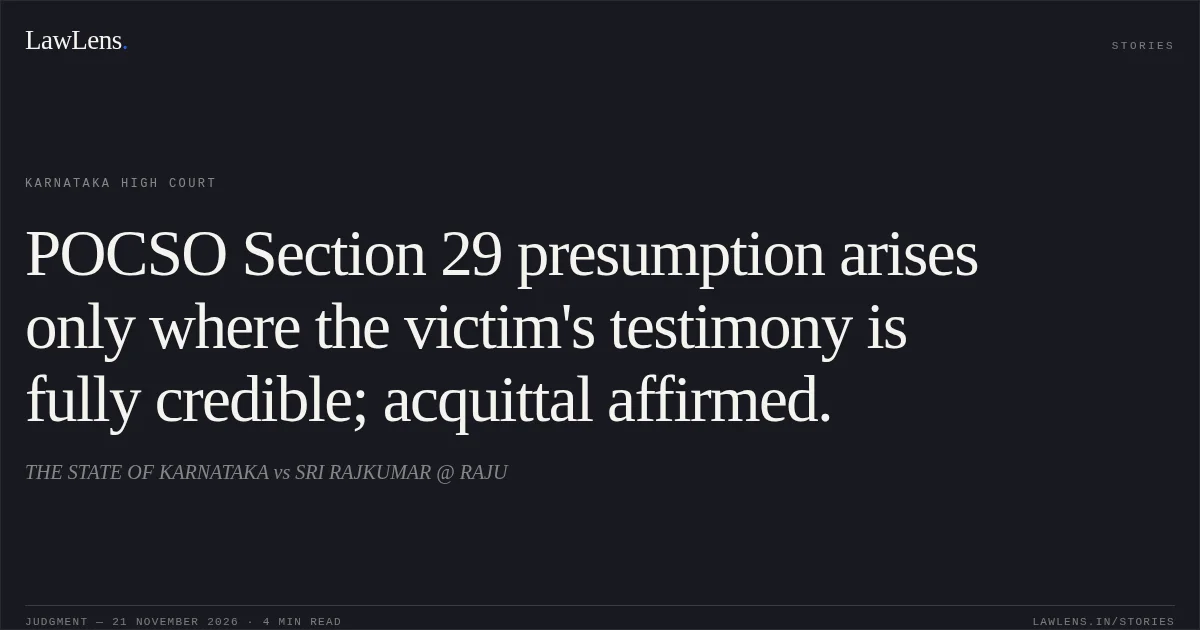
¶ 41The s. 29 POCSO presumption arises only if the victim's testimony is fully credible and trustworthy (Debraj Dutta v. State of West Bengal).
¶ 36The statutory presumption does not relieve courts of analysing the evidence, and the accused may rebut it (Deepak v. State (NCT of Delhi)).
¶ 42A charge under s. 376 must rest on hard evidence rather than conjecture or moral disapproval (Paramjit Singh Bedi v. State of Punjab).
¶ 44Cumulative doubt is relevant to the assessment of the prosecution case (Jaspal Singh v. State of Punjab).
¶ 43The understanding of a 16–18-year-old is material (Tilku v. State of Uttarakhand).
¶ 31Caution is needed regarding misuse of POCSO and consensual adolescent relationships (State of U.P. v. Anurudh).
¶ 33Section 94 of the Juvenile Justice Act, 2015 was cited for age determination where no birth certificate exists.
¶ 30Provisions in the judgment · 16 · Linked ones open on LawLens
Bharatiya Nagarik Suraksha Sanhita, 2023 Section 419
Code of Criminal Procedure, 1973 Section 378Section 207Section 313Section 161Section 164Section 417
Indian Penal Code, 1860 Section 363Section 279Section 337Section 343Section 376Section 366
Protection of Children from Sexual Offences Act, 2012 Section 6Section 29
Juvenile Justice (Care and Protection of Children) Act, 2015. Section 94
04Reasoning
The Court first considered whether the Special Court's view was a possible one.
¶ 35 · ¶ 39The Court found the victim's evidence materially inconsistent on how she came to be in the motorcycle, the railway station and the train, comparing her deposition with her police and s. 164 statements.
¶ 20–23The Court treated this inconsistency as undermining the foundational facts needed to invoke the s. 29 presumption under Debraj Dutta.
¶ 36The Court held that the victim's voluntary travel with the accused and her consent to intercourse, as recorded in the evidence, indicated a consensual relationship.
¶ 29, 32The Court relied on Tilku and Anurudh to treat her age of understanding as material.
¶ 31, 33–34The Court found the age proof deficient for want of a birth certificate and no s. 94 JJ Act determination, and held that the State had not proved the victim's minority.
¶ 30 · ¶ 34The medical and FSL evidence showed no injuries and no seminal traces, and the Court held that this, together with the uncorroborated evidence of family members lacking personal knowledge, left the prosecution case unproved.
¶ 29 · ¶ 24–25 · ¶ 29–30The Court held that the Special Court's reasons, grounded in the panchanamas, seizure records and the independent witnesses' evidence on the Bengaluru stay, were plausible and not perverse.
¶ 40–51 · ¶ 46Applying Jaspal Singh and Paramjit Singh Bedi, the Court held that the cumulative doubts and the absence of hard evidence precluded conviction.
¶ 43–4505Holding
The Court answered Point No. 1 in the negative, holding that the State failed to show the acquittal was without appreciation of the entire evidence, and that the prosecution had not proved guilt beyond reasonable doubt.
¶ 45 · ¶ 47The appeal is dismissed, and the acquittal of the accused under ss. 363, 279, 337, 343 and 376(2)(n) IPC and s. 6 POCSO Act, passed on 08.01.2024 in Special Case (POCSO) No. 16 of 2023, is confirmed.
¶ 48Original Court PDF
THE STATE OF KARNATAKAvsSRI RAJKUMAR @ RAJU
Click to open original judgment
Original judgment, available to read, download and summarize on LawLens.in