Facts
The petitioner filed a writ petition under Article 226 seeking directions restraining the respondents from interfering with her peaceful possession over the disputed property and from harassing her without an interim order of a competent court
Source reference: para. 2; p. 1The dispute arose out of a family/property dispute between the petitioner and private respondents, and a civil suit concerning the property was already pending
Source reference: para. 3; p. 1The petitioner alleged that, despite being more than 85 years of age, she was repeatedly harassed by the police and that the police were acting in collusion with the private respondents to obstruct construction allegedly being undertaken by her
Source reference: para. 4; p. 1The Court declined to examine the factual allegations of police collusion, observing that such an inquiry could have consequential implications, including the possible filing of a complaint or F.I.R. against private persons or police officers
Source reference: para. 5; p. 2Issues
Whether a writ petition under Article 226 is maintainable where the substantive dispute concerns possession of immovable property between private parties and a civil suit is already pending?
Source reference: paras. 3, 8–10; pp. 1–3Whether police, revenue, and executive authorities may interfere in a private civil dispute concerning title or possession, except for the limited purpose of maintaining public peace and preventing breach of law and order?
Source reference: paras. 6–13; pp. 2–5Whether the petitioner was entitled to a writ directing the authorities to protect her possession and prevent alleged police harassment?
Source reference: paras. 2–3, 14; pp. 1, 5Law Applied
The Court applied Article 226 of the Constitution, holding that writ jurisdiction is not ordinarily available for adjudicating private disputes concerning title or possession of immovable property, particularly where a civil suit is pending and the necessary private parties have not been impleaded
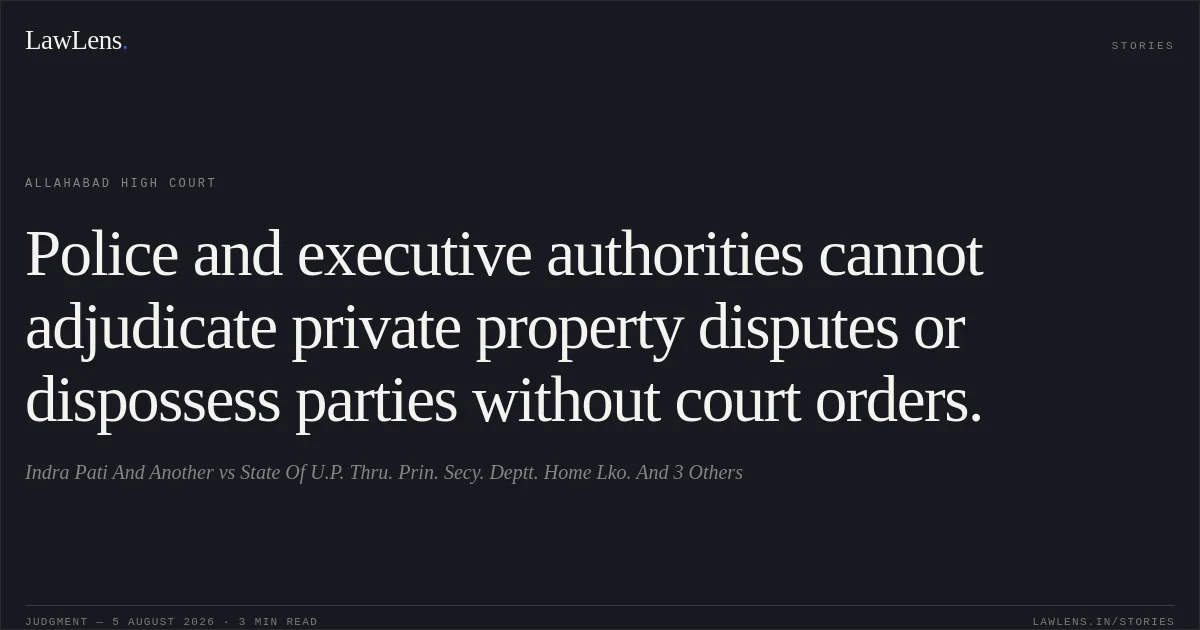
Source reference: paras. 3, 8–9; pp. 1–2It reiterated that police, revenue, and executive authorities cannot adjudicate civil rights, assist one party in dispossessing another, or restore possession without an order of a competent civil court; their role is limited to maintaining public peace and preventing breach of law and order under the Bharatiya Nagarik Suraksha Sanhita, 2023, or the corresponding provisions of the Code of Criminal Procedure, 1973
Source reference: paras. 7–8; p. 2The Court relied on Parmatma Saran v. State of U.P., Writ-C No. 3263 of 2020, Neutral Citation No. 2020:AHC:21481-DB; Suman Singh v. District Magistrate, Writ-C No. 12310 of 2022, Neutral Citation No. 2022:AHC:176795-DB; Prem Lata Maurya v. State of U.P., Writ-C No. 1266 of 2023; and Suresh Kumar Gangwar v. State of U.P., Writ-C No. 28828 of 2016, Neutral Citation No. 2016:AHC:99893-DB
Source reference: paras. 9–12; pp. 2–4It also reaffirmed the binding effect of the Government Orders dated 1 December 2014 and 16 September 2015 and the D.G.P. Circular dated 11 March 2023, which prohibit police and administrative authorities from deciding private property rights or effecting dispossession, while permitting lawful preventive action where there is an apprehension of breach of peace
Source reference: paras. 9–13; pp. 2–5Reasoning
The Court found that the petition substantially concerned a family dispute over possession of immovable property, which was already the subject matter of civil litigation. Such questions were within the jurisdiction of the competent civil court and could not be determined through a writ petition or by police and executive authorities
Source reference: paras. 3, 8–10; pp. 1–3The Court further held that, although police authorities could act to preserve public order and prevent a breach of peace, they could not side with either party, determine title or possession, or obstruct or facilitate construction or dispossession on the basis of one party’s claim
Source reference: paras. 6–8, 13; pp. 2, 5In view of these principles, the petitioner failed to establish a basis for the requested mandamus.
Source reference: no citationNevertheless, the Court reiterated the obligations of the authorities under the applicable Government Orders and the D.G.P. Circular and warned that deviations could invite departmental and contempt proceedings
Source reference: para. 13; p. 5Holding
The Court held that the petitioner had not established any ground for interference under Article 226 in relation to the pending private civil dispute and was not entitled to the requested directions protecting possession or restraining alleged harassment
The writ petition was accordingly disposed of, with liberty to the petitioner to approach the appropriate authority or competent court for redressal of her grievances
Source reference: para. 14; p. 5The Court directed police officers, District Magistrates, Sub-Divisional Magistrates, and other executive authorities to comply strictly with the relevant Government Orders and the D.G.P. Circular, maintain peace impartially, and refrain from adjudicating or altering civil rights in property disputes
Source reference: para. 13; p. 5Acts & Sections Cited
4 provisions across 1 statute referred to in this judgment. Each provision opens on LawLens.
Code of Criminal Procedure, 19734
Original Court PDF
Indra Pati And AnothervsState Of U.P. Thru. Prin. Secy. Deptt. Home Lko. And 3 Others
Click to open original judgment
Original judgment, available to read, download and summarize on LawLens.in