01Facts
The first informant (Parag Shah) alleged that between 2011 and 2013, he lent shares of several reputed companies to Accused Nos. 1 (late Pradeep Kampani) and 2 (Geeta Kampani) based on a trust-based relationship, with an agreement to pay 10% interest and return corporate benefits.
¶ 3.2–3.3The informant alleged the accused reneged on the promise to return the shares when they appreciated in value, leading to the registration of FIR No. 39 of 2018 for offences under Sections 120B, 406, 420, and 34 of the IPC.
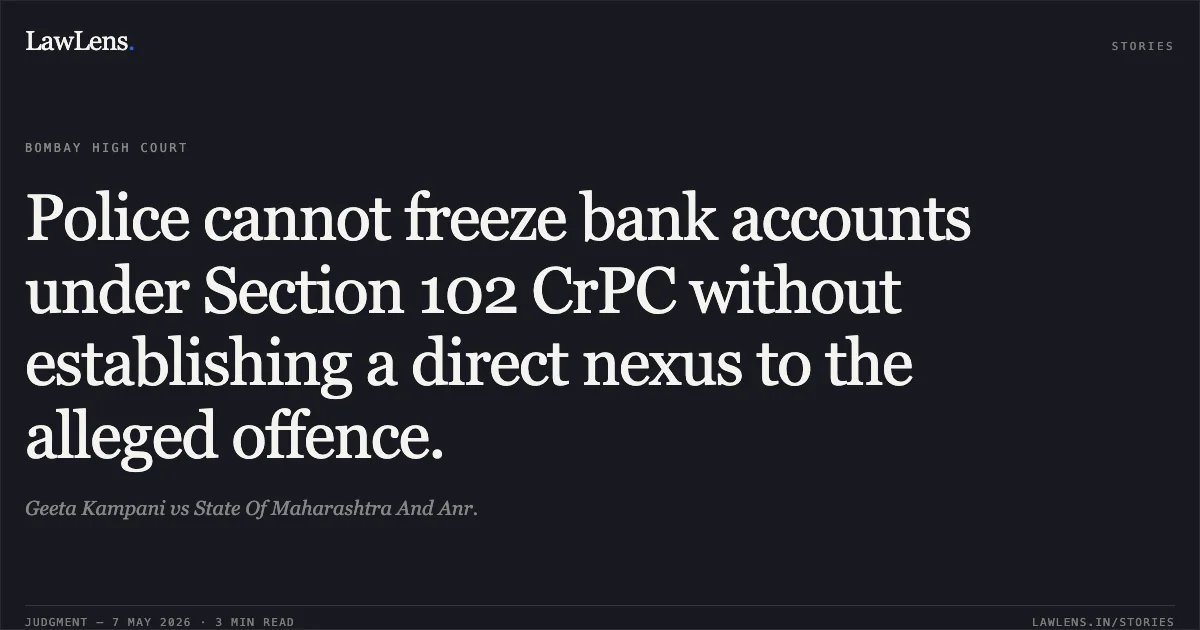
¶ 3.4During the investigation, the Economic Offences Wing (EOW) froze the bank accounts and mutual fund units of the accused under Section 102 of the Cr.P.C.
¶ 3.5Following a remand from the Sessions Court, the Magistrate ordered the de-freezing of the accounts on December 7, 2023, but imposed a condition that the accused must furnish a bank guarantee of Rs. 6.55 Crores.
¶ 3.8Accused No. 2 challenged the bank guarantee condition (APL 790/2024), while the informant challenged the de-freezing itself (APL 191/2024).
¶ 3.9–3.1002Issues
i.1. Whether the Investigating Officer had the authority under Section 102 of the Cr.P.C. to freeze bank accounts and mutual fund units that lacked a direct link or nexus to the alleged offence.
¶ 6 / para 27ii.2. Whether the condition to furnish a bank guarantee of Rs. 6.55 Crores for de-freezing accounts is legally sustainable when the seizure itself is found to be without nexus.
¶ 9 / para 4203Law Applied
Section 102 of the Code of Criminal Procedure, 1973, which empowers police to seize property "alleged or suspected to have been stolen" or "found under circumstances which create suspicion of the commission of any offence".
¶ 18State of Maharashtra v. Tapas D. Neogy, establishing that bank accounts are "property" but can only be seized if they have a "direct link" with the commission of the offence.
¶ 21M.T. Enrica Lexie v. Doramma, the court reiterated that property not suspected of commission of the investigated offence cannot be seized.
¶ 22Nevada Properties Pvt. Ltd. v. State of Maharashtra, the court held that Section 102 is an investigative tool to collect evidence, not a provision to perform "compensatory justice" or act as a recovery agent.
¶ 24, 37Shento Varghese v. Julfikar Husen was cited to underscore that seizure can be challenged on jurisdictional grounds if the property lacks a nexus to the crime.
¶ 25Provisions in the judgment · 19 · Linked ones open on LawLens
Code of Criminal Procedure, 1973 13 provisions
Section 102Section 120Section 173Section 451Section 452Section 453Section 454Section 455Section 456Section 457Section 458Section 459Section 482Indian Penal Code, 1860 Section 34Section 406Section 410Section 420
Companies Act, 2013 Section 44Section 46
04Reasoning
The Court observed that the dispute appeared to be a civil transaction given a criminal flavour, noting that the informant had even withdrawn a Notice of Motion for interim relief in a related civil suit.
¶ 11, 40Critically, the Court found that several mutual fund units were acquired by the accused prior to the period of the alleged transactions (2011–2013), and the IO failed to establish a "trail" or "direct link" between the proceeds of the allegedly misappropriated shares and the funds in the frozen accounts.
¶ 36, 39The Court reasoned that Section 102 is intended for securing evidence for trial, not for securing the complainant's claim or acting as a "recovery agent".
¶ 37–38While the Magistrate was correct in de-freezing the accounts due to lack of nexus and the completion of the investigation (charge-sheet filed), the Court found the condition of a Rs. 6.55 Crore bank guarantee to be "onerous" and a device that virtually frustrated the object of de-freezing, essentially acting as an attachment before judgment without satisfying civil law rigours.
¶ 42–4305Holding
The Court held that property can only be frozen under Section 102 Cr.P.C. if there is an objective nexus with the crime, which was absent here.
¶ 42The High Court dismissed the informant’s application (APL 191/2024) and allowed the accused’s application (APL 790/2024).
¶ 44The order to de-freeze the accounts was upheld but modified: the condition to furnish a bank guarantee of Rs. 6.55 Crores was set aside and replaced with a direction to furnish an indemnity bond in the sum of Rs. 6.55 Crores, undertaking to bring back the amount with interest if directed by the Trial Court at the conclusion of the trial.
¶ 43–44Original Court PDF
Geeta KampanivsState Of Maharashtra And Anr.
Click to open original judgment
Original judgment, available to read, download and summarize on LawLens.in