Facts
An FIR was registered on 23 December 2021 under Sections 302 and 120-B IPC concerning the murder of Rajaraj Verma on 22 December 2021.
Source reference: paras. 5–10After investigation, the police filed a charge-sheet dated 22 March 2022 against four accused, while the investigation against Raj Bahadur and the owners of N.R.I. City remained pending; Raj Bahadur was subsequently deleted from the list of accused for want of evidence.
Source reference: paras. 5–10The Sessions Court framed charges and commenced trial. After the informant was examined as PW-1, applications under Section 319 Cr.P.C. were filed seeking the summoning of Raj Bahadur and Rekha Verma as additional accused.
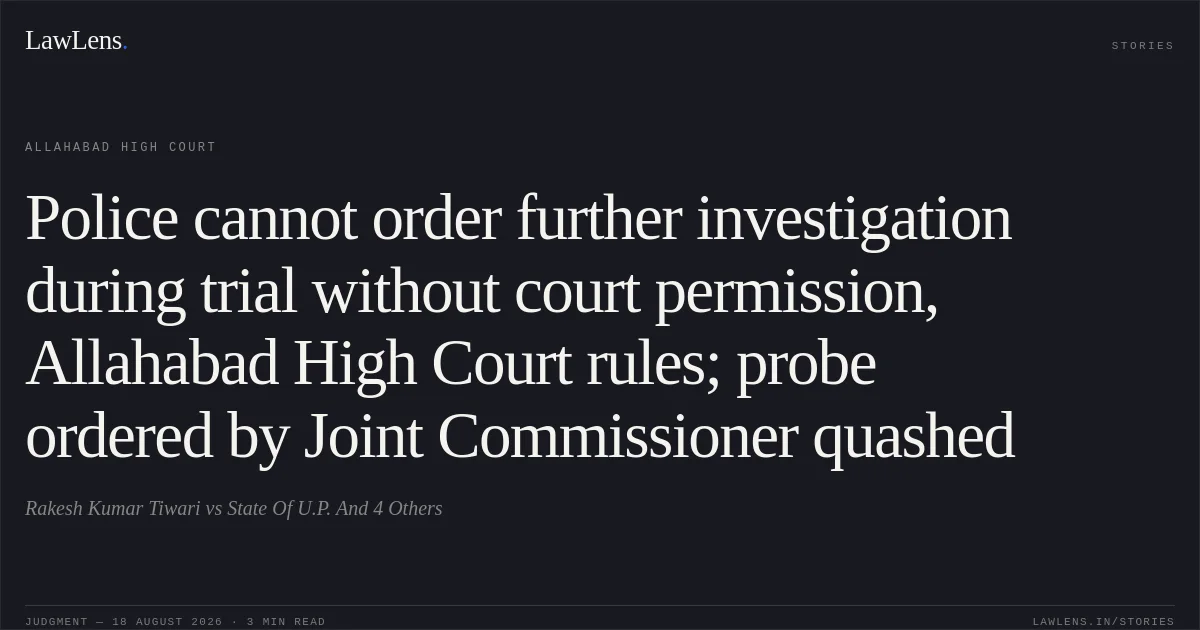
Source reference: para. 11During the pendency of the Section 319 application, the informant sought further investigation. On 5 December 2025, the Joint Commissioner of Police, Crime and Headquarters, Kanpur Nagar, directed further investigation under Section 173(8) Cr.P.C./Section 193(9) BNSS, without obtaining prior permission from the Trial Court.
Source reference: paras. 12–13Thereafter, the Inspector, Police Station Moolganj, informed the Trial Court of the police direction and sought access to the case diary and related documents. The Trial Court’s order merely facilitated such access and did not independently grant permission for further investigation.
Source reference: paras. 15–16, 21–22Issues
Whether a police officer, including a superior police officer, can direct further investigation under Section 173(8) Cr.P.C. in a case where the trial is pending, without obtaining leave of the Court?
Source reference: para. 14Whether the Inspector’s application dated 17 December 2025 and the Trial Court’s consequential order amounted to judicial permission for further investigation?
Source reference: paras. 15–16, 21–22Whether the Joint Commissioner of Police’s order dated 5 December 2025 was legally sustainable?
Source reference: paras. 20, 23–25Law Applied
Section 173(8) Cr.P.C. permits further investigation after submission of a police report, but the requirement of obtaining prior permission of the Court has been read into the provision as a matter of legal practice and procedural propriety.
Source reference: para. 19In Vinay Tyagi v. Irshad Ali, (2013) 5 SCC 762, the Supreme Court held that further investigation and the filing of a supplementary report require the investigating agency to seek the Court’s leave.
Source reference: para. 19This principle was affirmed in Vinubhai Haribhai Malaviya v. State of Gujarat, (2019) 17 SCC 1, and applied in Peethambaran v. State of Kerala, (2024) 16 SCC 65, which held that the power to order further investigation rests with the Magistrate or competent Court, and not with the investigating agency.
Source reference: para. 19The Court also relied on Pramod Kumar v. State of Uttar Pradesh, (2026) 5 SCC 308, which held that police authorities must apply to the competent Court for permission before undertaking further investigation.
Source reference: para. 19Section 193(9) BNSS now expressly provides that further investigation during trial may be conducted only with the permission of the Court trying the case and ordinarily must be completed within ninety days, subject to extension by the Court.
Source reference: para. 18Reasoning
The High Court held that the Joint Commissioner of Police had unilaterally directed further investigation while the Sessions trial was pending, contrary to the settled requirement that prior leave of the Trial Court must be obtained.
Source reference: paras. 17, 20, 23The police application dated 17 December 2025 did not seek judicial permission to conduct further investigation; it merely informed the Court that the Joint Commissioner had already ordered it and requested access to the case diary and documents.
Source reference: paras. 21–22The Trial Court’s consequential direction to facilitate such access therefore could not be treated as an order granting permission for further investigation.
Source reference: paras. 21–22Since the police order preceded and bypassed judicial consideration, it was not cured by the subsequent administrative communication or the Trial Court’s limited procedural order.
Source reference: paras. 23–24The Joint Commissioner consequently acted beyond jurisdiction and undermined the Court’s supervisory authority over further investigation during trial.
Source reference: paras. 23–24Holding
The writ petitions were allowed.
The High Court quashed the Joint Commissioner of Police’s order dated 5 December 2025 directing further investigation.
Source reference: para. 25The police were permitted to submit a proper application before the learned Trial Judge under Section 173(8) Cr.P.C. or Section 193(9) BNSS, as applicable.
Source reference: para. 25Further investigation could be undertaken only if, and after, the Trial Court granted permission.
Source reference: para. 25Any investigation conducted pursuant to the impugned order was declared non est and directed to be struck off the record.
Source reference: para. 25Acts & Sections Cited
6 provisions across 3 statutes referred to in this judgment. Each provision opens on LawLens.
Indian Penal Code, 18602
Code of Criminal Procedure, 19733
Bharatiya Nagarik Suraksha Sanhita, 20231
Original Court PDF
Rakesh Kumar TiwarivsState Of U.P. And 4 Others
Click to open original judgment
Original judgment, available to read, download and summarize on LawLens.in