01Facts
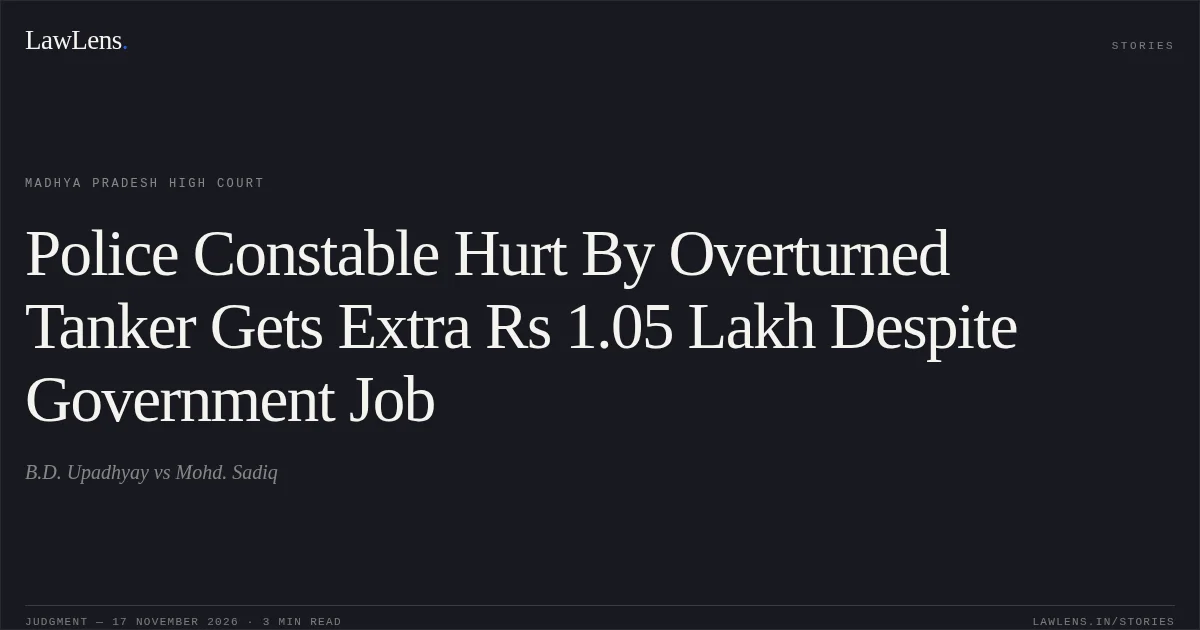
On 26.04.2009 at about 11:00 p.m., the appellant, a Police Constable at Police Station Barhi, District Katni, was struck when Respondent No. 1's tanker overturned on him while being parked in the police station's open space. He suffered grievous injuries to the left leg and injuries to the head, chest, back and shoulder.
¶ 2He was treated at Government Hospital Barhi, District Hospital Katni and National Hospital Jabalpur, incurring medical expenses of Rs. 1,76,820/-. A Medical Board assessed permanent disability at 40% of the left lower limb.
¶ 2The appellant filed a claim under Section 166 of the Motor Vehicles Act, 1988 seeking Rs. 30,00,000/-. The Tribunal awarded Rs. 2,42,821/- with 6% interest from the date of filing.
¶ 3The appellant sought enhancement of Rs. 3,00,000/-.
¶ 3The Insurance Company (Respondent No. 3) opposed enhancement.
¶ 5Dr. Akhilesh Gumasta (PW-2) deposed to 40–60% permanent disability, and disability certificate Ex. P-29 was issued.
¶ 8The Tribunal made no award for pain and suffering.
¶ 802Issues
i.1. Whether the compensation of Rs. 2,42,821/- awarded by the Tribunal is just and reasonable in view of the nature of injuries and 40% permanent disability suffered by the appellant.
¶ 7ii.2. Whether the appellant's continued government employment as a Police Constable precludes or diminishes compensation for permanent disability, absent proof of actual salary loss or reduced earning capacity.
¶ 8–9iii.3. Whether a multiplier-based calculation of future loss of income is warranted on the facts.
¶ 903Law Applied
The appeal was preferred under Section 173(1) of the Motor Vehicles Act, 1988 against an award under Section 166 of the Act.
¶ 1 · ¶ 3Compensation must be just and reasonable, having regard to the nature of injuries, the extent and permanence of disability, the period of treatment, the claimant's age, and the likely physical hardship over life.
¶ 7, 9Continuation in government service is not, by itself, a ground to deny compensation for permanent physical disability and its impact on daily activities, physical comfort and enjoyment of life.
¶ 8A multiplier-based future income loss calculation requires evidence of actual salary loss or definite reduction in earning capacity.
¶ 8–9Entitlement to compensation for pain and suffering, loss of amenities and continuing physical inconvenience, to be assessed as a reasonable lump sum.
¶ 8, 10No precedent was cited in the judgment.
Provisions in the judgment · 2 · Linked ones open on LawLens
Motor Vehicles Act, 1988 Section 173Section 166
04Reasoning
The Court found the Tribunal's award on the lower side given the grievous injuries, 40% disability of the left lower limb, and the appellant's age and likely lifelong hardship.
¶ 9Because the Tribunal had awarded nothing under pain and suffering, and the medical evidence supported 40–60% disability, the Court treated this as a gap requiring correction.
¶ 8The appellant's government employment was held not to defeat compensation for disability, but the absence of any evidence of salary reduction or lost earning capacity meant no multiplier-based future loss was computed.
¶ 8–9The Court instead granted a lump sum of Rs. 1,05,000/- as reasonable compensation for the overall consequences of disability, pain and suffering, loss of amenities and continuing inconvenience.
¶ 1005Holding
The Tribunal's award was inadequate, but no multiplier-based future income loss was justified on the record.
¶ 9, 10The appeal is allowed in part. The award is enhanced by Rs. 1,05,000/- with 6% interest from the date of depositing court fees until payment.
¶ 11Respondent No. 3 (Insurance Company) must deposit the enhanced amount with interest before the Claims Tribunal within 60 days of receiving a certified copy, for disbursement to the appellant.
¶ 12The remaining findings and directions of the Tribunal stand unaltered.
¶ 13Original Court PDF
B.D. UpadhyayvsMohd. Sadiq
Click to open original judgment
Original judgment, available to read, download and summarize on LawLens.in