01Facts
The petitioner was appointed as Constable (G.D.) in the 18th Battalion, Special Armed Force (SAF), Shivpuri, on 13.10.1996 through direct recruitment.
¶ 3He alleged that on 10.02.2007 respondent No. 5, the then Inspector General, SAF, directed him to perform construction work at his farmhouse in Alwar, Rajasthan, and that he was subsequently subjected to harassment and deprived of salary for 90 days.
¶ 3He had 15 days' earned leave and 15 days' special leave sanctioned from 23.03.2007, which was cancelled on 27.03.2007 without reasons.
¶ 4He then applied for medical leave on 18.04.2007 and 19.05.2007, supported by medical certificates, which he alleged were not considered.
¶ 4His services were terminated on 31.05.2007 under Regulation 192-B of the M.P. Police Regulations, declaring him a deserter, without a regular departmental enquiry.
¶ 4He alleged mala fides arising from his complaint against respondent No. 5.
¶ 5The State contended that notices were issued at his residence and published in newspapers, that the medical papers were merely outdoor prescriptions, and that his service record was unsatisfactory.
¶ 6The appellate order dated 12.11.2007 and the mercy-petition rejection dated 09.05.2008 were passed against him.
¶ 2The petitioner died during the pendency of the writ petition.
¶ 2302Issues
i.1. Whether the petitioner's services could be terminated under Regulation 192-B of the M.P. Police Regulations without duly considering his explanation for absence and the medical documents submitted in support of it, and whether the impugned orders satisfy the principles of natural justice.
¶ 9 · ¶ 11 · ¶ 18ii.2. Whether the allegation of mala fides, arising from the petitioner's complaint against respondent No. 5, can be sustained on the record.
¶ 19iii.3. Whether the petitioner's previous punishments and service record can validate an otherwise procedurally defective termination order.
¶ 20iv.4. Whether the appellate and mercy orders cure the defect in the original termination order.
¶ 21v.5. Whether, following the petitioner's death, the legal representatives are entitled to consequential service and monetary benefits, and to what extent.
¶ 23–2503Law Applied
Regulation 192-B of the M.P. Police Regulations empowers the declaration of desertion and termination, but it cannot be exercised mechanically without examining whether the absence was wilful and whether the procedure was fair.
¶ 9 · ¶ 18Unauthorised absence does not by itself establish misconduct, and absence occasioned by illness or other compelling circumstances cannot be treated as wilful without a proper finding (Krushnakant B. Parmar v. Union of India, (2012) 3 SCC 178).
¶ 13–14Termination entails serious civil consequences and must be preceded by a fair procedure and a reasonable opportunity to explain (D.K. Yadav v. J.M.A. Industries Ltd., (1993) 3 SCC 259).
¶ 15–16Unauthorised absence constitutes indiscipline, which does not dispense with the duty to examine the employee's explanation (State of Punjab v. Dr. P.L. Singla, (2008) 8 SCC 469).
¶ 17A finding of mala fides requires cogent and convincing material.
¶ 19A prior adverse service record cannot substitute for lawful procedure.
¶ 20The appellate authority must independently examine the grounds raised.
¶ 21Full back wages are not an automatic consequence of setting aside termination.
¶ 2504Reasoning
The petitioner specifically attributed his absence to illness and produced medical documents, yet the authorities rejected the explanation merely because the papers were outdoor prescriptions, without examining the circumstances in which they were submitted or recording a reasoned finding.
¶ 14 · ¶ 16Issuance and publication of notices did not satisfy procedural fairness, because the explanation itself was not considered.
¶ 16The cancellation of sanctioned leave was not examined, and the cancellation alone could not establish wilful desertion.
¶ 12The Court declined to record a finding of mala fides on bare allegations, but noted that the surrounding circumstances reinforced the need for an objective and independent assessment.
¶ 19The disciplinary record was held not to cure the procedural defect.
¶ 20The appellate and mercy rejections did not remedy the infirmity, since the appellate authority failed to independently consider the leave and medical grounds.
¶ 21–22Because the petitioner died during the proceedings, reinstatement was not possible, but the legality of termination still affected the dues of his legal representatives, so the petition was not rendered infructuous.
¶ 23–24Given the length of service, the nature of the infirmity, the medical explanation, and the death of the petitioner, the Court limited relief to partial back wages.
¶ 2505Holding
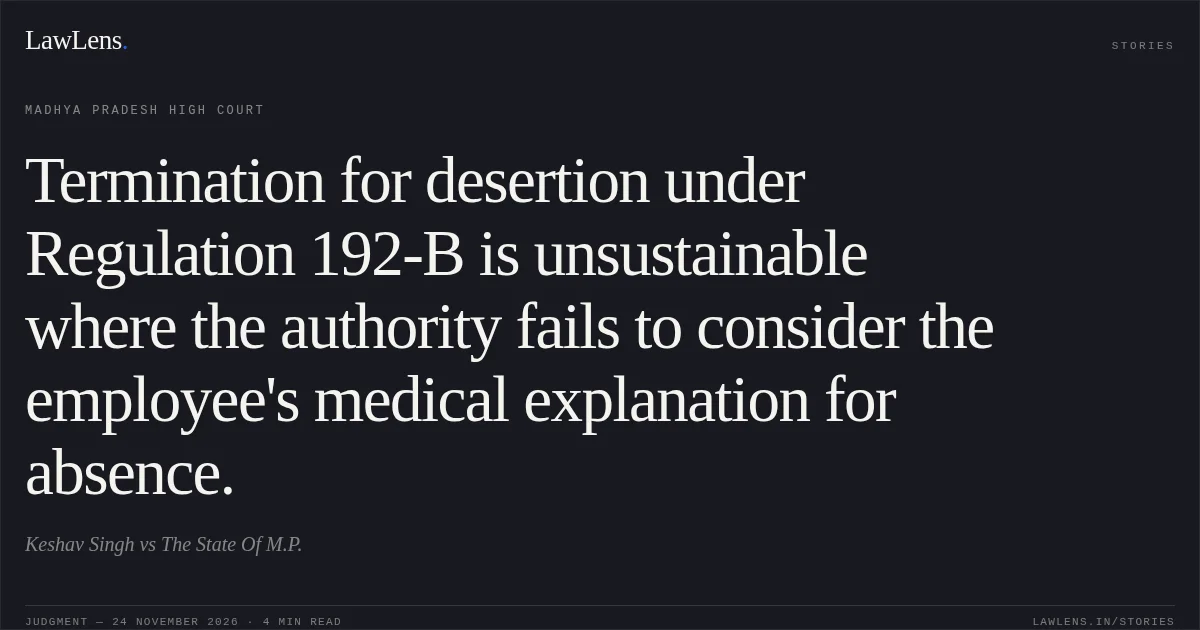
The termination order dated 31.05.2007, the appellate order dated 12.11.2007, and the mercy order dated 09.05.2008 suffer from procedural infirmity because the petitioner's explanation and medical documents were not duly considered, and they cannot be sustained.
¶ 22The petition was allowed. The impugned orders were quashed and set aside. Reinstatement was not granted in view of the petitioner's death. For computation purposes, his service was treated as continuing from 31.05.2007 until the date of death. The respondents were directed to pay 50% of back wages for that period to his widow, after adjusting amounts already paid. Terminal and pensionary benefits were to be recalculated on the same basis and paid to the widow within three months of receipt of a certified copy, failing which 6% interest would apply. The prayer for a departmental enquiry against respondent No. 5 was not entertained, with liberty to the legal representatives to pursue remedies available in law. No order as to costs.
¶ 26(i)–(vi) · ¶ 27Original Court PDF
Keshav SinghvsThe State Of M.P.
Click to open original judgment
Original judgment, available to read, download and summarize on LawLens.in