01Facts
The First Additional Sessions Judge, Pipariya, convicted Appellant No. 1, Babu Ahirwar, under Section 326 and Section 323/34 IPC, sentencing him to five years' rigorous imprisonment with a fine of Rs. 2,000 and three months' rigorous imprisonment with a fine of Rs. 500, respectively. Appellant No. 2, Narmada Ahirwar, was convicted under Section 326/34 and Section 323 IPC, with the same sentences.
¶ 1On 16.10.2026, the parties filed I.A. No. 24544 of 2026 seeking permission to compound the offence and dispose of the appeal on the basis of their compromise.
¶ 2The Court directed the parties to appear before the Registrar (J-II) for verification. The verification report, received on 27.10.2026, certified that the compromise was voluntary and free from threat, inducement or coercion.
¶ 3The Court recorded that the Section 326/34 IPC offence is non-compoundable.
¶ 4The appellants are in custody.
¶ 1002Issues
i.1. Whether a conviction under Section 326 or 326/34 IPC, which is non-compoundable under Section 320 CrPC, can be quashed on the basis of a compromise between the parties.
¶ 5ii.2. Whether the High Court, while exercising appellate jurisdiction, can invoke its inherent powers under Section 482 CrPC to give effect to such a compromise.
¶ 5iii.3. Whether the conviction under Section 323 IPC, simpliciter or read with Section 34, can be compounded under Section 320(5) CrPC.
¶ 903Law Applied
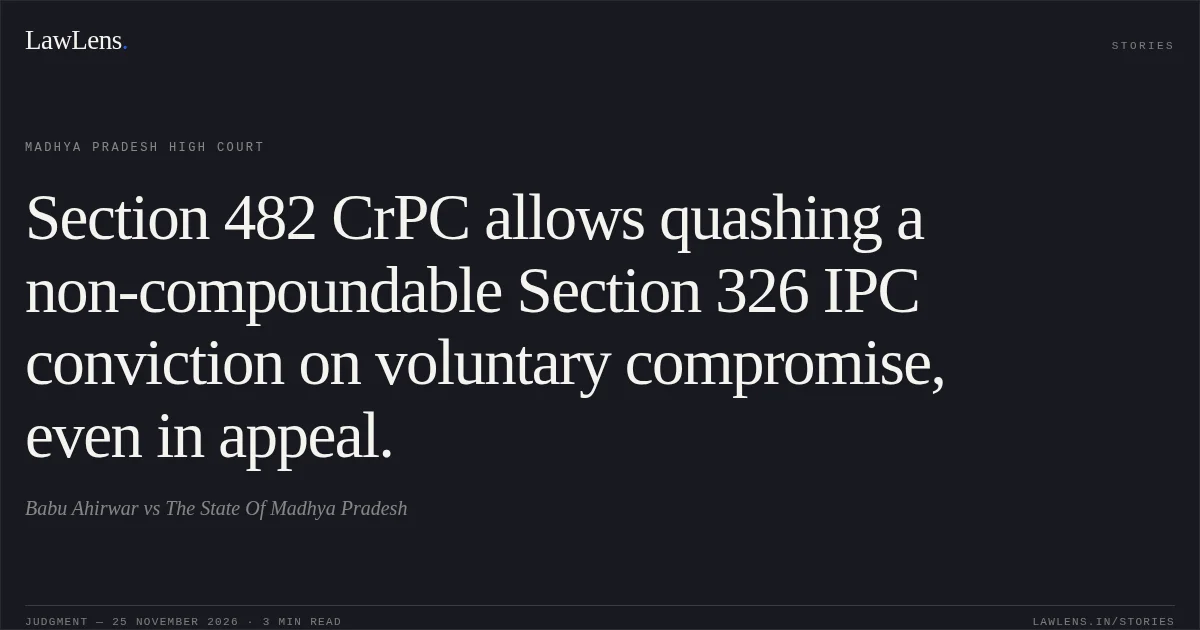
The Court relied on Section 320 CrPC, under which the offence under Section 326 IPC is non-compoundable. It held that an appellate court cannot permit compounding of a non-compoundable offence, but it may invoke its inherent jurisdiction under Section 482 CrPC to secure the ends of justice, concurrently with its appellate jurisdiction.
¶ 5It relied on Popular Muthiah v. State (2006) 7 SCC 296 and Shiji @ Pappu v. Radhika (2011) 10 SCC 705 for this proposition.
¶ 5It applied Ramgopal v. State of Madhya Pradesh (2021) 6 SCC 521, under which the High Court may quash proceedings, even after conviction, on a voluntary compromise where the offence is predominantly private. The Court must weigh the nature and effect of the offence on society, the seriousness of the injuries, the voluntariness of the compromise, and the accused's conduct.
¶ 6Section 320(5) CrPC permits the court to grant leave to compound an offence where an appeal is pending.
¶ 9Provisions in the judgment · 5 · Linked ones open on LawLens
Indian Penal Code, 1860 Section 326Section 323Section 34
Code of Criminal Procedure, 1973 Section 320Section 482
04Reasoning
The Court first verified, through the Registrar (J-II) report, that the compromise was voluntary and uncoerced.
¶ 3–4It then recognised that the Section 326 offence could not be compounded under Section 320 CrPC, and so it turned to Section 482 CrPC.
¶ 5Applying the Ramgopal framework, the Court found the dispute to be essentially private and the parties to have resolved it of their own volition.
¶ 6–7It held that continuing the conviction would serve no useful purpose and that quashing it would secure the ends of justice.
¶ 7Because the appellate court could not compound the Section 326 offence directly, the Court used its inherent power to quash that conviction.
¶ 5For the Section 323 conviction, which is compoundable, the Court directly granted leave to compound under Section 320(5) CrPC.
¶ 9The judgment does not separately discuss the seriousness of the injuries or the appellants' conduct beyond the general finding in para. 7.
¶ 705Holding
The Court held that the compromise, being voluntary, justified quashing the conviction under Section 326 IPC (Babu Ahirwar) and Section 326/34 IPC (Narmada Ahirwar) under Section 482 CrPC.
¶ 8It granted leave to compound the Section 323 IPC offence (with or without Section 34) under Section 320(5) CrPC. It accordingly acquitted both appellants of that charge.
¶ 9The Court ordered their immediate release from custody and refund of any fine paid. The appeal was allowed and disposed of, and a copy of the judgment was directed to the trial court for compliance.
¶ 10–13Original Court PDF
Babu AhirwarvsThe State Of Madhya Pradesh
Click to open original judgment
Original judgment, available to read, download and summarize on LawLens.in