01Facts
The applicants are the husband (Applicant No.1), mother-in-law, father-in-law, and two sisters-in-law of Respondent No.2. The marriage was solemnised on 04.12.2022.
¶ 2Respondent No.2 alleged that after about three months she left for Varanasi for studies and visited the matrimonial home only intermittently.
¶ 2Respondent No.2 alleged that the applicants taunted her over dowry and her education, demanded a four-wheeler (specifically a Toyota Fortuner), and threatened to deny her residence and financial support for studies, and that the husband would remarry.
¶ 2 · ¶ 6Respondent No.2 returned to her parental home on 07.08.2025 and refused divorce.
¶ 2On 29.01.2026 the husband allegedly conducted a tilak and faldaan ceremony secretly, and Respondent No.2 learned that his family had been negotiating a second marriage for about one and a half years.
¶ 2Respondent No.2 lodged FIR No. 161/2026 dated 11.02.2026 at P.S. Waidhan, District Singrauli, under Sections 85 and 3(5) BNS and Sections 3 and 4 of the Dowry Prohibition Act, 1961.
¶ 1 · ¶ 2The applicants' case is that the FIR is a counterblast to earlier proceedings. The husband lodged a complaint on 19.08.2025, followed by a counter-complaint from Respondent No.2 on 23.08.2025.
¶ 3A mediated settlement dated 04.09.2025 for Rs. 33,00,000 was paid by the husband. Respondent No.2 allegedly then demanded a further Rs. 20,00,000 and refused mutual divorce.
¶ 3The husband filed a divorce petition under Section 13 of the Hindu Marriage Act on 21.01.2026, and the FIR followed on 11.02.2026.
¶ 3The petition was filed under Section 528 BNSS, 2023 seeking quashing of the FIR.
¶ 102Issues
i.1. Whether the FIR contains specific, non-omnibus allegations against the husband's relatives (Applicants No.2 to 5) sufficient to justify their continued prosecution under Sections 85 and 3(5) BNS and the Dowry Prohibition Act, 1961.
¶ 2 · ¶ 3 · ¶ 7 · ¶ 11ii.2. Whether the prosecution, being a retaliatory counterblast to matrimonial proceedings, constitutes an abuse of process warranting quashing under Section 528 BNSS (Section 482 CrPC).
¶ 3 · ¶ 1103Law Applied
Courts must be cautious in proceeding against the husband's distant relatives in matrimonial and dowry-related prosecutions, and may not rope them in on omnibus allegations unless specific instances of involvement are made out, as laid down in Kahkashan Kausar v. State of Bihar (2022) 6 SCC 599, quoting K. Subba Rao v. State of Telangana.
¶ 8Complaints must be scrutinised with great care because of the tendency to implicate the husband's entire family, and relatives living elsewhere and rarely visiting the complainant's residence present a different complexion, as held in Preeti Gupta v. State of Jharkhand (2010) 7 SCC 667.
¶ 9The absence of time, date, place, or manner of harassment renders an FIR vague; a mere reference to family members, without specific allegations of active involvement, must be nipped in the bud; and a retaliatory FIR filed after a divorce notice may be treated as an abuse of process, as held in Dara Lakshmi Narayana v. State of Telangana (2024).
¶ 10The jurisdiction to quash under Section 528 BNSS (Section 482 CrPC) is invoked as the procedural basis for the petition.
¶ 1 · ¶ 11Provisions in the judgment · 7 · Linked ones open on LawLens
Bharatiya Nagarik Suraksha Sanhita, 2023 Section 528
Code of Criminal Procedure, 1973 Section 482
Bharatiya Nyaya Sanhita, 2023 Section 85Section 3
Dowry Prohibition Act, 1961 Section 3Section 4
Hindu Marriage Act, 1955 Section 13
04Reasoning
The Court examined the FIR and found that it alleged cruelty and dowry demands "at the behest of present applicants" without specifying the date, place, or time of any act of cruelty as against the applicants.
¶ 6 · ¶ 7The Court held that this deficiency falls within the category the Supreme Court has repeatedly identified as omnibus and vague.
¶ 7Applying Kahkashan Kausar and Preeti Gupta, the Court treated the inclusion of the relatives as generalised, with no particularised role attributed to each of them.
¶ 8 · ¶ 9Applying Dara Lakshmi Narayana, the Court noted that the relatives were not shown to have resided in the matrimonial home.
¶ 10The Court's reasoning on the FIR's timing as a retaliatory measure is limited, as the factual chronology (cross-complaints, settlement, divorce petition, and FIR) is recited in the petitioners' submissions rather than found by the Court.
¶ 3 · ¶ 1105Holding
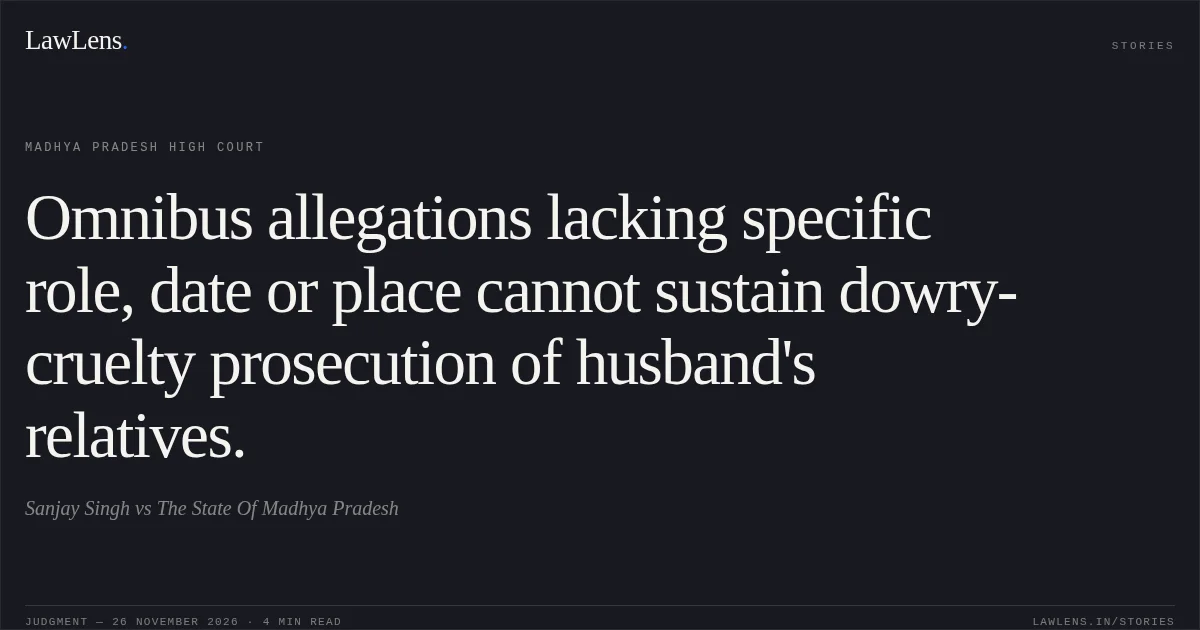
The Court held that the allegations against the applicants are omnibus and general, and that their prosecution cannot be sustained on that basis.
¶ 11The Court allowed the petition under Section 528 BNSS and quashed FIR No. 161/2026 dated 11.02.2026 at P.S. Waidhan, Singrauli, under Sections 85 and 3(5) BNS and Sections 3 and 4 of the Dowry Prohibition Act, 1961, together with all consequential proceedings, insofar as they relate to the applicants. The applicants were discharged and their bail bonds, if any, were discharged.
¶ 12The order does not separately analyse the specific allegations attributed to the husband, such as the dowry demand and the alleged second marriage, and does not address whether those specific allegations would independently survive scrutiny.
¶ 7 · ¶ 11 · ¶ 12Original Court PDF
Sanjay SinghvsThe State Of Madhya Pradesh
Click to open original judgment
Original judgment, available to read, download and summarize on LawLens.in